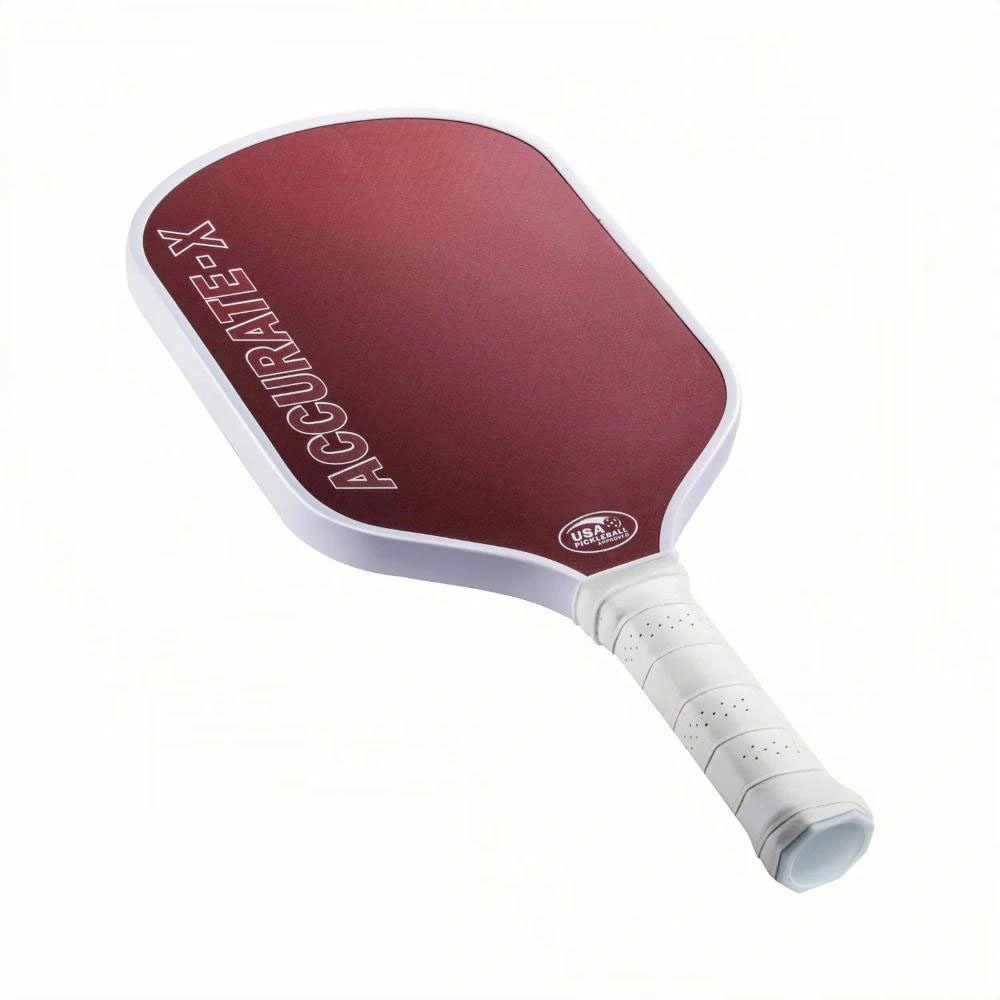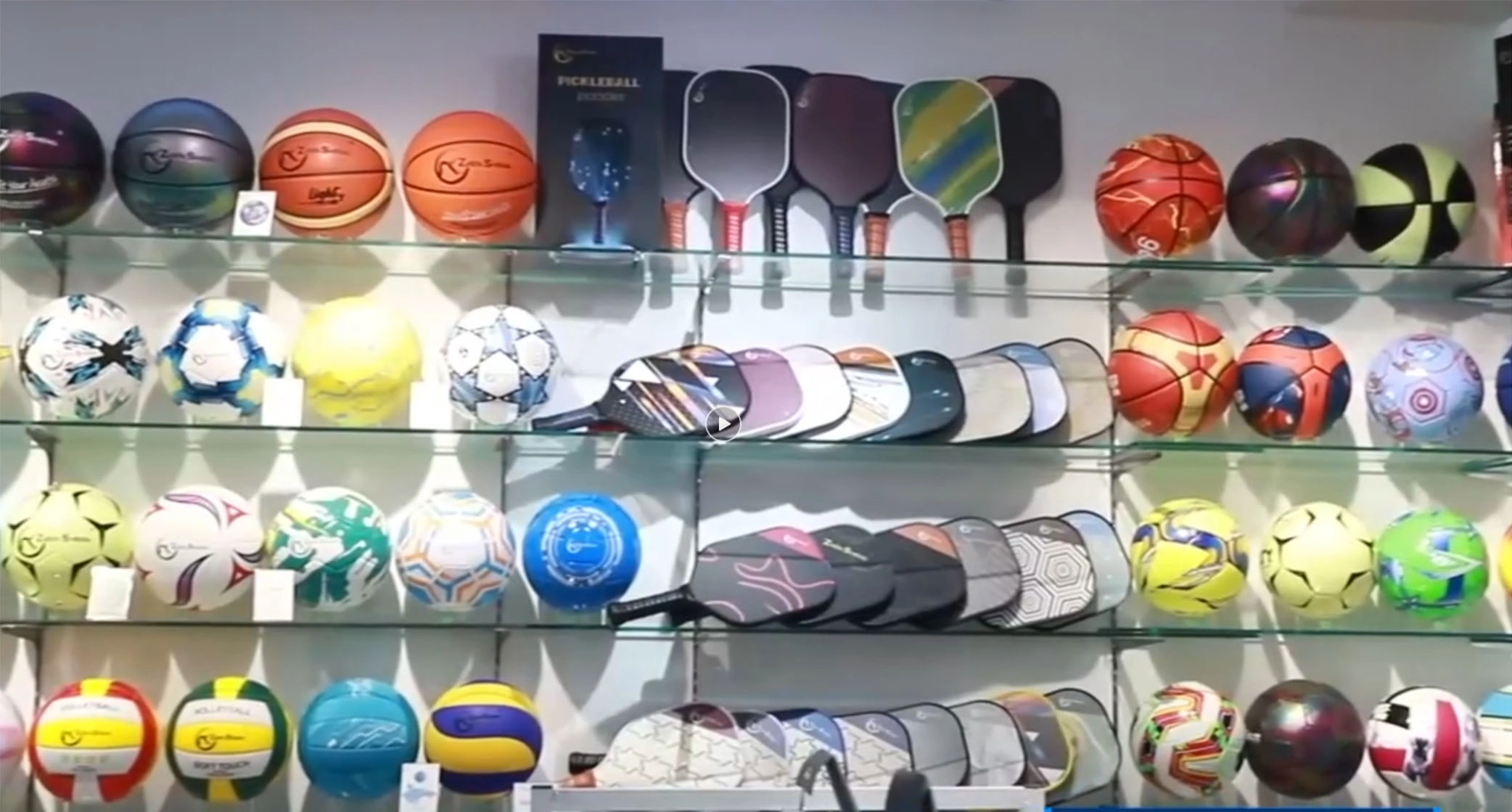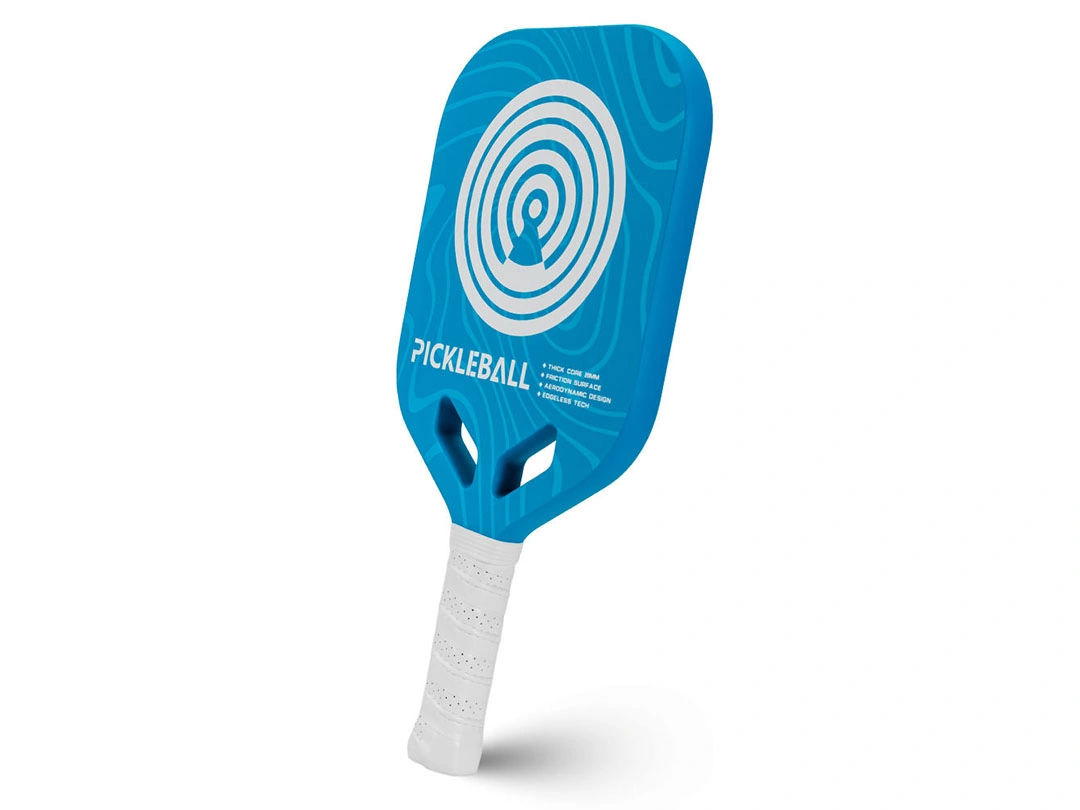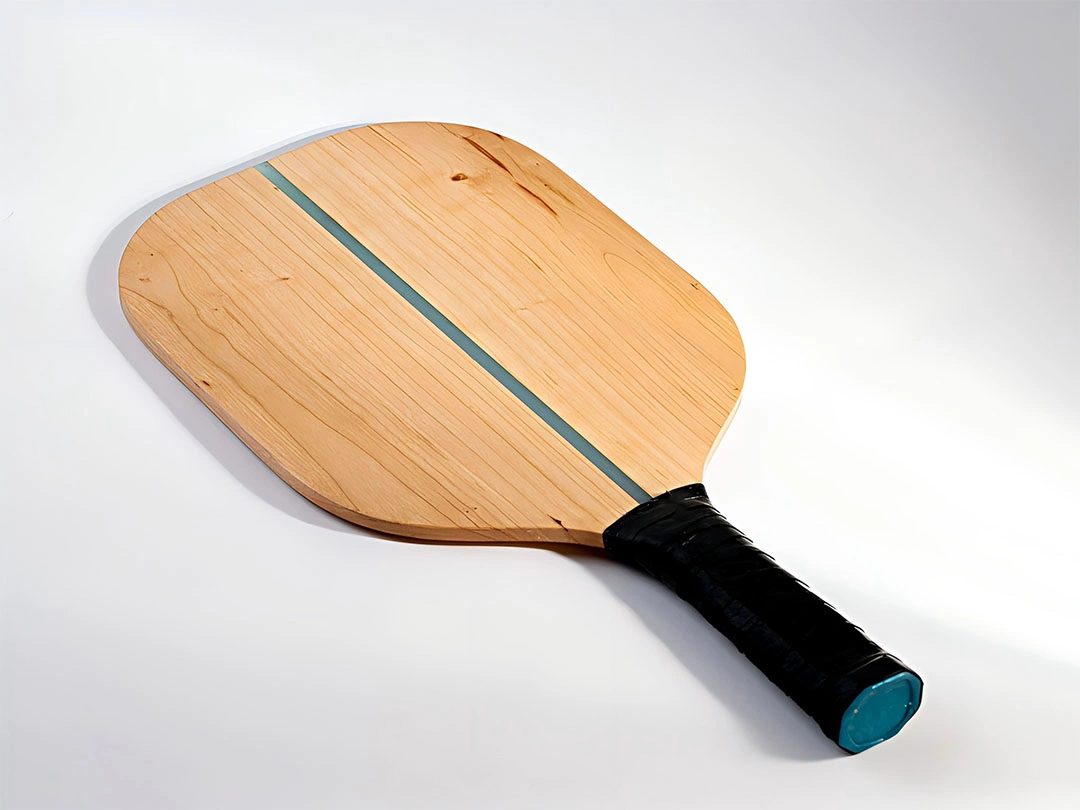
The Opportunity Is Real — and the Window Is Still Open
Twenty-four point three million Americans played pickleball in 2025 — a 22.8% year-over-year increase and 171.8% growth over three years, according to the 2026 SFIA Topline Participation Report. The global pickleball equipment market reached $702.9 million in 2025 and is projected to hit $1.85 billion by 2032 at a 14.8% CAGR, according to Coherent Market Insights. Every projection points the same direction: up.
Here is what makes 2026 different from 2022: the market has matured enough to reward real brands, but it is still young enough that brand loyalty is fluid. New players enter every week with no paddle preference. Existing players upgrade frequently. Corporate buyers, club operators, and sporting goods retailers are all actively searching for reliable supply partners who can deliver branded product on time.
Unlike tennis or golf — categories locked up by decades-old conglomerates — pickleball is still a category where a well-positioned new brand can capture meaningful market share within 12 months.
This guide gives you the complete 5-step roadmap: business model selection, sales channel strategy, OEM manufacturing, unit economics, and compliance. Follow it in sequence and you will have a launch-ready brand — not just a product idea.
Step 1 — Define Your Business Model & Market Position
Before you look at a single factory quote, you need to answer three questions: What model are you building? What tier are you entering? Who exactly are you serving?
White-Label vs. Private-Label vs. Full-Custom OEM
These three terms are used interchangeably in the market and they should not be. They represent meaningfully different capital requirements, timelines, and competitive moats.
White-label means you purchase a manufacturer’s existing, finished paddle design and apply your logo. Zero tooling cost, fastest time-to-market (often 2–4 weeks), lowest MOQ. The trade-off: your “brand” is selling the same physical product as a dozen other brands. Defensibility is near zero. This is a starting point, not a destination.
Private-label means you select from a manufacturer’s existing mold library, customize the graphics, colorway, handle spec, and packaging, and sell it under your brand name. You own the brand identity; the factory owns the tooling. MOQ at NexaPaddle starts at 100 pieces for thermoformed lines and 300 pieces for cold press. This is the sweet spot for most new entrants — real brand differentiation without the capital commitment of custom tooling. For a deeper look at how this model works operationally, the private-label paddle program at NexaPaddle covers the full workflow.
Full-custom OEM means you develop a proprietary shape, core spec, or construction process that no other brand can replicate. This requires mold investment (typically $3,000–$8,000 per mold depending on complexity), longer development timelines (60–90 days for first samples), and higher MOQs. The payoff is a genuinely defensible product. This is the right move for your second or third SKU — not your launch product.
Choosing Your Pricing Tier
The market segments clearly into four tiers, each with distinct manufacturing requirements and margin profiles:
| Tier | Retail Price Range | Construction | Target Buyer |
|---|---|---|---|
| Budget | $25–$50 | Cold press, fiberglass or basic carbon | Beginners, schools, clubs, gift buyers |
| Mid | $60–$130 | Thermoformed, T700 carbon, PP honeycomb | Intermediate players, Amazon FBA sweet spot |
| Premium | $130–$180 | Thermoformed, T700/T800, foam edge | Advanced players, performance-focused |
| Pro/Flagship | $180–$250+ | Full-foam thermoformed, GEN4/GEN5 core, T800 | Competitive players, brand halo products |
The current consumer “sweet spot” — where the highest volume of informed buyers is concentrating — is the $90–$130 mid tier. Buyers in this range are educated: they search specifically for “T700 raw carbon thermoformed” and understand they are getting 90–95% of the performance of a $220 paddle at half the price. Brands like Vatic Pro and 11Six24 have built significant followings by owning this value narrative.
Niche Selection: Where New Brands Win
Competing head-to-head against Selkirk and JOOLA on their terms is a losing strategy for a new entrant. The brands that break through in 2026 are picking a lane:
- Women’s market: Underserved aesthetically and ergonomically. Lighter swing weights, shorter handles, and design-forward colorways command premium pricing with less competition.
- Tennis converts: The fastest-growing player segment. Elongated paddle shapes (415–425mm length), extended handles (145mm+), and two-handed backhand compatibility are specific, searchable needs.
- Quiet/noise-sensitive paddles: HOA communities, indoor facilities, and condo courts represent a real and growing niche. NexaPaddle’s Silent Series (Mold #8, NCT-BV dual-zone dampening core) is purpose-built for this segment.
- Control-focused players: As the USAPA tightens PBCoR limits and bans power paddles, the market is shifting toward control and spin. Brands that lead with “precision” rather than “power” are aligned with regulatory direction.
For a complete blueprint for launching a paddle brand — from identity to first shipment — the blueprint for launching a paddle brand covers the full OEM workflow.
Step 2 — Choose Your Sales Channels
Your channel choice determines your margin requirements, packaging spec, and launch timeline. Get this wrong and you will build a product that does not fit the channel it needs to sell through.
Amazon FBA: Highest Volume, Highest Competition
Amazon dominates sporting goods discovery in the United States. The $20–$50 range drives the highest listing volume (approximately 34% of top ASINs), but the $90–$130 thermoformed carbon tier is where informed buyers concentrate and where new brands can compete on differentiation rather than price.
What wins on Amazon in 2026:
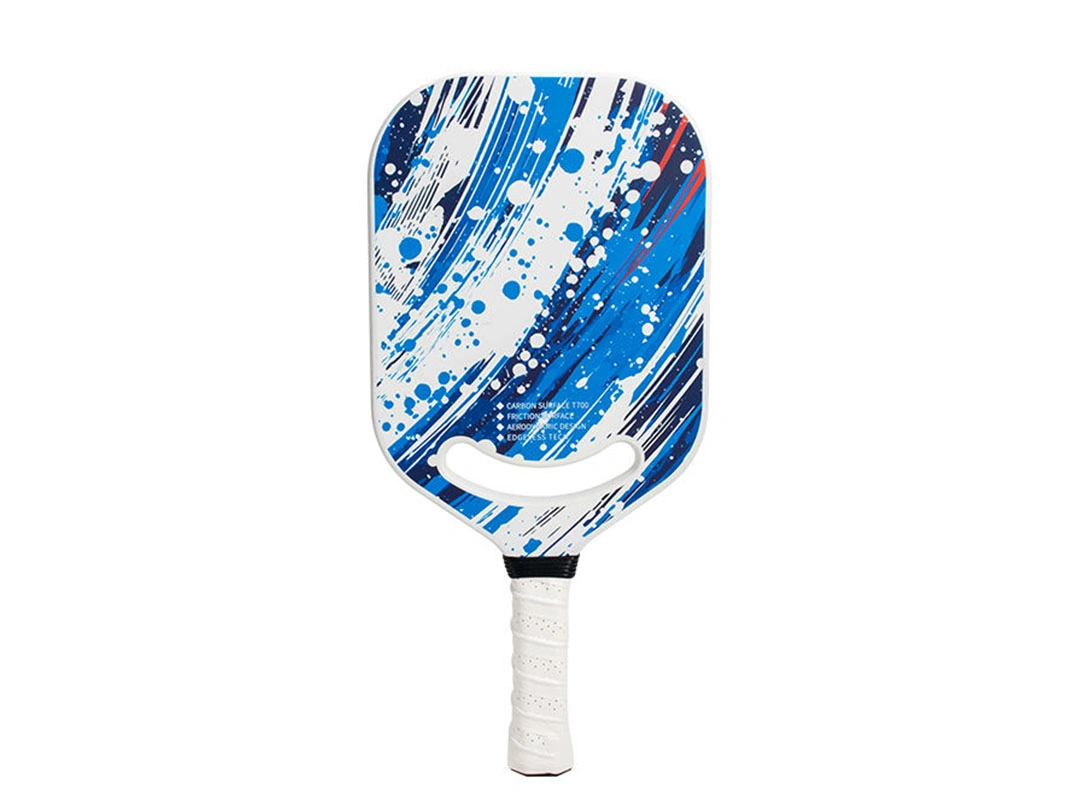
- Visual differentiation: Amazon search results are a thumbnail grid. A paddle with bold, high-contrast UV-printed graphics stops the scroll. Generic two-tone paddles do not.
- Review velocity: Early review momentum compounds into organic ranking. A great unboxing experience — retail-quality packaging, branded inserts, a thank-you card — drives the 5-star reviews that fuel the flywheel.
- USAPA listing: Buyers searching “USAPA approved pickleball paddle” are high-intent. Being listed is a conversion driver, not just a compliance checkbox.
- FBA-ready packaging: Amazon has strict fulfillment center requirements. Working with a manufacturer fluent in FNSKU labeling, poly-bag specs, and suffocation warning stickers eliminates costly receiving rejections.
For the complete sourcing and differentiation playbook for this channel, the Amazon FBA sourcing & branding playbook covers every operational detail.
Shopify D2C: Best Margins, Requires Brand-Building Investment
Direct-to-consumer via Shopify delivers the highest gross margins (no marketplace fees, full customer data ownership) but requires meaningful investment in content, SEO, and paid acquisition to drive traffic. This channel rewards brands with a clear story and a community — not commodity products.
D2C works best as a complement to Amazon, not a replacement. Use Amazon to acquire customers at scale; use your Shopify store to retain them with subscription accessories, limited-edition colorways, and loyalty programs.
Wholesale & Club Partnerships
Sporting goods retailers, pro shops, and club operators represent a high-volume, lower-margin channel that provides brand legitimacy and physical shelf presence. Club partnerships — supplying a facility’s loaner fleet or pro shop inventory — are particularly effective for new brands because they generate trial at scale. A player who uses your paddle at a club lesson is a warm prospect for a direct purchase.
Influencer-Led Launches: The 2026 Playbook
The most capital-efficient launch strategy in 2026 is the creator-led model. Holbrook Pickleball achieved an 86% revenue boost through grassroots affiliate marketing — attending local tournaments, recruiting 173+ brand ambassadors, and building community relationships rather than buying ad spend. 11Six24, founded by David Groechel, scaled entirely through radical transparency: the founder answered customer questions directly on Discord and Reddit, positioning the brand as the “paddle nerd’s” choice. They eventually signed pro Dekel Bar to legitimize the brand to the mainstream.
The pattern: community first, product second, paid media last. For brands looking to replicate this model with manufacturing support, creator-led paddle launches with NexaPaddle covers the influencer-to-OEM workflow.
Step 3 — Supply Chain & OEM Manufacturing

This is where most new brands make their most expensive mistakes. Supply chain decisions made in month one determine your product quality, your compliance risk, and your unit economics for the next two years.
China vs. Vietnam: The 2026 Sourcing Decision
China holds approximately 80% of global pickleball paddle supply. The engineering depth, material availability (T700, T800 carbon fiber, EPP foam, proprietary core technologies), and manufacturing sophistication are unmatched. For complex constructions — thermoformed unibody, GEN4 foam-injected cores, GEN5 polymeric mesh — China is the only realistic option at scale.
Vietnam is emerging rapidly as the primary tariff-mitigation alternative. US Section 301 tariffs on Chinese sporting goods imports have made Vietnam-sourced paddles meaningfully more cost-competitive on a landed-cost basis. Vietnam factories are capturing mid-to-high-end thermoformed production, with FOB prices for USAPA-certified thermoformed paddles running $28–$45. Lead times are 35–60 days. The trade-off: smaller engineering depth than China, and some Vietnam factories still rely on imported Chinese laminates — which may not fully resolve tariff exposure depending on rules-of-origin determinations.
The practical 2026 answer: For brands launching with standard thermoformed constructions and targeting the $80–$150 retail tier, Vietnam sourcing is worth evaluating seriously for tariff savings. For brands building proprietary core technology, GEN4/GEN5 constructions, or complex flagship products, China remains the manufacturing center of gravity. For a detailed breakdown of the Vietnam sourcing model and a 3-SKU strategy built around it, the Vietnam OEM sourcing & 3-SKU strategy guide covers the full framework.
Choosing the Right Factory
Not all factories that claim thermoforming capability actually have it. The five questions that separate real manufacturers from trading companies:
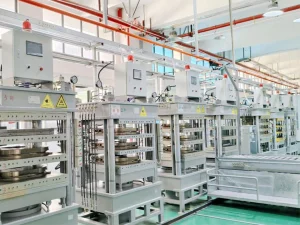
- What thermoforming equipment do you use? A real thermoforming operation uses hydraulic hot presses or autoclaves with controlled temperature and pressure parameters. If they cannot describe their equipment specifically, investigate further.
- What is your internal PBCoR target? A compliance-serious factory tests PBCoR internally and targets below the USAPA limit — not at it. NexaPaddle’s internal target is ≤0.42 (USAPA limit: ≤0.44; UPA-A limit: ≤0.43), providing a compliance buffer across the production run.
- Do you run accelerated aging simulations? Thermoformed paddles can drift above PBCoR limits after months of use as the core breaks down. A factory that only tests day-one performance is not protecting your brand.
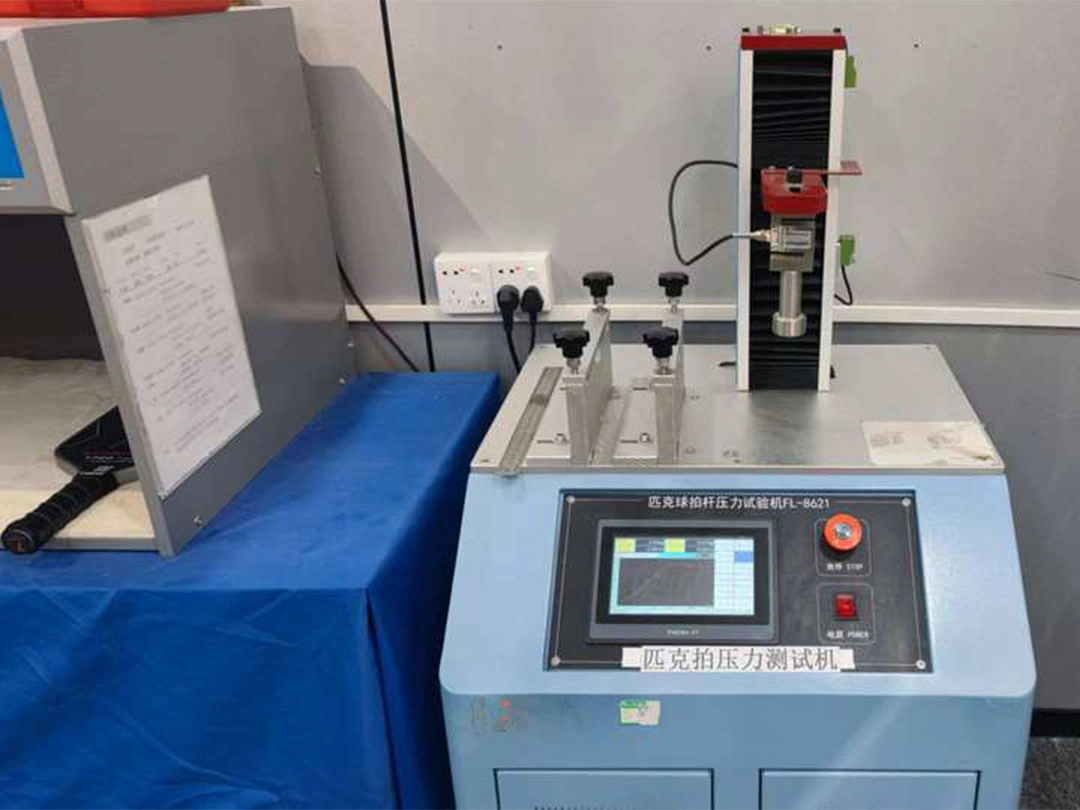
- What is your surface roughness measurement protocol? USAPA requires Rt ≤40µm and Rz ≤30µm. NexaPaddle uses a Starrett SR-100 tester after every coating stage, not just at final QC.
- Can you provide batch-level QC data from a recent production run? A factory that cannot produce this data does not have reliable QC systems.
Material Selection: What Actually Matters
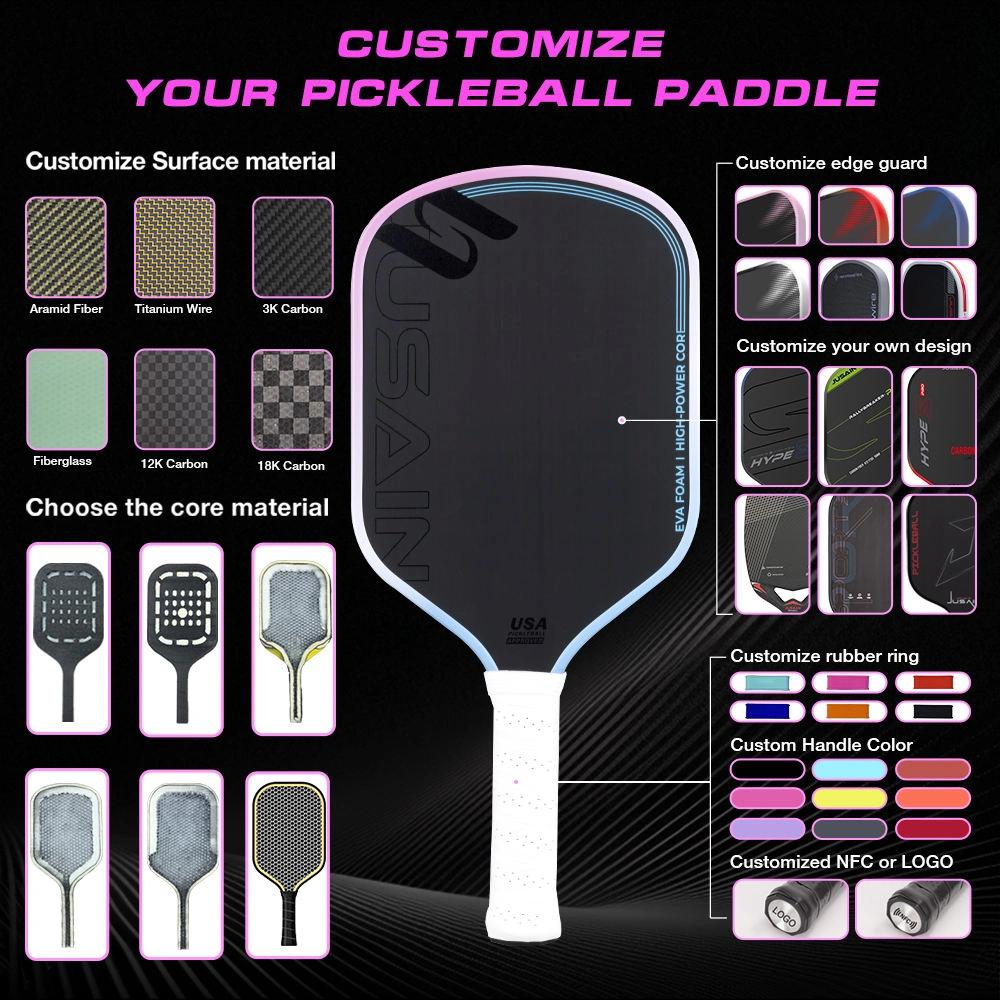
The face material and core construction are the two decisions that define your product’s performance tier and your manufacturing cost:
Face materials by tier:
- Fiberglass: Budget tier. Good pop, forgiving, cost-effective. Best for entry-level and beginner-focused brands.
- T700 carbon: Mid-to-premium tier. Superior control, spin generation, durability. The standard for serious performance paddles.
- T800 carbon: Premium-to-flagship tier. Higher ball speed, grittier matte texture, maximum surface friction. Top-tier face material.
- T800 + Titanium Thread: Flagship only. Maximum measurable surface friction currently available. Used in NexaPaddle’s highest-performance builds.
Core materials by tier:
- PP honeycomb: Industry workhorse. Cost-effective, proven, all-around performance. Entry to advanced.
- PP + foam edge (thermoformed): Enlarged sweet spot, edge stability. Mid-range thermoformed standard.
- EPP foam filled (GEN4): Explosive power, excellent vibration absorption. Power-focused premium builds.
- EPP foam non-filled (GEN4): Soft touch, joint-friendly, absorb-then-release feel. Control players, older players.
- GEN5 Polymeric Mesh: Massive sweet spot, luxury flagship. NexaPaddle’s top-tier offering.
Critical warning on foam density: High-density EVA+EPP foam at 8×–10× expansion is the correct spec for performance paddles. The cheap alternative — 15×–17× expansion foam — is dramatically less expensive but performs poorly: mushy feel, rapid power loss, high return rates. Always ask your factory for the specific expansion ratio. A quote that says “EVA+EPP core” without specifying density is a red flag.
For a comprehensive comparison of how top brands approach OEM manufacturing — and how to compete with them — the competing with top paddle brands via OEM guide provides the competitive intelligence.
IP Protection and Sample Rounds
Before committing to mass production:
- Sign an NDA with your factory covering your design files, spec sheets, and artwork.
- Run at least two sample rounds: First sample validates construction and feel; second sample validates production-representative quality after any adjustments.
- Lock your spec in writing: Face material, core material, core thickness, edge construction, handle spec, weight range, and surface treatment — all documented with revision numbers. Any post-certification change to these parameters requires re-evaluation.
Step 4 — Cost Structure & Unit Economics
Understanding your unit economics before you place your first order is not optional. The brands that run out of cash are almost always the ones that modeled FOB price as their cost — and forgot about everything that happens between the factory gate and the customer’s hands.
FOB Cost Example Table
The following ranges are indicative based on NexaPaddle’s pricing structure and industry benchmarks. Actual costs vary by volume, customization level, and material spec.
| Cost Component | Budget (Cold Press Fiberglass) | Mid (Thermoformed T700) | Premium (Thermoformed T800/GEN4) |
|---|---|---|---|
| Materials & core | $3.50–$5.00 | $8.00–$12.00 | $14.00–$20.00 |
| Labor & process | $2.00–$3.50 | $4.00–$6.00 | $6.00–$9.00 |
| Tooling amortization | $0.50–$1.00 | $1.00–$2.00 | $2.00–$4.00 |
| QC & testing | $0.50–$1.00 | $1.00–$1.50 | $1.50–$2.50 |
| Packaging | $1.00–$2.00 | $2.00–$4.00 | $3.00–$6.00 |
| FOB subtotal | $8–$15 | $25–$38 | $45–$65 |
| Certification (amortized/unit at 500 pcs) | $0.50–$1.00 | $6.00–$12.00 | $6.00–$12.00 |
| Ocean freight + duty (est.) | $2.00–$4.00 | $4.00–$7.00 | $6.00–$10.00 |
| Estimated landed cost | $11–$20 | $35–$57 | $57–$87 |
Note: Certification cost amortization assumes $6,000 total per model across 500 units. Freight and duty estimates assume standard ocean shipping; tariff rates vary by sourcing country and HS code.
Margin Math: Amazon FBA vs. D2C
Amazon FBA example (mid-tier thermoformed, $120 retail):
- Retail price: $120.00
- Amazon referral fee (15%): –$18.00
- FBA fulfillment fee (est.): –$6.50
- Landed cost: –$46.00
- Gross margin: ~$49.50 (41%)
D2C Shopify example (same paddle, $120 retail):
- Retail price: $120.00
- Payment processing (3%): –$3.60
- Shipping to customer: –$8.00
- Landed cost: –$46.00
- Gross margin: ~$62.40 (52%)
Target gross margin for a sustainable paddle brand: 45–65% depending on channel. If your math does not reach 45% gross margin at your target retail price, you either need to raise the price, reduce the cost, or reconsider the channel.
MOQ Leverage on Cost
Volume is the single most powerful lever on unit cost. NexaPaddle’s price step points break at 100 / 200 / 300 / 500 / 1,000 units. The meaningful drops happen at 300 (cold press) and 500 (thermoformed). For first orders:
- Thermoformed lines: Start at 100 pcs to validate product-market fit. Expect to pay near the top of the FOB range.
- Cold press lines: 300 pcs is the minimum for custom branding. This is the right opening order for a budget SKU.
- Repeat orders: Once you have sell-through data, move to 500+ pcs to capture the next cost step.
For a detailed breakdown of how budget paddle economics work at the factory level, the cost breakdown for budget paddle manufacturing article covers the full bill of materials. For the wholesale volume economics, why bulk buying saves retailers money explains the volume pricing logic.
Step 5 — Certification, Compliance & Avoiding Costly Mistakes

Compliance is not a box to check at the end of your launch process. It is a structural decision that affects your product design, your factory selection, your marketing language, and your ongoing production management. The brands that treat it as an afterthought pay for it — sometimes catastrophically.
USAPA Approval 2026: The Two-Track System
Since September 1, 2025, two separate certification tracks govern competitive pickleball:
Track 1 — USAPA (USA Pickleball Association): The baseline certification required for recreational leagues, USAPA-sanctioned tournaments, and most club play. Required for using “listed on the USA Pickleball Approved Paddle List” language in marketing. Critical for Amazon conversion on high-intent searches.
Track 2 — UPA-A (USA Pickleball Association — Advanced): The professional circuit standard, required for PPA Tour and MLP events since September 2025. More rigorous testing requirements. A paddle can be USAPA-listed but not UPA-A certified.
Which track do you need?
| Target Market | Certification Needed |
|---|---|
| Recreational clubs, USAPA leagues, Amazon FBA | USAPA listing |
| Competitive players, club tournaments | USAPA (UPA-A is a marketing differentiator) |
| Pro player partnerships, PPA/MLP visibility | USAPA + UPA-A |
The Real Budget: $6,000 Per Model
The most persistent underestimate in paddle brand planning is what certification actually costs. The realistic all-in figure is $6,000–$10,000+ per model when pursuing dual-track certification:
| Cost Component | Estimated Range |
|---|---|
| USAPA testing fee (per model, ~8 samples required) | ~$4,500 |
| UPA-A annual brand fee (if pursuing) | $10,000/year |
| UPA-A per-paddle testing fee (if pursuing) | $3,000/paddle |
| Sample production (pre-submission) | $400–$800 |
| International shipping (factory → lab) | $200–$500 |
| Re-test fees (if first submission fails) | ~$4,500 additional |
| Iteration sampling | $300–$600 |
| Miscellaneous (customs, admin) | $200–$400 |
| USAPA-only total estimate | $5,500–$7,000 |
| Dual-track (USAPA + UPA-A) total estimate | $18,000–$25,000+ |
UPA-A fee structure as of 2026: $10,000 annual brand fee + $3,000 per paddle model. Source: The Kitchen Pickle / UPA-A official announcement.
For most new brands, USAPA listing alone is the right starting point. Budget approximately $6,000–$7,000 per model for USAPA certification including samples, shipping, and one re-test contingency. Add UPA-A only when you have pro-circuit distribution ambitions and the revenue to justify the annual brand fee.
Brands that work with factories running internal pre-testing (NexaPaddle’s internal surface roughness target is Rt ≤35µm, below the USAPA limit of ≤40µm) typically pass on the first submission, keeping total USAPA certification cost closer to $5,500. Brands that submit without pre-testing often require re-testing, pushing costs to $9,000–$10,000.
The Timeline: 6–12 Weeks from Design Freeze to Inventory
| Phase | Duration |
|---|---|
| Design freeze & spec lock | 1–7 days |
| Sample production | 5–10 days |
| Submission + international shipping | 3–10 days |
| Lab testing (USAPA queue) | Variable — days to weeks |
| Mass production (thermoformed, 100 pcs) | 10–18 days |
| Packaging + fulfillment prep | 3–10 days |
| Realistic total | 6–12 weeks |
Plan for 12 weeks. Brands that plan for 6 and encounter one re-test cycle learn this the hard way.
What Gets Paddles Banned: The 5 Compliance Parameters
In January 2026, USA Pickleball launched mandatory RFID field-testing at Golden Ticket tournaments — beginning in Glendale, Arizona — in partnership with Pickleball Instruments. Early testing of nearly 1,000 paddles identified counterfeit equipment and compliance drift, signaling a new era of on-site enforcement. The era of submitting a perfectly tuned “golden sample” and mass-producing slightly non-compliant paddles is over.
The five parameters that determine compliance:
- Surface roughness: Rt ≤40µm, Rz ≤30µm (measured with Starrett SR-100)
- PBCoR: ≤0.44 (USAPA standard, effective November 2024); ≤0.43 (UPA-A, effective November 2025)
- Dimensions: Combined length + width ≤24 inches; maximum length ≤17 inches
- Core deflection: Face must not depress beyond USAPA ranges under standardized load
- COF (Coefficient of Friction): Must remain within USAPA limits
The PBCoR aging problem: Thermoformed paddles can drift above PBCoR limits after months of use as the internal core breaks down. A paddle that passes ≤0.44 fresh off the line may exceed that threshold after three months of heavy play. This is exactly what trapped brands in the Q4 2024 power paddle ban. Require accelerated aging simulation data from your factory before authorizing mass production.
Recent Banned Paddle Examples
- JOOLA Gen 3 (May 2024): Multiple models delisted. Root cause: “Certification by Similarity” failure — retail paddles did not match the physical samples submitted for testing. Result: class action settlement providing $300 refund per purchase; JOOLA filed a $200M lawsuit against USA Pickleball, which filed a countersuit.
- Gearbox Pro Power Elongated (announced December 2024, effective July 2025): Failed the new PBCoR standard. Retired from tournament play.
- CRBN (2022): Surface roughness exceeded USAPA limits. Temporary delisting, forced re-engineering.
Critical Marketing Language Rule
Wrong: “USAPA Approved Paddle”
Right: “Listed on the USA Pickleball Approved Paddle List”
USAPA has enforced against brands using “approved” language. The paddle is listed — USAPA does not endorse or “approve” specific brands. Using incorrect language risks delisting and marketplace action.
Trademark & Design Patent
Register your brand name as a trademark (USPTO) before launch. File a design patent on any proprietary shape or graphic element you intend to defend. These are not optional for brands building long-term equity — they are the legal foundation of your competitive moat.
For the complete compliance roadmap including the six batch consistency locks that protect your listing post-certification, the USAPA approval cost, timeline & compliance roadmap covers every operational detail. For the manufacturing mistakes that get paddles banned — and how to avoid them — how to avoid banned paddle manufacturing mistakes is required reading before you place your first production order.
12-Month Launch Timeline
| Month | Milestone | Key Actions |
|---|---|---|
| 1 | Strategy & sourcing | Define niche, tier, channel. Shortlist 2–3 factories. Request quotes. |
| 2 | Factory selection & spec lock | Sign NDA. Lock paddle spec (face, core, edge, handle, weight). Request first samples. |
| 3 | Sample review & iteration | Evaluate first samples. Adjust spec. Request second samples. Begin brand identity design. |
| 4 | Certification submission | Submit to USAPA testing lab. Begin packaging design. Stage marketing assets. |
| 5 | Awaiting certification | Build Amazon listing draft. Set up Shopify store. Recruit first 10–20 brand ambassadors. |
| 6 | Certification received | Trigger mass production. Finalize packaging. Begin pre-launch content. |
| 7 | Production & logistics | Monitor production. Arrange freight. Prepare FBA shipment or 3PL inbound. |
| 8 | Inventory arrives | Complete Amazon listing. Launch paid ads. Activate ambassador program. |
| 9 | Launch & review velocity | Drive early review momentum. Monitor sell-through. Respond to customer feedback. |
| 10 | Optimize & reorder | Analyze channel performance. Place reorder at higher volume for cost step. |
| 11 | Expand SKU or channel | Add second SKU (flagship or entry). Explore wholesale outreach. |
| 12 | Year-end review | Full P&L review. Plan Year 2 product roadmap. Evaluate USAPA renewal status. |
Frequently Asked Questions
1. How much capital do I need to launch a pickleball paddle brand in 2026?
A realistic minimum for a single-SKU thermoformed launch: $30,000–$50,000. This covers: first production run (100 pcs at ~$35–$57 landed cost = $3,500–$5,700), USAPA certification (~$6,000–$7,000), packaging design and production (~$2,000–$4,000), Amazon launch advertising (~$3,000–$5,000), brand identity and photography (~$2,000–$4,000), and working capital buffer for reorders. Brands launching with a cold press budget SKU at 300 pcs can start closer to $20,000–$30,000, but the margin profile is thinner and the competitive differentiation is harder to establish.
2. China or Vietnam — which is better for paddle OEM right now?
It depends on your product. For standard thermoformed T700 paddles targeting the $80–$150 retail tier, Vietnam is worth evaluating seriously — tariff savings on US Section 301 duties can meaningfully improve landed cost. For complex constructions (GEN4 foam-injected cores, GEN5 polymeric mesh, T800+Titanium Thread), China has the engineering depth and material supply chain that Vietnam cannot yet match. Many brands in 2026 are running a hybrid: China for flagship SKUs, Vietnam for mid-tier volume. Confirm rules-of-origin compliance with your freight forwarder before assuming Vietnam sourcing fully resolves tariff exposure.
3. Is USAPA approval mandatory to sell on Amazon?
No — you can sell paddles on Amazon without USAPA listing. But you cannot use any USAPA certification language in your listing until your paddle appears on the active USA Pickleball Approved Paddle List. More practically: buyers searching “USAPA approved pickleball paddle” — a high-intent, high-conversion search — will not find your listing. For brands targeting the $80+ tier where buyers are informed and certification-aware, USAPA listing is a significant conversion driver. For budget bundles targeting casual buyers, it is less critical.
4. What MOQ should I expect from a paddle factory?
At NexaPaddle: 100 pieces for thermoformed paddles (standard molds, standard sizes, limited customization); 300 pieces for cold press paddles with custom branding. Custom shapes or sizes trigger mold fees and may increase MOQ thresholds. For first orders, minimize custom triggers — use standard molds, stock packaging options, and simple artwork. Invest in custom tooling once product-market fit is validated. Price per unit drops meaningfully at 300 pcs and again at 1,000 pcs.
5. How long does it take from concept to first shipment?
Plan for 6–12 months for a full-custom OEM launch with USAPA certification. The breakdown: 4–6 weeks for spec development and sampling, 4–6 weeks for USAPA lab testing (longer if re-test is needed), 3–4 weeks for mass production, 3–5 weeks for ocean freight and customs clearance. Brands using existing molds (private-label model) and skipping USAPA certification for the initial launch can compress this to 8–12 weeks. The single biggest timeline risk is a USAPA re-test — build a buffer.
Ready to Build Your Brand?
NexaPaddle is a USAPA-certified manufacturer with 10+ years of experience and 300+ brands served globally. We offer the full stack: thermoformed and cold press production across all tiers, T700/T800/GEN4/GEN5 core technology, internal pre-testing against USAPA compliance parameters, FBA-ready packaging, and private-label programs starting at 100 pieces.
Whether you are launching your first SKU or scaling an existing line, our team will work backward from your target retail price and launch date to recommend the right mold, spec, and timeline.
Contact NexaPaddle to start the conversation. Share your target market, price tier, and launch timeline — we will respond with a concrete recommendation within 24 hours.
Sources
- Sports & Fitness Industry Association (SFIA). 2026 Topline Participation Report (March 2026). https://sfia.org/resources/participation-hits-new-high-but-majority-of-americans-not-yet-meeting-recommended-guidelines-of-150-minutes-of-weekly-activity-sfias-2026-topline-report-finds/
- Coherent Market Insights. Pickleball Equipment Market Size, Share & Trends Analysis Report, 2025–2032. Global market value $702.9M in 2025; projected $1,848.1M by 2032 at 14.8% CAGR. https://www.coherentmarketinsights.com/industry-reports/pickleball-equipment-market
- USA Pickleball. Equipment Standards & Certification — Approved Paddle List. https://usapickleball.org/play/equipment-standards/paddle-testing-and-approval/
- USA Pickleball. Equipment Standards Manual (USAP-Equipment-Standards-Manual.pdf) — PBCoR limit ≤0.44 effective November 2024. https://usapickleball.org/docs/rules/USAP-Equipment-Standards-Manual.pdf
- USA Pickleball. Statement on De-Certified JOOLA Paddles and Equipment Testing Standards (May 2024). https://usapickleball.org/equipment/usa-pickleball-statement-on-decertified-joola-paddles-and-equipment-testing-standards
- Top Class Actions. JOOLA Gen 3 False Advertising Class Action Lawsuit Settlement. https://topclassactions.com/lawsuit-settlements/closed-settlements/joola-gen-3-false-advertising-class-action-lawsuit-settlement/
- Pickleheads. USA Pickleball to Remove Gearbox Pro Power Elongated from Approved List (December 2024). https://www.pickleheads.com/blog/usa-pickleball-gearbox-pro-power-elongated-ban
- USA Pickleball & Pickleball Instruments. Field-Testing Program Announcement (January 16, 2026). https://usapickleball.org
- The Kitchen Pickle. UPA-A Lowers Pickleball Paddle Testing Fee, Will Become Nonprofit (2026). https://thekitchenpickle.com/blogs/news/upaa-pickleball-paddle-testing-certification-fee-nonprofit
- UpPromote. Holbrook Pickleball Case Study — 86% affiliate revenue growth, 173 brand ambassadors recruited.
- Association of Pickleball Professionals (APP). Pickleball Participation & Player Data Report (2024–2025).
- NexaPaddle. Internal Manufacturing Standards, Product Catalog & OEM Pricing Reference (2025–2026). https://nexapaddle.com