The advanced player segment is the fastest-growing tier in pickleball. As more competitive tennis players cross over and recreational players level up their game, the demand for equipment that actually performs at a high level — not just markets itself as high-performance — has reached a point where generic paddles are no longer acceptable. Advanced players notice the difference. They talk about it, test equipment, and make purchasing decisions based on specs, not slogans.
The pickleball equipment market is valued at $702.9 million in 2025, with 36.5 million players in the United States alone. Within that market, the carbon fiber paddle segment stands at $137.9 million in 2025 and is projected to grow at a 12.8% CAGR to $412.86 million by 2034. That growth is concentrated in the upper tiers — players who have been through a few entry-level paddles and are now specifically looking for professional-grade construction.
For brand owners and retailers serving this segment: the players you’re selling to know what T700 carbon fiber is. They know what thermoforming does. They can feel the difference between a 13.5mm and 16mm core. If your product line doesn’t reflect that technical reality, you’re not competing in this market — you’re being passed over for a brand that does.
This article covers what defines a professional pickleball paddle from a manufacturing standpoint: face materials, core technology, construction processes, handle geometry, and the performance metrics that matter for advanced play. It’s written for paddle brands and manufacturers sourcing pro pickleball paddles at scale, but advanced players evaluating their next paddle will find it equally useful.
What Defines a Professional Pickleball Paddle
The word “professional” gets applied liberally in paddle marketing. From a manufacturing standpoint, four pillars separate a genuine pro paddle from a mid-tier one that’s been photographed well.
Pillar 1: Face Material — T700 Carbon Fiber
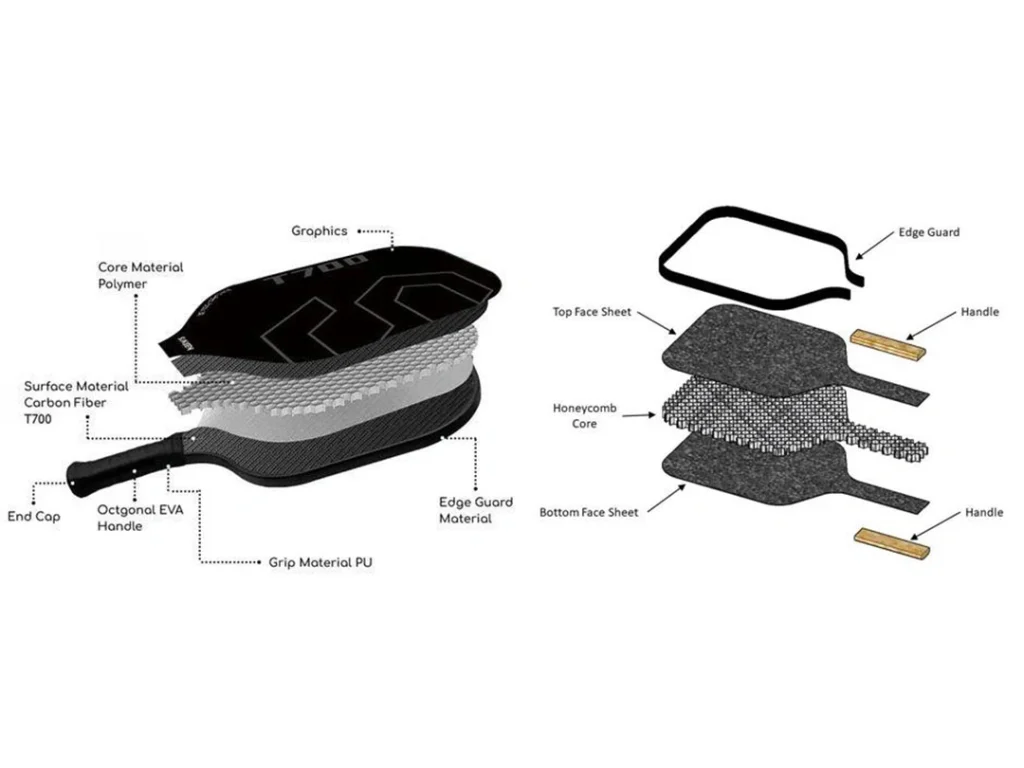
Every serious paddle on the market today converges on Toray T700 carbon fiber as the baseline face material. This isn’t a branding convergence — it’s a materials science outcome. Toray’s T700SC technical data shows the following fiber properties:
| Property | T700SC (Toray) |
|---|---|
| Tensile Strength | 4,900 MPa |
| Tensile Modulus | 230 GPa |
| Elongation at Break | 2.1% |
| Filament Diameter | 7 μm |
| Density | 1.80 g/cm³ |
For context: structural steel runs 400–800 MPa. T700 is the same grade used in load-bearing structures of the Boeing 787 Dreamliner. Applied to a paddle face, those properties translate to a surface that resists micro-fracture under thousands of impact cycles, maintains structural stiffness over a full season, and generates spin through fiber geometry rather than applied coatings.
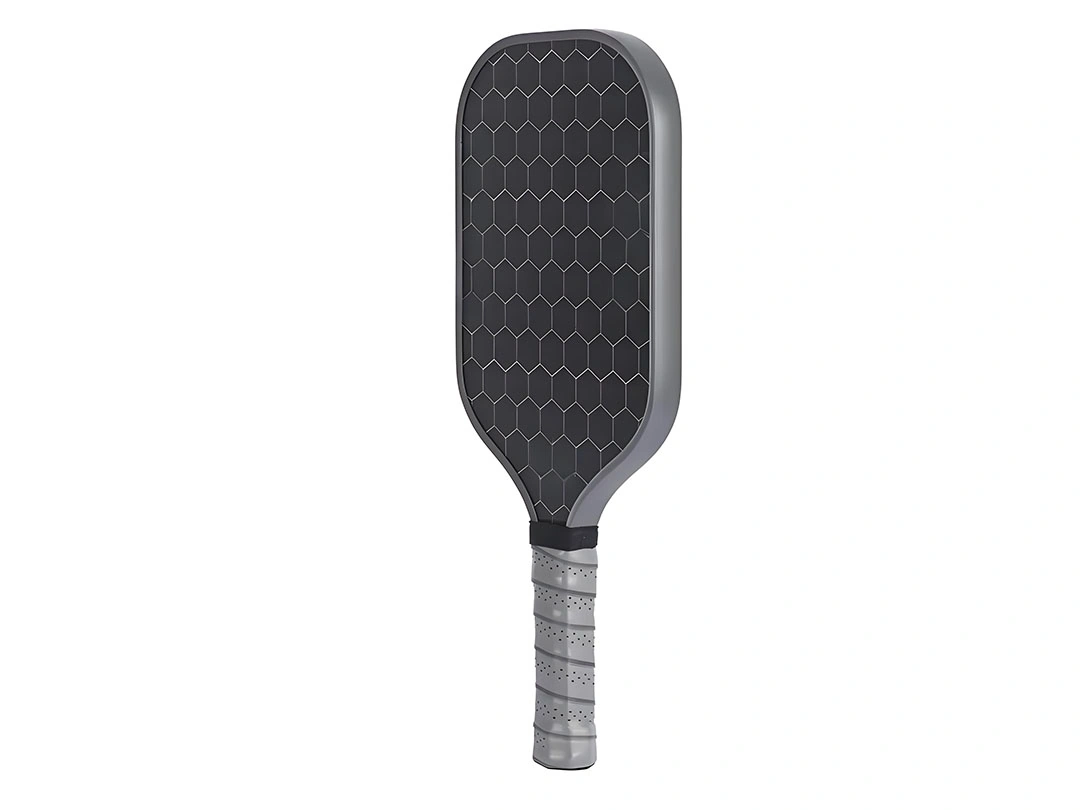
The 7-micron filament diameter is critical for spin generation. When T700 fibers are laid up in either UD (unidirectional) or 3K woven patterns and cured without surface coating, the resulting face has a micro-texture at the scale of those filament bundles. That texture creates the friction at the ball-paddle interface that generates angular momentum — measured at 2,300+ RPM spin output from raw T700 surfaces. And unlike spray-on grit coatings, which are adhesive-bonded particles that degrade in 60–90 days of regular play, the T700 micro-texture is intrinsic to the fiber. There is nothing to wear away.
Pillar 2: Core Technology
The core determines energy return, dwell time, and the paddle’s vibration profile. In professional paddles, the core options break down as follows:
PP Honeycomb remains the workhorse of professional construction — reliable, predictable, compatible with both thermoforming and hot press forging, and available in varying cell geometries to tune stiffness. Most competition paddles at the $130–$200 retail tier use optimized PP Honeycomb.
GEN3 Core 2.0 represents the next level — thermoformed honeycomb with tighter cell geometry engineered specifically for high-velocity impact cycles. NexaPaddle’s GEN3 Core 2.0 Series uses this architecture in combination with T700 faces for players who need consistent power delivery across extended rallies.
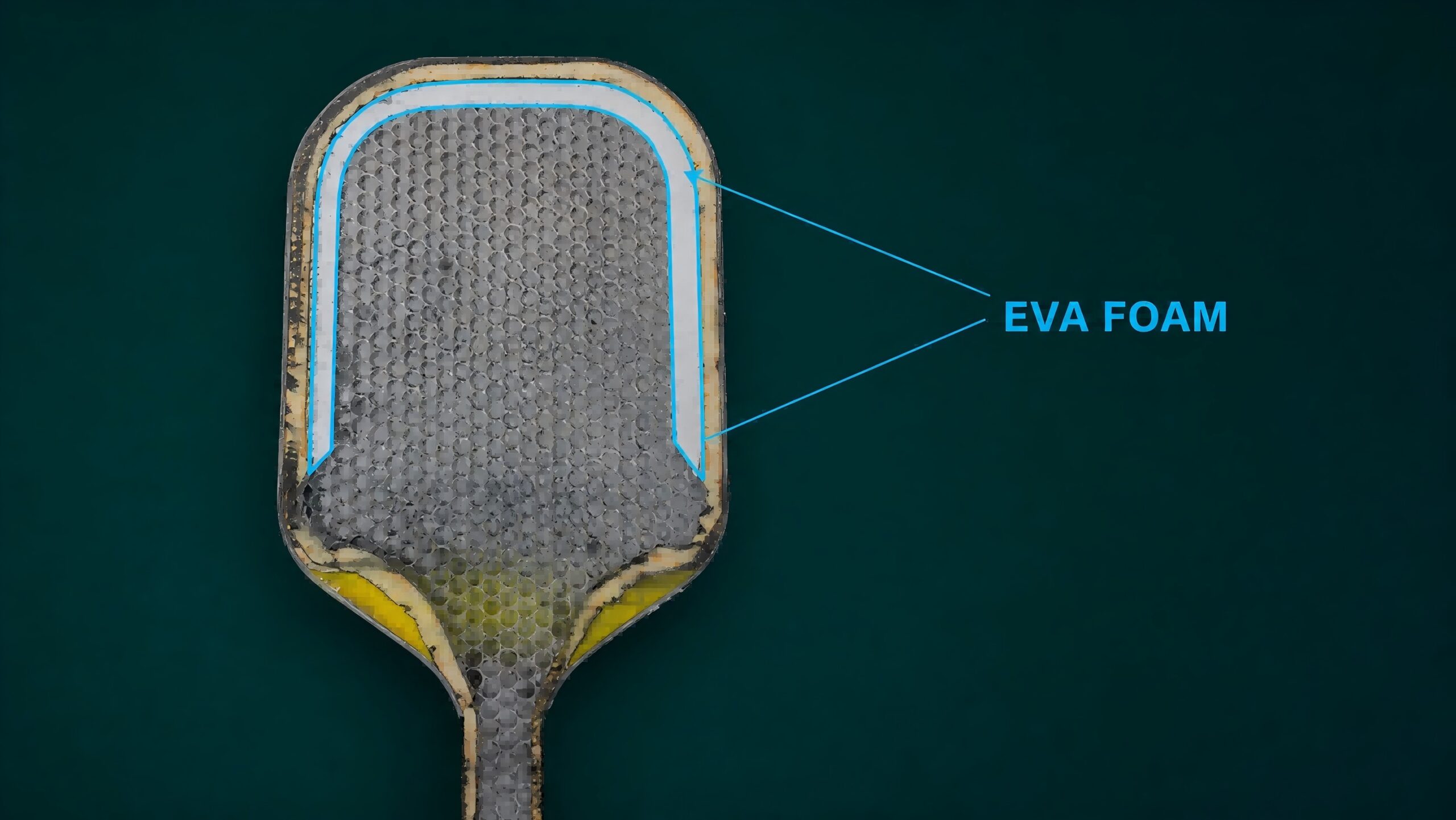
GEN4 EPP Foam (Expanded Polypropylene) eliminates core crush failure entirely and dampens vibration significantly — useful for players managing arm fatigue or operating in noise-sensitive environments. This is the architecture behind Selkirk’s BoomCore and CRBN’s TruFoam.
GEN5 Gatling Polymeric Mesh represents the current engineering frontier: a structured polymeric mesh geometry designed to maximize energy return at the outer edge of USAPA’s PBCoR envelope.
Pillar 3: Construction Process
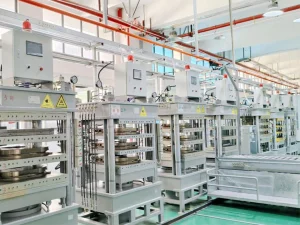
How the face and core are bonded determines structural longevity and performance consistency. Cold press uses adhesives — reliable and cost-effective for entry to mid tier, but the adhesive bond is a finite-life structural joint. Thermoforming and hot press forging eliminate adhesive bond points entirely by fusing the paddle under heat and pressure into a single unibody structure. The difference in delamination resistance between a cold press and a thermoformed paddle is not marginal — it is categorical.
Pillar 4: Performance Metrics
A professional paddle needs to hit specific engineering targets. Advanced players and competitive brands evaluate against these benchmarks:
| Metric | Professional Benchmark | Why It Matters |
|---|---|---|
| Twist Weight | 6.5+ | Expands functional sweet spot; reduces torque on mishits |
| Swing Weight | 110–120 | Balances kitchen hand speed with drive plow-through |
| Dwell Time | Core-dependent | Affects spin manipulation and touch shot precision |
| PBCoR | ≤ 0.43 (USAPA, Nov 2025) | Maximum legal power output without failing certification |
These are not aspirational targets. They are engineering specifications that a quality manufacturer designs to hit by calculation, not by approximation.
The Extended Handle Advantage for Advanced Players
Standard pickleball handles run 130mm. The shift to extended handles — 145mm and above — is one of the most significant ergonomic developments in pro paddle design, and it’s driven by a concrete market trend: tennis-to-pickleball crossover players.
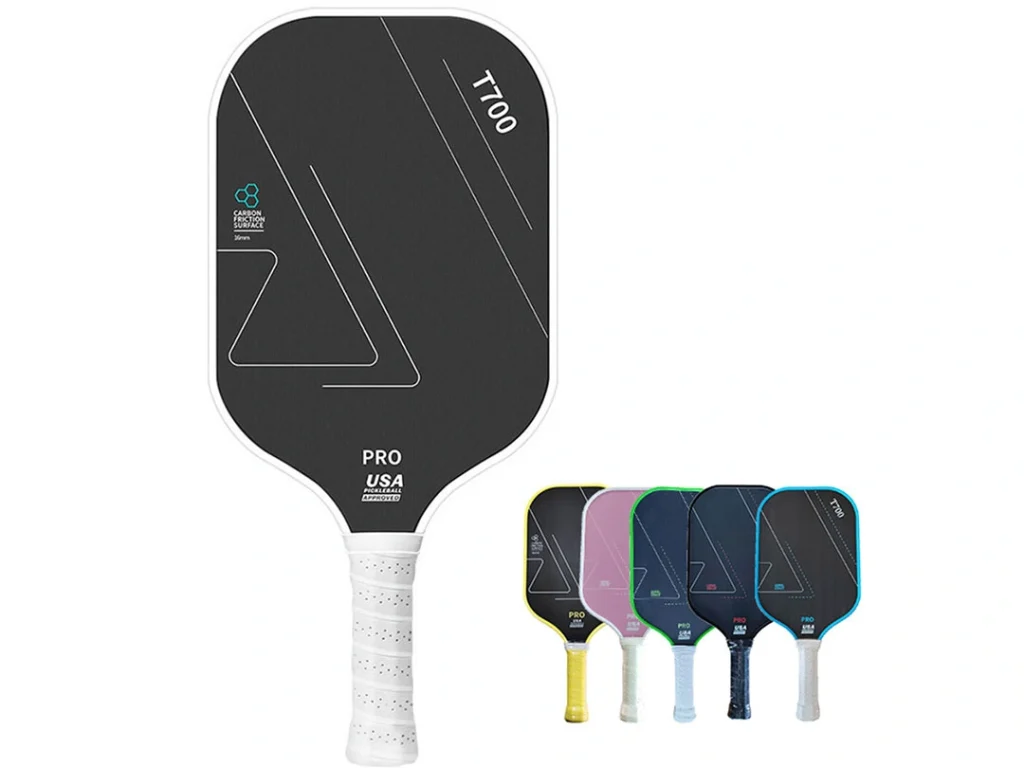
Tennis is pickleball’s largest feeder sport. Players who have spent years with a two-handed backhand arrive at pickleball with a deeply conditioned stroke — and find immediately that a 130mm handle doesn’t accommodate it. The off-hand runs out of grip real estate. The result is either an awkward modified grip that compromises the stroke, or a player actively seeking a paddle designed for two-handed backhand play.
Beyond the two-handed backhand argument, extended handles affect leverage mechanics on all strokes. More handle length shifts leverage further from the head, which translates to more whip on drives and serves. Players generating pace from the baseline — aggressive baseliners rather than kitchen-game specialists — benefit from the additional leverage even on single-handed strokes.
NexaPaddle Mold #5: Extended Handle Thermoformed
NexaPaddle’s Mold #5 is engineered specifically around the extended handle use case. Full specifications:
| Specification | Mold #5 |
|---|---|
| Face | T700 UD/3K carbon fiber |
| Core | PP Honeycomb |
| Dimensions | 415×185mm |
| Thickness | 16mm |
| Weight | 215–230g |
| Handle Length | 145mm |
| Construction | Thermoformed |
| MOQ | 100 pcs |
The 145mm handle provides 15mm of additional grip real estate over standard handles. In thermoformed construction, that extended handle is part of the same continuous carbon fiber structure as the face — there is no adhesive junction at the handle-neck transition that would be the first structural failure point under the rotational loads of a two-handed backhand.
The 16mm core thickness in this configuration is deliberate. Thicker cores produce softer, more controllable ball response — important for players who need precision as well as spin. This is not a pure power configuration; it’s designed for the complete player who uses the two-handed backhand as a control weapon as well as a driving stroke.
For brands building pro and advanced pickleball paddles aimed at the tennis crossover demographic, this specification is a direct match to what those players are looking for.
NexaPaddle GEN3 Core 2.0 Series: Extended Handle for Aggressive Baseliners
The GEN3 Core 2.0 Series pushes the dimensions further for players who favor aggressive baseline play:
- Face: T700 carbon fiber
- Dimensions: 417×188mm
- Handle: 149mm
- Core: GEN3 2.0 Thermoformed Honeycomb
The 149mm handle is at the outer edge of what extended handle configurations typically offer. Combined with a 417×188mm face — one of the larger face profiles in the competitive market — this configuration is tuned for players who want maximum reach, maximum leverage on drives, and a face profile that doesn’t punish slightly off-center contact. The GEN3 2.0 core provides consistent energy return across extended rally sequences.
Explore the full T700 carbon fiber paddles range built around these extended handle configurations.
Hot Press Forging — The Ultimate Construction for Pro Pickleball Paddles
Thermoforming eliminated the delamination risk of cold press construction by creating an unibody structure without adhesive bond points. Hot press forging takes that structural logic one step further.
How Hot Press Forging Differs from Thermoforming
Standard thermoforming uses flexible tooling and pressure-controlled ovens. The process is highly controlled but allows for minor dimensional variation across different paddle positions in the mold, and small internal void spaces can form during the cure cycle.
Hot press forging uses precision-machined steel molds under extreme pressure. Steel molds cannot flex — which means:
- Tighter dimensional tolerances — every paddle off the production run is within a narrower specification window
- More uniform fiber compression — pressure is distributed evenly across the entire face, not just at the application points
- Fewer void spaces — the primary initiation site for delamination is internal voids where moisture or air can infiltrate and expand; forge construction eliminates them structurally
- Zero delamination risk — not reduced risk, but eliminated risk under normal competitive play conditions
For tournament players who cycle through multiple paddles per season because standard thermoformed models eventually delaminate under high-frequency competitive use, the forged construction directly addresses that failure mode. A forged paddle is designed to survive an entire competitive season at the same structural integrity it had on day one.
NexaPaddle Mold #7: Hot Press Forged Specifications
| Specification | Mold #7 |
|---|---|
| Face | T700 UD/3K carbon fiber |
| Core | PP Honeycomb |
| Dimensions | 420×185mm (BV71/BV73) / 425×186mm (BV75) |
| Thickness Options | 13.5–14mm (power) / 16mm (control) |
| Weight | 220–235g |
| Handle Length | 145mm |
| Construction | Hot Press Forging |
| MOQ | 100 pcs |
The dual thickness option in this mold is the key customization lever for advanced players:
- 13.5–14mm: Stiffer face response, more direct energy transfer from swing to ball, higher power output. Preferred by players who generate pace through technique and want maximum ball speed on drives.
- 16mm: Softer feel, longer dwell time, more control on touch shots and resets. Preferred by all-court players who need the kitchen game to perform as well as baseline exchanges.
The BV71/BV73/BV75 shape variants refer to slightly different face profiles within the same mold family — allowing brands to differentiate their SKU lineup with subtle geometry adjustments rather than entirely new tooling investments.
For brands that need tournament-grade durability and are working with players who compete at the highest levels, the forged T700 carbon pickleball paddle factory capability is the relevant manufacturing reference.
Explore the full thermoformed pickleball paddles range to understand how thermoformed and forged construction compare across different performance tiers.
Custom Specifications for the Advanced Player
Generic paddles exist because they hit acceptable performance across a broad player range. Advanced players are not a broad range — they are a specific player profile with specific requirements. That requires customization.
Why Advanced Players Need Customization
Three areas drive customization demand at the advanced level:
Weight tuning: Competitive players often have a target swing weight range they’ve dialed in over years of play. A paddle that’s 5g heavier than preferred disrupts hand speed; 5g lighter than preferred reduces drive power. Factory-standard weight ranges (e.g., 215–230g) span 15g — which for an advanced player is too wide. Custom weight tuning through strategic use of edge tape, perimeter foam, or adjusted core density narrows that range to 3–5g of variance.
Core thickness selection: The 13.5mm vs. 16mm decision affects every aspect of how the paddle plays — power output, dwell time, vibration damping, and arm fatigue profile. Advanced players who have played both configurations at a high level know which one fits their game. They are not guessing.
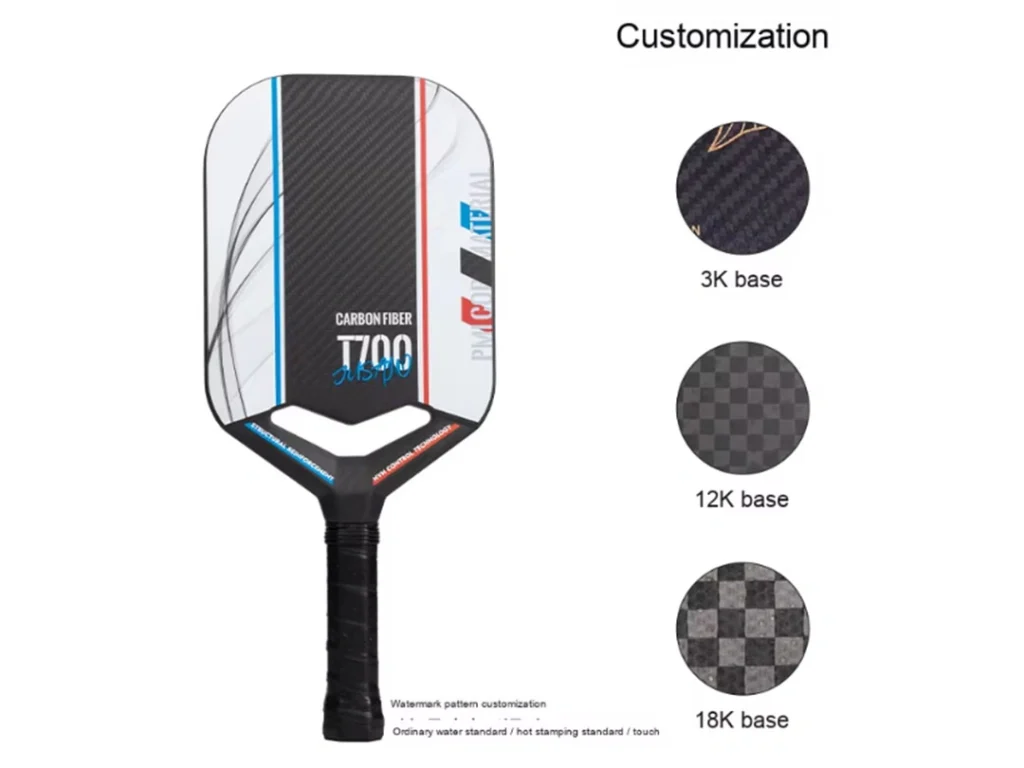
Face texture preference (UD vs. 3K): UD carbon fiber creates a smoother, directionally consistent surface texture that generates spin most efficiently in strokes where the face contacts the ball at consistent angles (typically forehand drives and serves). 3K woven carbon creates an omnidirectional crosshatch texture that performs more uniformly across varied swing angles — useful for players with diverse shot profiles. Both are T700; the difference is surface geometry, not material grade.
NexaPaddle’s Customization Capabilities
NexaPaddle’s manufacturing infrastructure supports full custom specification across every performance variable:
Molds: 8+ proprietary molds covering face dimensions from 415×185mm to 425×186mm, handle lengths from 130mm to 149mm, and multiple thickness options within each mold family.
Face material range: Fiberglass → T700 carbon (UD/3K) → T800+Titanium thread → Kevlar/Aramid hybrid. Each tier represents a genuine performance increment, not just a price increment.
Core options: PP Honeycomb (standard and GEN3 2.0 thermoformed) → GEN4 EPP Foam → GEN5 Gatling Polymeric Mesh. Core selection determines the paddle’s dwell time, vibration profile, and compliance headroom.
Pre-USAPA testing: NexaPaddle tests for PBCoR (≤0.43 since November 2025 enforcement), surface roughness via profilometer, and dimensional compliance before submission. The 2024 USAPA certification cycle processed 1,713 submissions with only 1,225 approved. Pre-testing eliminates the guesswork and protects your 60–90 day launch timeline from a rejection.
MOQ and timeline: 100 pcs minimum for thermoformed and hot press forged constructions; 300 pcs for cold press. Concept to delivery: 60–90 days.
The custom OEM pickleball paddles process covers all of these variables through a structured consultation — material selection, mold configuration, compliance testing, and production scheduling.
For brands exploring the upper end of the material range, raw carbon pickleball paddles represent the spin-performance baseline that advanced players have come to expect at the pro tier.
Performance Metrics That Matter for Professional Play
Advanced players evaluate paddles against objective performance data. Brands that serve this segment need to understand those metrics at the engineering level to specify and source correctly.
Twist Weight (Target: 6.5+)
Twist weight is the paddle’s resistance to rotation around its long axis when contact occurs off-center. Higher twist weight means the paddle doesn’t rotate in the hand on mishits — which effectively expands the usable sweet spot. This is why advanced players prefer paddles that test at 6.5+ on standard twist weight measurement: off-center contact at the kitchen line, where placement precision matters more than power, produces a predictable rather than erratic result.
Thermoformed and forged construction naturally produces higher twist weight than cold press for a given paddle geometry, because continuous carbon fiber distributes torsional stress more evenly across the entire face.
Swing Weight (Target: 110–120)
Swing weight measures the rotational inertia of the paddle as it moves through a swing arc. It is not the same as static weight. A paddle with more weight concentrated toward the face has higher swing weight than one with the same total mass concentrated at the handle.
The 110–120 range for pro paddles represents a deliberate tradeoff: high enough for plow-through power on baseline drives, low enough for quick hand exchanges at the non-volley zone. Paddles below 110 are hand-speed weapons but sacrifice drive power. Paddles above 120 are power tools but slow down at the kitchen. The professional sweet spot is the overlap.
Dwell Time
Dwell time is the duration of ball-face contact during impact. Longer dwell time allows the player to influence ball trajectory and spin during that contact window — essential for advanced shot-making like sharp cross-court angles, roll volleys, and deceptive drops. Core architecture is the primary dwell time variable: foam cores produce longer dwell than honeycomb; thicker cores produce longer dwell than thinner ones.
The tradeoff is that longer dwell time typically means reduced power output (more energy is absorbed rather than returned). Advanced players choose based on their play style: foam core for touch-game specialists, honeycomb for power-baseline players.
PBCoR (≤0.43 USAPA Limit Since November 2025)
PBCoR (Pickleball Coefficient of Restitution) governs the paddle’s “trampoline effect” — how much energy it returns to the ball relative to the impact energy. USAPA tightened the maximum from 0.44 to 0.43 in November 2025. Paddles previously approved at 0.44 may no longer qualify under the updated standard.
For professional play, PBCoR is a compliance floor and ceiling simultaneously: brands want their paddles as close to 0.43 as possible (maximum legal power output) without exceeding it (certification failure). This requires factory-level testing with calibrated equipment, not post-submission guesswork.
The technical relationship between PBCoR and construction is important: thermoformed and forged paddles, because of their structural efficiency, naturally approach the 0.43 limit more closely than cold press designs. This is simultaneously a performance advantage (maximum legal power) and a compliance management responsibility. The two things are not in conflict — they require the same solution: precise factory testing before submission.
Why T700 Is the Engineering Sweet Spot for Pro Paddles
The carbon fiber ladder runs T300 → T700 → T800. Understanding where T700 sits — and why it’s not T300 or T800 — completes the professional paddle picture.
| Property | T300 | T700 | T800 |
|---|---|---|---|
| Tensile Strength | 3,530 MPa | 4,900 MPa | 5,490 MPa |
| Tensile Modulus | 230 GPa | 230 GPa | 294 GPa |
| Elongation | 1.5% | 2.1% | 1.9% |
| Cost-Performance | Budget | Optimized | Premium |
T700 is 39% stronger than T300 — a categorical difference in fatigue resistance that shows up as paddle longevity and consistent surface stiffness over a season. T800 is only 12% stronger than T700, while its significantly higher modulus (294 GPa vs. 230 GPa) makes the face stiffer in a way that doesn’t translate proportionally to on-court gains for most players, and it costs substantially more to source.
T700’s elongation-at-break of 2.1% (vs. T800’s 1.9%) means it absorbs slightly more deformation before fracturing — exactly the behavior you want in a face material that takes thousands of impact cycles per season. Combined with the 7μm filament diameter that generates spin through intrinsic fiber geometry, T700 is the engineering optimum for professional paddle construction at this stage of the sport’s technical development.
The full analysis of why carbon fiber pickleball paddles built on T700 represent the current professional standard is covered in depth in the material science documentation.
Frequently Asked Questions
What makes a pickleball paddle “professional grade”?
Four engineering characteristics define professional grade: a T700 or higher carbon fiber face (generating 2,300+ RPM spin through intrinsic fiber geometry), a performance-optimized core (PP Honeycomb, GEN3 2.0, or foam), thermoformed or hot press forged construction (eliminating adhesive bond points and delamination risk), and compliance-tested performance metrics (Twist Weight 6.5+, Swing Weight 110–120, PBCoR ≤0.43). Generic paddles lack one or more of these; professional-grade paddles deliver all four.
Why is T700 carbon fiber preferred over T800 for pro paddles?
T700 delivers 4,900 MPa tensile strength — 39% stronger than T300 and sufficient for professional-level fatigue resistance. T800’s 5,490 MPa is only 12% stronger than T700, while its significantly higher modulus (294 GPa vs. 230 GPa) adds stiffness that doesn’t translate to proportional performance gains for most players, at meaningfully higher cost. T700’s 2.1% elongation-at-break also provides better impact absorption characteristics. The entire market — Selkirk, JOOLA, CRBN, Vatic Pro — converged on T700 because the engineering case is definitive, not because of cost-cutting.
What handle length do advanced players prefer?
The trend is clearly toward 145mm+ extended handles. Standard handles (130mm) are functional for single-handed play but limit two-handed backhand players — a growing segment driven by tennis crossover. NexaPaddle’s Mold #5 offers a 145mm extended handle in thermoformed T700 construction; the GEN3 Core 2.0 Series extends to 149mm for players who want maximum leverage on drives.
Are custom pro pickleball paddles USAPA approved?
Custom paddles are USAPA-certifiable, not pre-approved. Certification applies to specific designs, not manufacturers. NexaPaddle conducts pre-USAPA testing in-house for PBCoR (≤0.43), surface roughness, and dimensional compliance before submission. The 2024 certification cycle rejected 488 of 1,713 submissions — primarily on PBCoR grounds. Pre-testing eliminates that failure risk before it costs you submission fees and timeline.
What is the minimum order for custom professional paddles?
100 pieces for thermoformed and hot press forged constructions; 300 pieces for cold press. The historical industry standard was 300–500 units; NexaPaddle’s optimized production lines accommodate the lower MOQ specifically to allow brand owners to test the advanced player market with limited inventory commitment before scaling.
Conclusion
Advanced players are a specific, demanding, well-informed segment. They know what T700 is. They know what thermoforming does. They have already played enough paddles to know when construction quality is absent. Building professional pickleball paddles for this market requires specificity at every design decision: face material grade, core architecture, construction method, handle geometry, and performance metric targets. The brands producing the best pro pickleball paddles share one thing: they made those decisions with precision, not approximation.
The manufacturing infrastructure to build to those standards exists. T700 carbon fiber faces with 2,300+ RPM spin generation. Extended 145–149mm handles for two-handed backhand players. Hot press forged construction with zero delamination risk. Core options across PP Honeycomb, GEN3 2.0, GEN4 EPP Foam, and GEN5 Gatling Mesh. Pre-USAPA compliance testing. MOQ 100 pcs with 60–90 day concept-to-delivery timelines.
If you’re building a paddle line for advanced players — or serving brands that do — the technical conversation starts with specifications, not aesthetics. NexaPaddle’s manufacturing team works directly with brand owners, retailers, and tournament-level players through a structured consultation process covering material selection, mold configuration, compliance testing, and production planning.
Contact NexaPaddle to discuss your professional paddle manufacturing requirements.
Sources & Citations
Coherent Market Insights. (2025). Pickleball Equipment Market Size, Share & Trends Analysis Report. Pickleball equipment market valued at approximately $702.9 million in 2025; 36.5 million US players cited from Association of Pickleball Professionals (APP) player population data.
Industry Market Research. (2025). Carbon Fiber Pickleball Paddle Market Size, 2025–2034. Carbon fiber paddle segment valued at $137.9 million in 2025; 12.8% CAGR projection to $412.86 million by 2034.
Toray Industries. Torayca T700S Technical Data Sheet. Published fiber properties including 4,900 MPa tensile strength, 230 GPa modulus, 7μm filament diameter, 2.1% elongation. Boeing 787 structural application reference.
Helios Pickleball. Carbon Fiber Pickleball Paddle Guide: T700, Grades & Surface Tech. September 2025. Spin generation from raw T700 carbon fiber surfaces measured at 2,300+ RPM; spray-on grit degradation timeline of 60–90 days.
USA Pickleball. Equipment Standards & Approved Paddle List; Annual Certification Cycle Report 2024. PBCoR standard tightened from 0.44 to 0.43 in November 2025; 1,713 certification submissions processed in 2024; 1,225 approved.
NexaPaddle manufacturing specifications. (2026). Mold #5, Mold #7, and GEN3 Core 2.0 Series technical data. Internal manufacturing documentation for thermoformed and hot press forged paddle constructions.