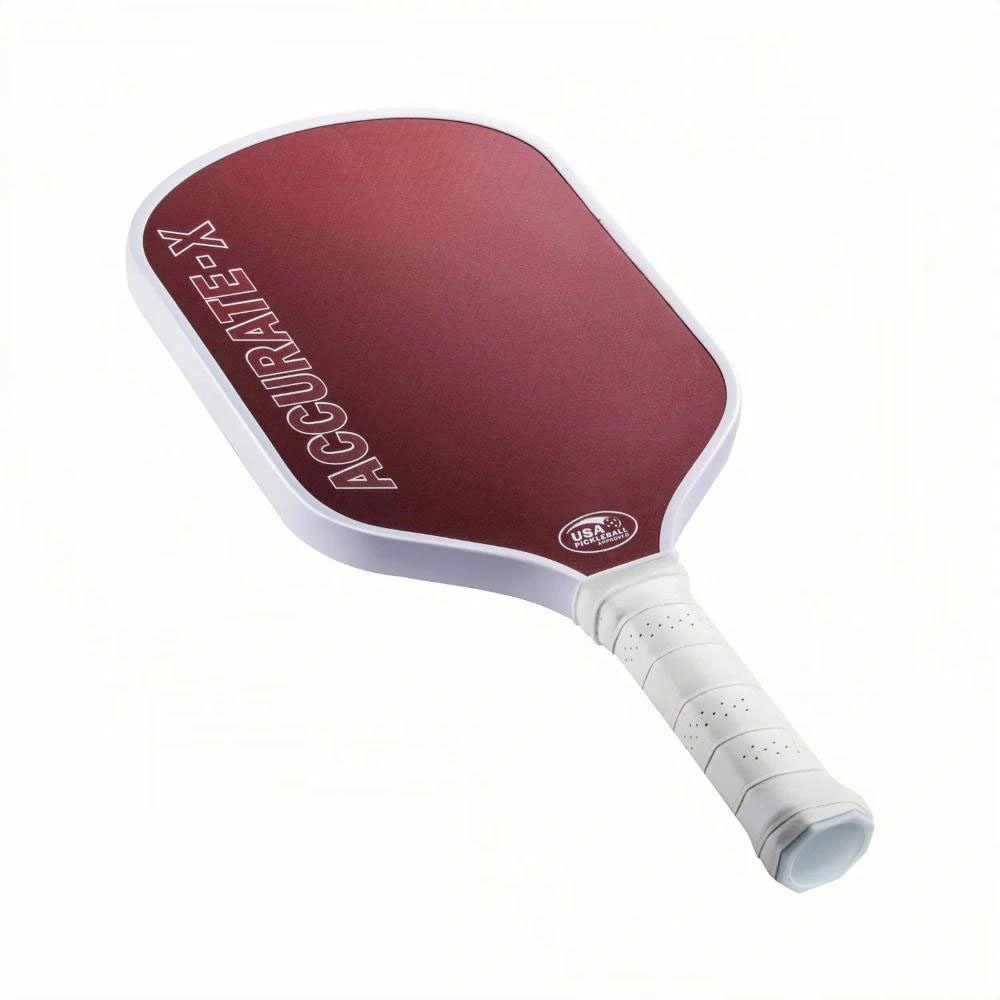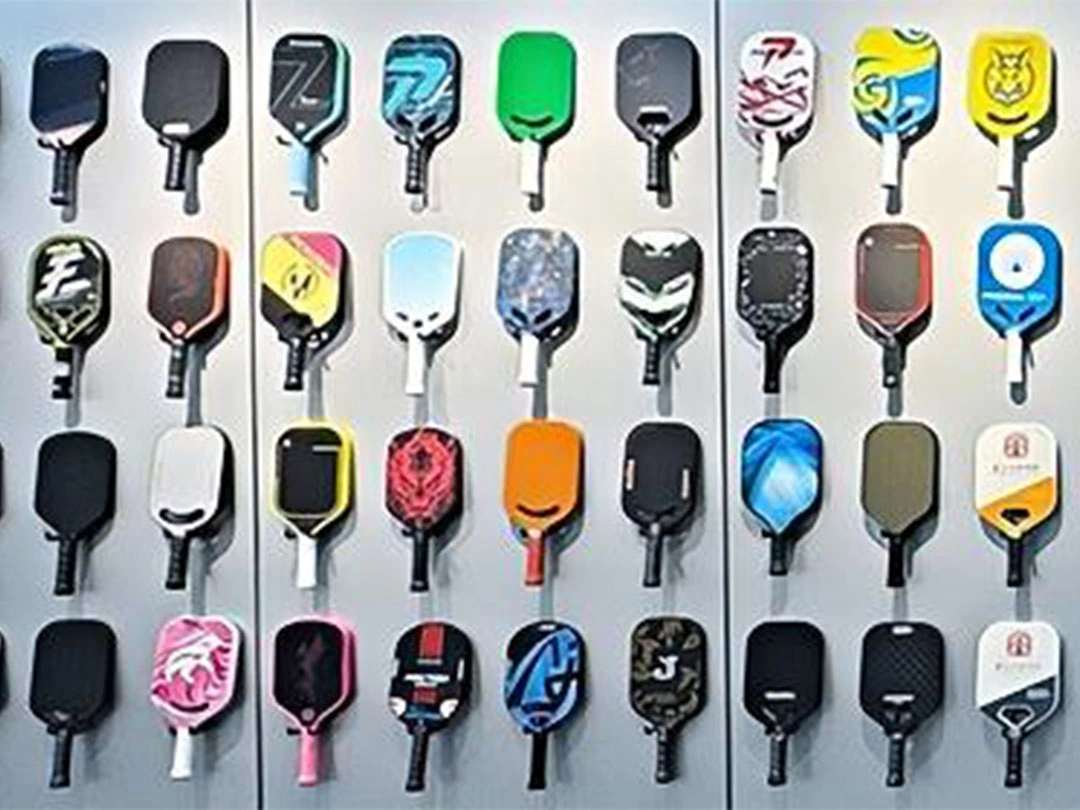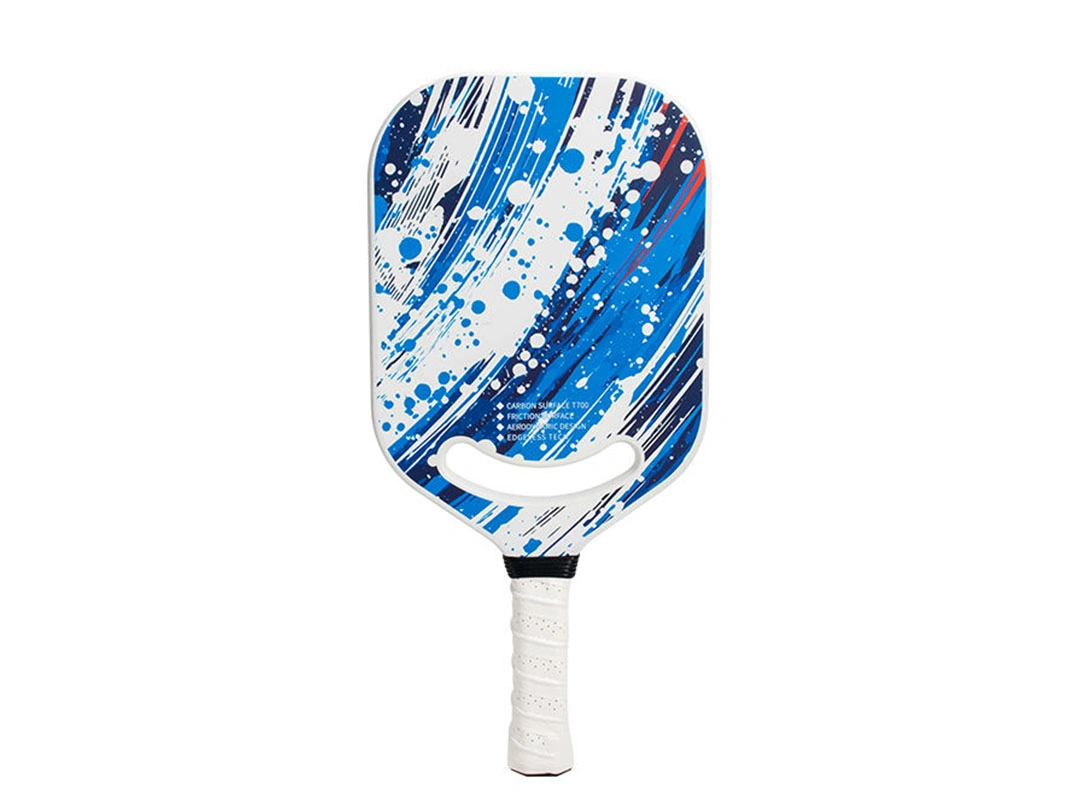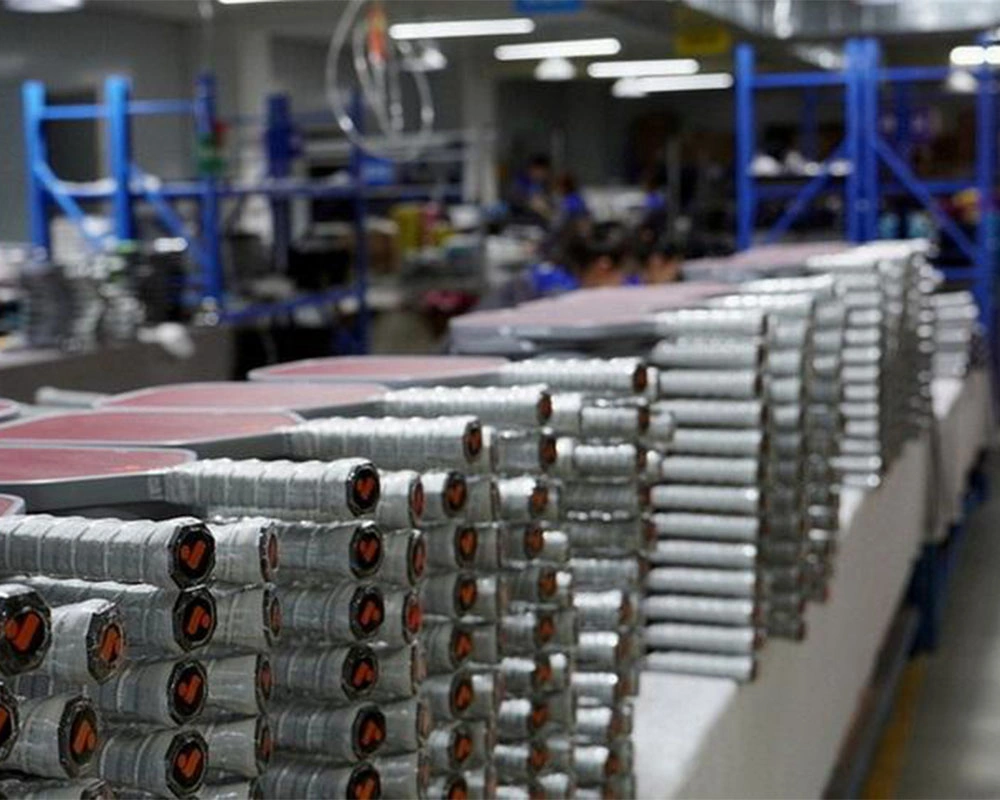
No—not as a category. “Gen 3” pickleball paddles are not subject to a category-wide U.S. ban in 2026. But an individual model can still be ineligible for a tournament or create patent-infringement risk. USAP or UPA-A certification addresses sports eligibility; it does not provide patent clearance.
But that answer needs an important qualification. Gen 3 is an industry and marketing term, not an official regulatory classification. A paddle does not pass because a factory calls its core “Gen 3,” “propulsion,” “foam-enhanced,” or “next generation.” Tournament eligibility depends on the performance and construction of the finished paddle, whether production units match the certified samples, and whether the model remains within the applicable limits throughout use.
That distinction matters to brands. The commercial risk is not simply choosing the wrong core name. It is approving a high-power sample with too little compliance margin, changing the structure after testing, allowing normal batch variation and break-in to push retail units beyond the certified performance envelope, or importing a construction that may fall within another company’s U.S. patent claims.
This guide explains the 2026 U.S. equipment and patent-risk landscape from a manufacturer-side perspective. Updated October 9, 2026: “Gen 3” remains an industry label rather than a prohibited paddle category; model-specific certification status and patent clearance must be checked separately.
Scope note: This is a sourcing and product-development guide, not a legal opinion or an infringement determination. A U.S. patent attorney must compare the final construction against the claims of all relevant, unexpired patents before launch. USA Pickleball and UPA-A certification are sports-governing requirements, not government permission to sell a consumer product or confirmation of patent freedom to operate.
Key Takeaways for Brand Owners
- Patent clearance and tournament certification are separate gates. A USAP- or UPA-A-listed paddle can still create patent risk.
- Patent claims follow the internal structure, not the Gen 3 or Gen 4 label. Core boundaries, gaps, fillers, and frame construction matter.
- Commission a U.S. FTO review before tooling or purchase-order approval. Do not rely solely on a supplier’s “patent-free” statement.
- Certify the production design and control it after approval. Break-in, material substitutions, and process drift can change both performance and legal risk.
Why “Gen 3” Became Associated With Banned Paddles
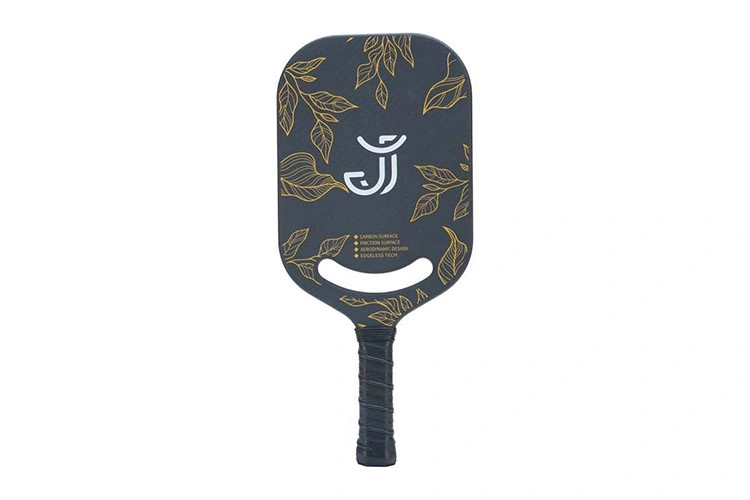
The confusion traces largely to high-profile paddle removals in 2024. USA Pickleball stated that certain JOOLA models were removed after the paddles sold in the market were found not to be the same samples originally submitted under a certification-by-similarity process. Newly submitted paddles were then tested and did not meet the applicable equipment standards.
That event did not create a blanket ban on every Gen 3-style construction. It demonstrated two broader compliance principles:
- The submitted paddle and the production paddle must be the same product in all material respects.
- A product-family label such as “Gen 3” does not determine certification status; the exact model does.
USA Pickleball later introduced PBCoR testing to measure power and limit excessive trampoline effect. Its January 2025 Equipment Standards Manual set a PBCoR ceiling of 0.44 from November 1, 2024, reducing it to 0.43 from November 1, 2025.
So the right buyer question is not, “Is Gen 3 banned?” It is:
Can this exact finished model pass the required tests, remain within the limits after break-in, and be reproduced consistently in mass production?
“Gen 3” Is Not a Standardized Core Specification
Suppliers do not always use the generation labels in the same way. Depending on the factory or brand, “Gen 3” may describe:
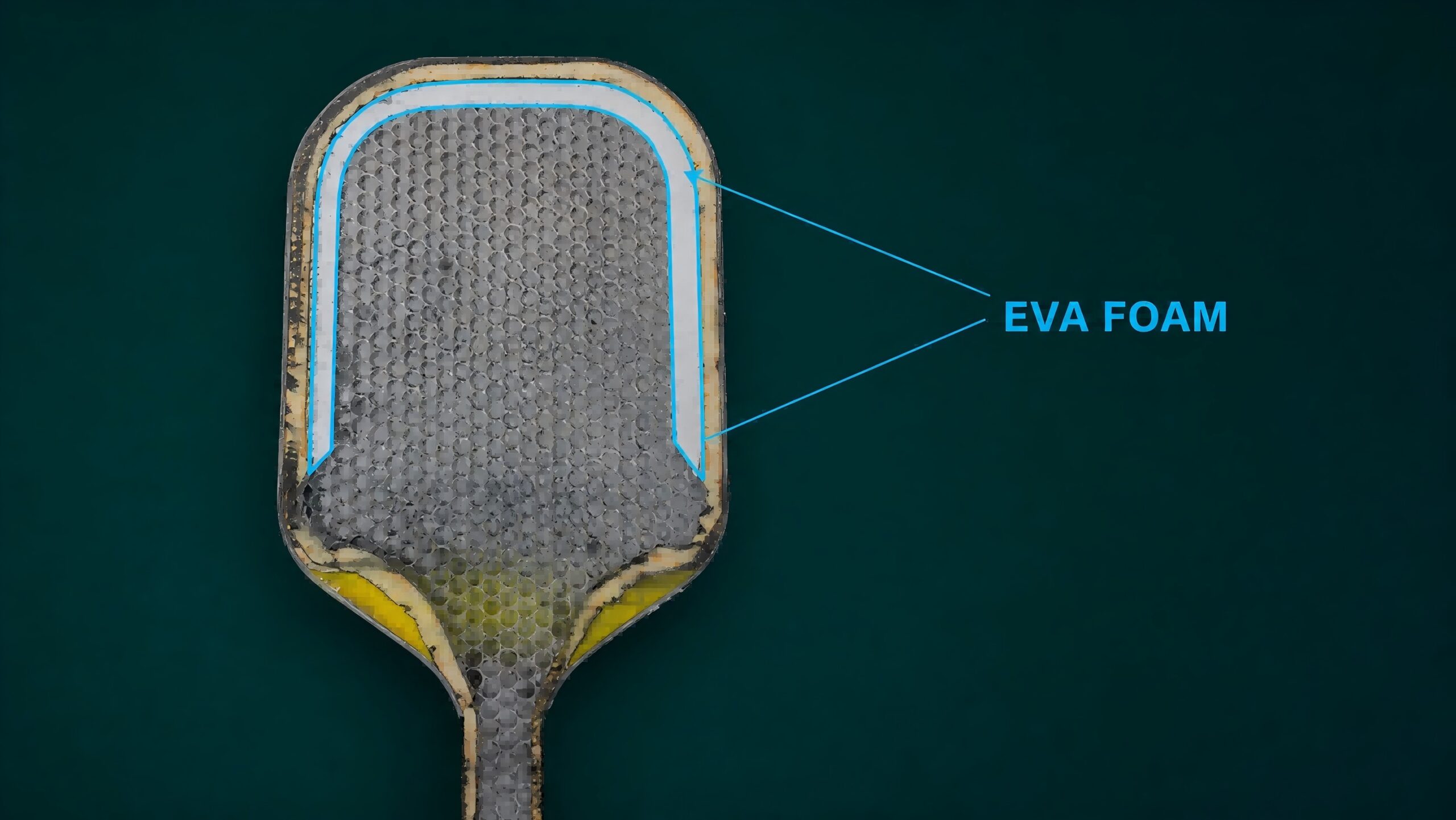
- A thermoformed PP honeycomb paddle with perimeter foam
- A more elastic honeycomb or resin system
- A propulsion-style structure designed for greater dwell and rebound
- A power-focused construction positioned between conventional thermoformed and full-foam designs
- A commercial product family rather than a distinct engineering architecture
For procurement, the term alone is too vague. A proper OEM brief should identify the actual construction:
- Core material, thickness, cell size, and density
- Perimeter-foam material, hardness, width, and location
- Face layup and fiber orientation
- Resin and adhesive system
- Thermoforming temperature, pressure, and dwell-time window
- Edge and handle construction
- Finished weight, swing weight, and balance range
- Surface material and finishing process
- Target power, spin, deflection, and durability values
Brands evaluating advanced-tech and thermoformed paddles should treat “Gen 3” as the start of a technical conversation, not as an adequate purchase specification.
The 2026 JOOLA Patent Risk: Why Gen 3 and Some Gen 4 Designs Need an FTO Review
The patent issue is separate from USAP or UPA-A performance compliance.
Sport Squad, Inc., doing business as JOOLA, is the assignee of at least two U.S. utility patents now being asserted against competing pickleball paddle suppliers:
- U.S. Patent No. 12,465,826 (the ’826 patent), issued November 11, 2025
- U.S. Patent No. 12,357,891 (the ’891 patent), issued July 15, 2025
The patents belong to the same broader patent family and claim priority to provisional applications filed in 2023. They concern paddle cores, gaps or voids, filler materials, and perimeter or frame structures—not the commercial labels “Gen 3” or “Gen 4.”
What the Published Claims Actually Focus On
Patent infringement is evaluated claim by claim. A product generally creates literal-infringement risk only when every limitation of at least one asserted claim is present; visual similarity or use of PP honeycomb alone is not enough.
At a high level, claim 1 of the ’826 patent describes a pickleball paddle with:
- Front and back surfaces
- A core whose outer boundary has one portion terminating farther inside the paddle than another portion
- A gap outside the core and between the core boundary and the paddle’s internal perimeter
- A first filler in at least part of that gap
- A frame around at least part of the paddle head, with a hollow interior
- A second filler within at least part of the frame’s hollow interior
The ’891 patent includes claims directed to other arrangements, including gaps in the core near both sides of the throat, filler placed in one or more of those gaps, and associated frame or additional filler structures.
That means PP honeycomb by itself is not the complete issue. The higher-risk question is whether a PP honeycomb—or another core material—is cut back, relieved, gapped, surrounded, or combined with fillers and a frame in the particular arrangement required by a patent claim.
Why Gen 4 Can Be Close to Gen 3 for Patent Purposes
The industry’s generation names are inconsistent. Some “Gen 4” paddles use a substantially different full-foam architecture. Others retain a central PP honeycomb core while changing the quantity, position, or mechanical role of foam and other filler materials.
Therefore:
- A full-foam paddle is not automatically outside the patents.
- A PP honeycomb paddle is not automatically inside the patents.
- A Gen 4 marketing label does not avoid a claim that covers the actual arrangement.
- Moving or changing the foam is useful only if the revised design omits at least one required claim limitation and also avoids other relevant claims and the doctrine of equivalents.
The correct analysis is a limitation-by-limitation claim chart based on a sectioned production paddle, drawings, bill of materials, and manufacturing method.
Current 2026 Patent Enforcement Status
On June 4, 2026, the U.S. International Trade Commission instituted Investigation No. 337-TA-1503 based on JOOLA’s complaint. The investigation covers alleged infringement of claims from the ’826 and ’891 patents in connection with imported pickleball paddles. JOOLA requested a limited exclusion order and cease-and-desist orders.
The ITC described the accused product category broadly as pickleball paddles “with a core, comprised of foam or other material, and various filler material(s).” This reinforces that the dispute is not confined to a single PP-honeycomb product name.
The ITC also expressly stated that instituting the investigation was not a decision on the merits. As of October 9, 2026, USITC records list Investigation No. 337-TA-1503 as pending before the administrative law judge, with an initial determination currently scheduled for June 8, 2027. It should therefore still be described as a pending infringement investigation—not as proof that every accused paddle infringes.
JOOLA and Paddletek Group separately announced a settlement concerning the Paddletek Reserve, HoneyFoam, and ProXR Signature Jolt products. According to that joint announcement, the relevant products will carry JOOLA’s propulsion-core patent number and royalties will be paid. In September 2026, JOOLA also announced that additional named defendants had resolved, consented to relief, or faced default, and it announced a separate settlement with Friday. These are party announcements and negotiated resolutions—not a Commission merits ruling, not a court definition of the full patent scope, and not proof that every Gen 3-style paddle infringes.
Minimum FTO Workflow Before a U.S. Launch
Before quoting or approving a Gen 3 or Gen 4-style OEM model for the United States:
- Freeze the internal architecture. Record the core boundary, all gaps, filler locations, frame cross-section, materials, and manufacturing sequence.
- Commission a U.S. freedom-to-operate search. At minimum, review the ’826 and ’891 patents, their continuations and related family members, plus patents owned by other paddle companies.
- Prepare a claim chart. Map every limitation of the relevant independent and dependent claims to the proposed product.
- Decide the commercial path. Obtain a non-infringement opinion, design around the claims, seek a license, or do not sell/import the model in the U.S.
- Control production changes. A supplier substitution or foam-layout change can alter both tournament performance and the patent analysis.
- Keep territory-specific SKUs when necessary. A structure intended for other markets should not automatically be offered to a U.S. buyer.
If a structure cannot obtain acceptable U.S. FTO clearance, a brand may consider a Europe-only, Asia-only, or other territory-specific SKU—but only after counsel reviews the patent landscape in each destination country. A U.S. patent is territorial, yet related European, Chinese, Korean, or other national patents and applications may exist in the same family. Market segmentation requires separate model numbers, packaging, sales-channel restrictions, distributor instructions, and controls that prevent the non-U.S. SKU from being diverted into the United States.
An OEM factory can provide drawings, cut sections, BOM records, and process evidence. It should not promise “patent-free” status without a qualified legal review covering the final product and sales territory.
Put Patent Responsibility Into the OEM Contract
An FTO review answers a technical-legal question; the supply agreement determines who carries the commercial loss if a dispute still arises. Brand owners should not leave patent responsibility to an email promise or a generic statement that the product is “original.”
Counsel should consider addressing:
- IP warranty: what the supplier is actually warranting, for which design, countries, and period
- Disclosure duty: whether the supplier must identify third-party designs, licensed technology, prior disputes, and known claims
- Indemnification: which infringement claims, defense costs, settlements, recalls, inventory losses, or import holds are covered
- Control of defense: who selects counsel, controls settlement, and communicates with the claimant
- Remedies: redesign, replacement, refund, license procurement, or order cancellation
- Liability limits: whether ordinary contractual caps exclude IP claims and whether the supplier has sufficient assets or insurance to support the promise
- Change control: written approval before any core, filler, frame, material, or process substitution
- Evidence retention: drawings, BOM revisions, lot records, test reports, and samples needed to defend the design
Contract language is not a substitute for clearance. A broad indemnity from a thinly capitalized supplier may have little practical value, and a brand that specifies or supplies the accused design may retain substantial exposure. Allocate responsibility only after both parties have disclosed who designed each feature and who controls U.S. sales.
The Two Certification Paths Brands Need to Understand
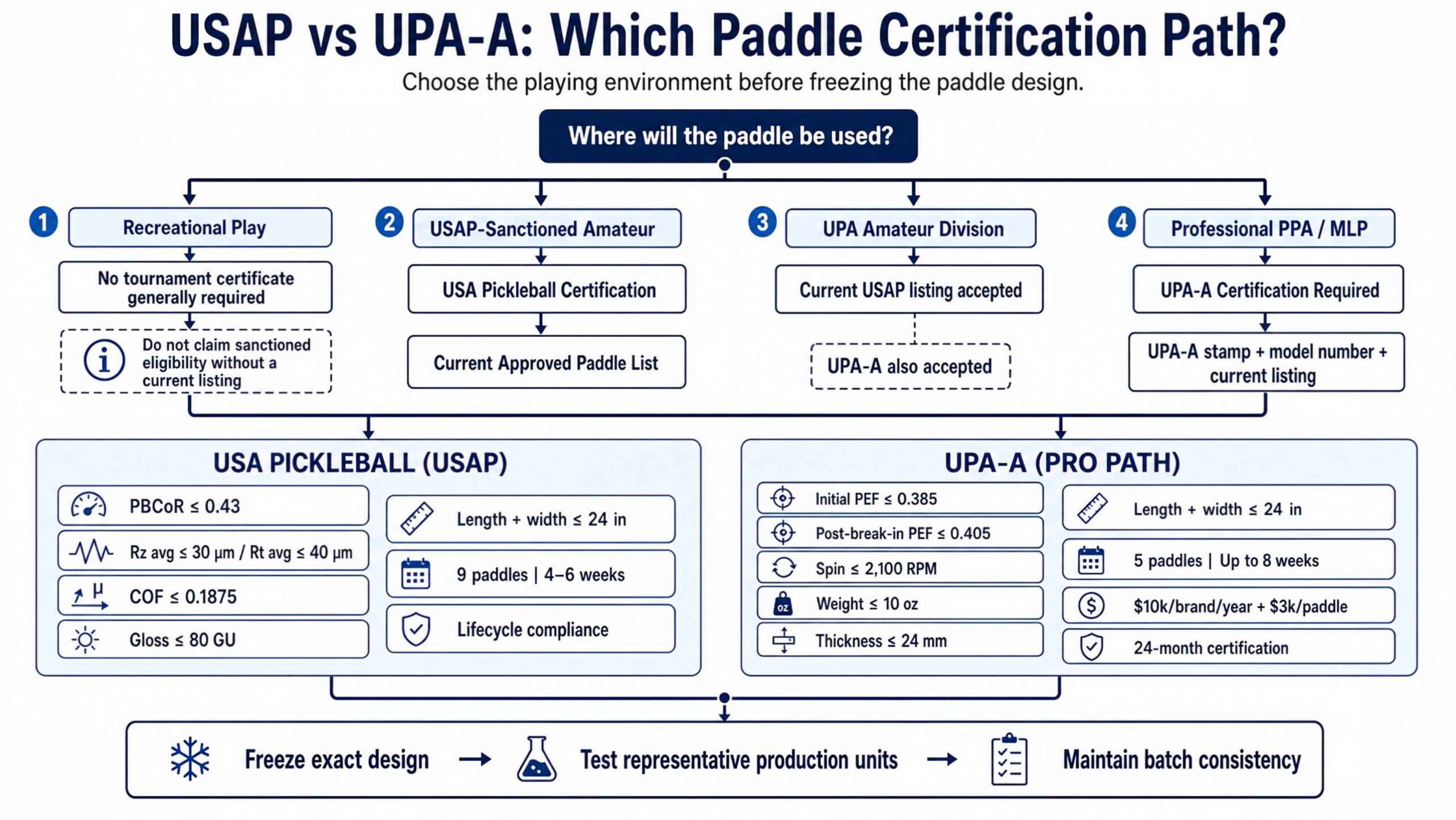
There is no single paddle certificate covering every level of competitive pickleball in the United States. In 2026, brands should decide where the model needs to be played before freezing its design.
| Commercial goal | Main equipment path | Practical implication |
|---|---|---|
| USA Pickleball-sanctioned amateur competition | USA Pickleball certification and a current listing on the Approved Paddle List | The exact model must pass USAP testing and remain listed |
| Amateur divisions at UPA events | A current USAP-listed paddle is accepted; UPA-A certification is also accepted | UPA-A is not generally required for these amateur divisions |
| Professional PPA and MLP competition | UPA-A certification | The paddle needs a UPA-A stamp, model number, and current approved listing |
| Recreational play | Tournament certification is generally not a condition of casual use | Marketing must not imply sanctioned-tournament eligibility without a valid listing |
USA Pickleball: The Broad Sanctioned-Play Route
USA Pickleball certification evaluates more than core power. The published equipment standards address materials, surface characteristics, reflection, dimensions, prohibited features, model identification, and continuing compliance.
For a Gen 3 power paddle, the main factory-side controls include:
- PBCoR: not above 0.43 under the published USAP standard effective November 1, 2025 n
- Spin rate for new certification submissions: 2,100 RPM or less under the USA Pickleball Spin Rate Test effective October 1, 2026 n
- Surface roughness: average Rz no greater than 30 µm and average Rt no greater than 40 µm, with additional single-reading limits
- Coefficient of friction: kinetic COF no greater than 0.1875 under the published method
- Gloss: no measurement above 80 GU for the hitting surface and edge guard
- Dimensions: combined length and width no greater than 24 inches, with length no greater than 17 inches
- Prohibited construction behavior: no spring-like, flexible-membrane, or compressible feature that creates a non-compliant trampoline effect
- Lifecycle compliance: the paddle must remain compliant through its useful life, including any break-in or degradation that improves performance
USA Pickleball’s submission FAQ currently says a paddle submission requires nine paddles shipped to six locations, final production graphics, and a normal testing window of approximately four to six weeks. The organization also conducts market inspections after certification.
UPA-A: The Professional-Tour Route
UPA-A applies a separate performance system for professional PPA and MLP play. Under UPA-A Paddle Rules version 26.4, new paddles are subject to:
- Initial Paddle Efficiency Factor (PEF) of 0.385 or less
- Post-break-in PEF not above 0.405
- Spin not above 2,100 RPM
- Maximum weight of 10 ounces
- Maximum thickness of 24 mm
- Combined length and width no greater than 24 inches
- Continuing consistency with the certified model
UPA-A also uses accelerated break-in and onsite screening. Its rules state that key production-paddle performance metrics—including MOI, ADF, spin rate, surface roughness, and PEF—must remain within 10% of the values measured for the certified model.
For 2026, UPA-A lists an annual brand fee of $10,000 and a $3,000 per-paddle testing fee, with each paddle certification valid for 24 months. Its submission checklist requires five paddles, and standard certification can take up to eight weeks. Brands should confirm current fees and timelines before budgeting because program terms can change.
The Five Gen 3 Compliance Risks That Usually Begin at the Factory
1. Designing to the Limit Instead of Designing With Margin
A prototype that measures just below a threshold is not automatically production-ready. Core density, foam volume, resin content, cure conditions, face thickness, and finished weight all vary within a manufacturing process.
If the development sample has almost no margin, ordinary variation may create a mixed batch in which some units perform differently from the certified sample. A safer development target uses an internal guard band below the governing limit. The exact guard band should be based on measured process capability, not a generic percentage copied from another model.
2. Ignoring Break-In
Power paddles can change as the face, adhesive system, honeycomb, and perimeter structure settle under repeated impact. A paddle that starts compliant may become more efficient after play.
For a Gen 3 program, a single new-paddle test is weak evidence. Development testing should include:
- Baseline measurements on multiple samples
- A documented impact or accelerated break-in cycle
- Repeat power, spin, deflection, and physical inspections
- Destructive inspection of selected units
- Review of core crush, debonding, face movement, and foam separation
UPA-A formally incorporates accelerated break-in into certification, while USA Pickleball requires compliance across the paddle’s useful life.
3. Certifying a Prototype That Is Not the Production Model
Beta units and hand-tuned samples are valuable for development, but they are not substitutes for representative final-production samples. In a 2025 statement regarding the Ronbus Ripple, USA Pickleball emphasized that prototype testing did not constitute full certification and that final production samples had to pass the complete process.
Before submission, freeze:
- Bill of materials and approved suppliers
- Core lot specification
- Foam and adhesive specifications
- Layup schedule
- Mold and process recipe
- Shape, thickness, edge design, and handle construction
- Surface finish and final artwork
- Model name and model number
Any performance-relevant change after submission should trigger a formal review and, where required, a new certification or model designation.
4. Treating One Passing Sample as Proof of Batch Consistency
Certification is model-based, but manufacturing risk is statistical. A brand needs evidence that the production window—not one carefully selected unit—can meet the requirement.
A practical pilot-lot plan should sample units from different mold positions, shifts, core lots, and production dates. Record at least:
- Finished weight and balance
- Thickness map
- Bond and edge integrity
- Surface roughness or an appropriately correlated process check
- Deflection or other correlated structural metric
- Post-break-in performance on validation samples
This is where an experienced custom and OEM pickleball paddle program creates value: the goal is not only to produce a powerful golden sample, but to reproduce the approved design at scale.
5. Using Certification Language Too Early
Do not print a certification mark, claim tournament eligibility, or advertise a model as approved merely because:
- A similar factory platform has passed before
- An engineering sample passed internal screening
- A pre-production prototype received favorable results
- Another brand uses a comparable core
- The application has been submitted
Use the relevant mark only after the exact model has completed the applicable process and appears on the official list. Product pages should link buyers to the current listing when making eligibility claims. For broader program planning, see NexaPaddle’s USAPA approved paddles resource.
A Better OEM Compliance Workflow for Gen 3 Paddles
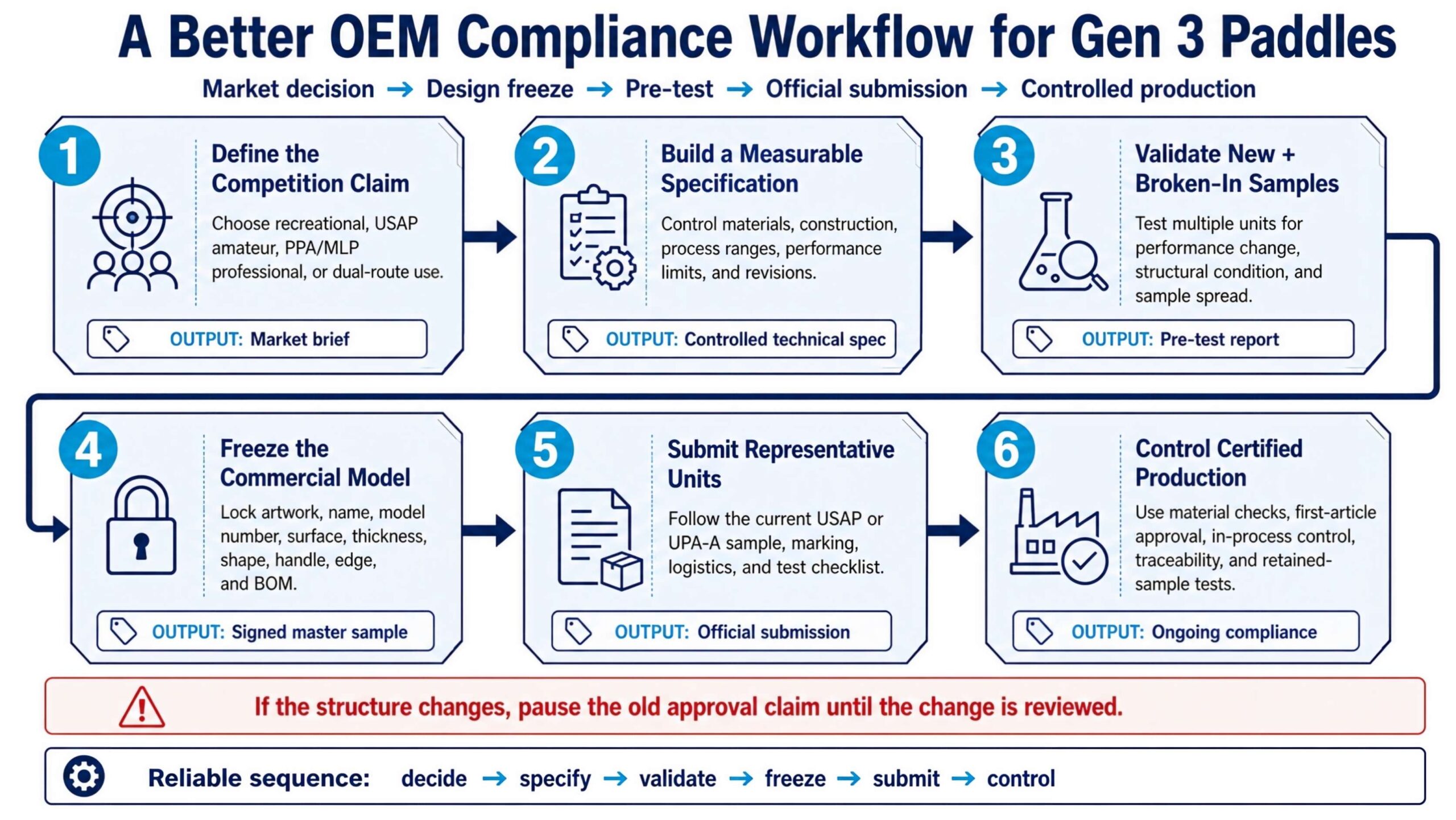
The most reliable sequence is market decision → design freeze → pre-test → official submission → controlled production, not “launch first and certify later.”
Phase 1: Define the Competition Claim
Decide whether the paddle is intended for recreational retail, USA Pickleball-sanctioned amateur play, professional PPA/MLP exposure, or more than one route. Put the required certification path in the product brief.
Phase 2: Build a Measurable Technical Specification
Replace “maximum power Gen 3 core” with controlled material, construction, process, and performance ranges. Include revision numbers so purchasing, engineering, the factory, and the testing body are referring to the same build.
Phase 3: Validate New and Broken-In Samples
Test multiple units before submission. Do not use an influencer demo or specially tuned sample as the sole reference. Review performance change, structural condition, and sample-to-sample spread.
Phase 4: Freeze the Commercial Model
Lock the final artwork, name, model number, surface process, thickness, shape, handle, edge system, and bill of materials. Keep a signed master sample and a controlled specification pack.
Phase 5: Submit Representative Units
Follow the current body-specific checklist. USAP and UPA-A have different sample, marking, logistics, and testing requirements. Do not assume approval from one program automatically replaces the other.
Phase 6: Control Production After Certification
Use incoming-material checks, first-article approval, in-process control, pilot-lot validation, lot traceability, and periodic retained-sample testing. If the structure changes, stop using the old approval as a blanket claim until the change has been reviewed.
Free 2026 Buyer Checklist
Planning a Gen 3 or Gen 4-style paddle launch? Use the Pickleball Paddle FTO & USAP/UPA-A Compliance Checklist to review architecture, patent clearance, certification, contract allocation, pilot production, and launch approval.
What the 2026 Enforcement Trend Means for Brands
Certification is becoming less like a one-time launch document and more like an ongoing production obligation.
USA Pickleball began introducing field-testing technology at amateur tournaments in 2026. UPA-A rules allow market purchases, laboratory compliance checks, onsite testing, confiscation for further review, and penalties or delisting when paddles do not match the certified model.
For a brand, this changes the value of compliance:
- A pass result is not permission to relax the production specification.
- Traceability matters when a field unit performs differently.
- A high-power design needs more—not less—process control.
- Engineering changes must be managed as certification events, not informal factory substitutions.
- The approved-list status should be checked throughout the product lifecycle.
The strongest commercial position is not “our Gen 3 paddle is as powerful as possible.” It is:
Our model delivers the intended performance with documented margin, controlled production, and a clear certification path.
That statement is more credible to distributors, sponsored players, retailers, and consumers—and it reduces the risk of returns, relabeling, stranded inventory, and reputation damage.
Final Answer: A Gen 3 Paddle Needs Both Performance Clearance and Patent Clearance
There is no category-wide U.S. tournament ban on Gen 3 pickleball paddle cores. But it is no longer sufficient to ask only whether a model can pass USAP or UPA-A testing.
What matters is the exact finished model:
- Has U.S. patent counsel compared its internal structure with the claims of the ’826, ’891, related continuation patents, and other relevant patent families?
- Does the design omit required claim limitations, or has the brand obtained an appropriate license?
- Does it meet the applicable power, spin, surface, dimension, and construction requirements?
- Does it remain compliant after break-in?
- Do production units match the submitted samples?
- Is the model currently listed by the organization governing the intended event?
- Are the certification mark and marketing claims used accurately?
For brands developing power pickleball paddles, performance compliance and patent clearance should be built into the core specification, process window, validation plan, territorial sales plan, and purchase order before mass production begins.
NexaPaddle can support specification development, production-representative sampling, technical disclosure, factory-side quality planning, and preparation for third-party submission. Final certification decisions remain with the governing body, and final FTO or infringement conclusions must come from qualified patent counsel.
Frequently Asked Questions
Are all Gen 3 pickleball paddles banned in the United States?
No. “Gen 3” is not a prohibited category. Some individual models have been removed or have failed certification, but other high-performance paddles remain eligible when the exact model passes the applicable standards and stays on the relevant approved list.
Is USA Pickleball approval legally required to sell a paddle in the U.S.?
Not generally. USA Pickleball approval determines eligibility for USA Pickleball-sanctioned competition; it is not a government market-access license. A seller may still have separate U.S. import, labeling, advertising, chemical-warning, and product-safety obligations.
What is the current USA Pickleball PBCoR limit?
The published USA Pickleball Equipment Standards Manual sets a PBCoR not-to-exceed value of u003cstrongu003e0.43 effective November 1, 2025u003c/strongu003e. Brands should verify the latest manual and notices immediately before design freeze and submission.
Does a USAP-listed paddle automatically qualify for professional PPA or MLP play?
No. UPA-A certification is required for professional PPA and MLP divisions in 2026. USAP-listed paddles remain accepted for amateur competition at UPA events according to UPA-A’s current guidance.
Can a factory use an existing approval for a new private-label Gen 3 model?
Only when the governing body’s similarity or model rules are satisfied. A different core, surface, thickness, shape, edge design, handle construction, or other performance-relevant change may require a unique model designation and new testing. Never assume that shared tooling or a similar appearance transfers certification.
Does changing a Gen 3 paddle to “Gen 4” avoid JOOLA’s patents?
Not by itself. Patent analysis follows the product’s physical elements and the wording of the claims, not its generation name. If the Gen 4 version still uses a core, gaps, fillers, and a frame in an arrangement covered by a valid claim, renaming the technology does not remove the risk. A documented claim chart and U.S. FTO opinion are needed.
Planning a Gen 3 Paddle Launch?
If you are moving from patent and compliance research into product development, compare construction, sampling and production options on the Gen 3 pickleball paddle OEM page. For tournament-readiness planning, review USA Pickleball compliance support.
Official Sources
- U.S. Patent No. 12,465,826, USPTO Patent Gazette
- U.S. Patent No. 12,357,891, Google Patents record and claims
- USITC Investigation No. 337-TA-1503 institution notice
- USITC announcement explaining that no merits decision has yet been made
- JOOLA and Paddletek Group settlement announcement nnnn
- JOOLA September 2026 patent-enforcement update nnnn
- JOOLA and Friday September 2026 settlement announcement
- USA Pickleball Equipment Standards Manual, Revision 3.0
- USA Pickleball Equipment Submission FAQ
- USA Pickleball statement on de-certified JOOLA paddles
- USA Pickleball statement on the Ronbus Ripple production samples
- USA Pickleball 2026 field-testing announcement
- UPA-A Paddle Rules, Version 26.4
- 2026 UPA-A certification information
- 2026 UPA-A certification checklist
This article is for product-development and sourcing education, not legal advice or a freedom-to-operate opinion. Patent claims, ownership, continuation applications, litigation status, equipment standards, fees, and tournament policies can change. Have qualified U.S. counsel review the final product and current official records before importation, sale, or publication of a clearance claim.