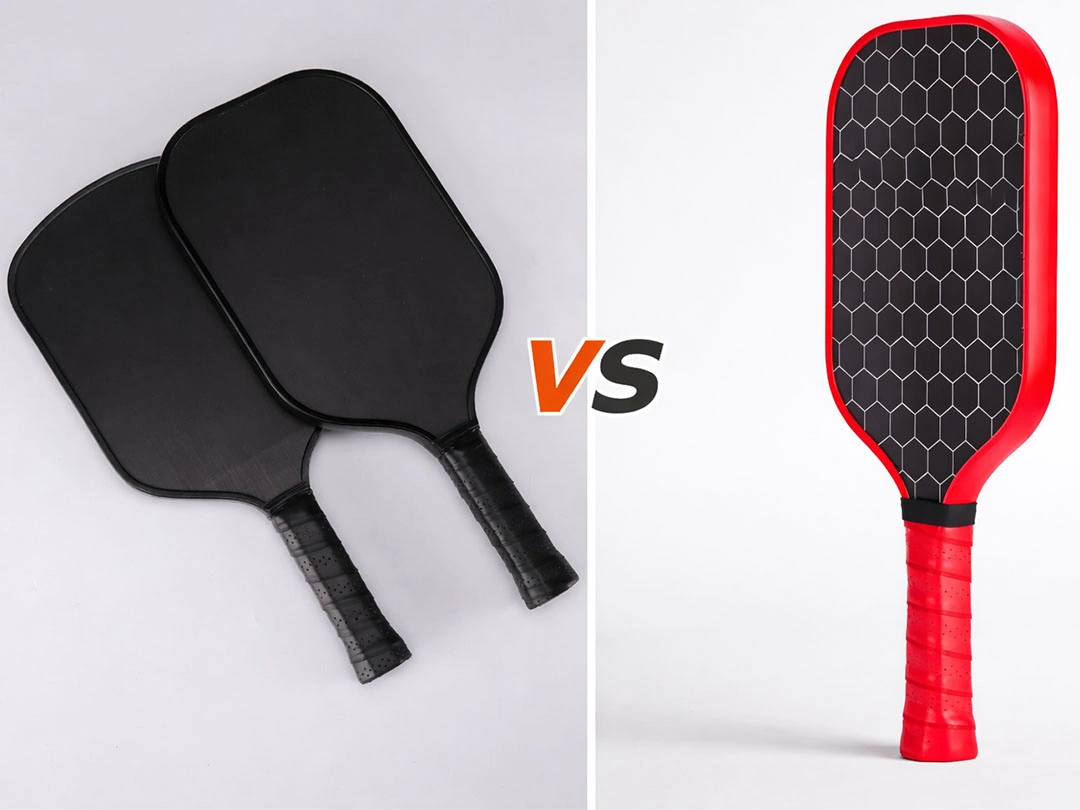
Introduction: Why Carbon Grade Decisions Are Brand Decisions
When you’re specifying a new pickleball paddle line, one of the most consequential choices you’ll make sits long before color selection or logo placement: which carbon fiber grade goes on the hitting face.
Get it right, and your paddles feel premium at every price tier. Get it wrong, and you’re either leaving margin on the table or launching a “flagship” that feels like entry-level.
This guide is written specifically for brand owners, Amazon FBA sellers, wholesalers, and retailers working with OEM paddle factories. We’ll break down the two most important carbon fiber axes — tensile grade (T300/T700/T800) and weave density (3K/12K/18K) — and show you exactly how to map them to your product tiers.
Part 1: Tensile Grade — T300, T700, T800
Carbon fiber “T-grade” refers to the tensile strength and modulus of the fiber itself. Higher T-number = higher stiffness and strength per fiber. For paddle faces, this translates directly into responsiveness, pop, and feel.
T300 — Entry-Level Carbon
Tensile Strength: ~3,530 MPa
Feel: Soft, dampened, forgiving
Best for: Entry-level paddles, beginner lines, price-competitive SKUs
T300 is the most widely used industrial carbon fiber globally — it’s in everything from automotive panels to consumer electronics. In pickleball paddles, it produces a softer, more muted feel. Players transitioning from fiberglass often prefer T300 carbon because it’s not a dramatic jump in stiffness.
OEM Application: If your brand is launching a sub-$79 MSRP paddle that needs to carry “carbon fiber” in the marketing copy without the premium price point, T300 is your material. It passes the visual test (black carbon face) while keeping BOM costs low.
NexaPaddle product fit: Cold press carbon UD/3K line (Product 1.2) — available in 13mm and 16mm core thicknesses, MOQ 300 pcs.
T700 — The Industry Standard for Mid-to-Premium Paddles
Tensile Strength: ~4,900 MPa
Feel: Responsive, crisp, punchy — the benchmark “carbon feel”
Best for: Mid-tier ($89–$149 MSRP), hero SKUs, USAPA-listed paddles
T700 is the workhorse of the professional pickleball market. The majority of USAPA-approved paddles in competitive play use T700 carbon fiber faces. The tensile properties hit a sweet spot: stiff enough to generate real power and spin, compliant enough to maintain feel and control.
At NexaPaddle, T700 is the standard specification for all Tier 2 thermoformed paddles — including Molds #3, #5, and #7. When brands want a thermoformed paddle that can be positioned as “pro-level” or “tour-proven,” T700 is the default starting point.
OEM Application: Your hero SKU — the one that drives reviews, repeat purchases, and brand reputation — should be built on T700 carbon. It’s the material that justifies the $119–$149 MSRP range and can withstand the scrutiny of serious players.
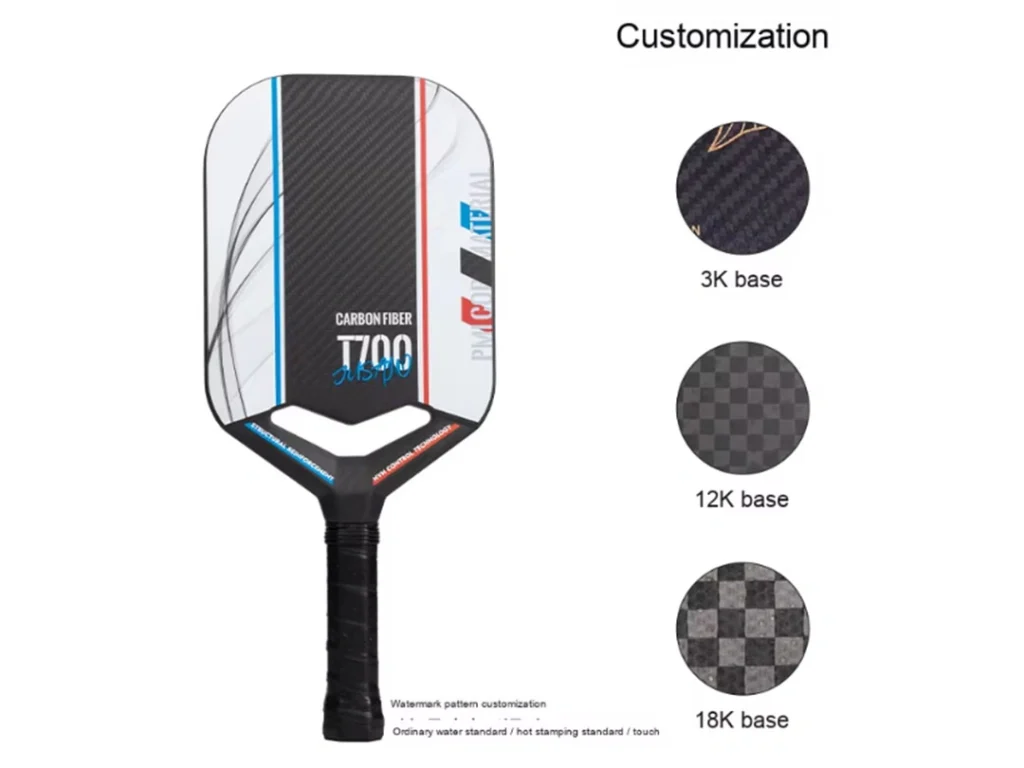
Key NexaPaddle T700 Products:
- Mold #3 — Edgeless power frame, 417×188mm, thermoformed
- Mold #5 — Extended 145mm handle, 415×185mm, T700
- Mold #7 — Hot Press Forged, 13.5–14mm or 16mm, 420–425mm length (flagship mid-tier)
- GEN3 Core 2.0 — T700, 417×188mm, 149mm extended handle
👉 Explore NexaPaddle’s T700 Carbon Fiber Paddles lineup.
T800 — Flagship Performance Carbon
Tensile Strength: ~5,490 MPa
Feel: Maximum stiffness, explosive response, elite spin potential
Best for: Flagship SKUs ($169+ MSRP), performance-first brands, pro partnerships
T800 is the top tier of commercially available carbon fiber in paddle manufacturing. The increased tensile modulus means the face deflects less on impact — transferring more energy back to the ball. For power-oriented brands or spin-focused lines, T800 delivers measurable, marketable performance differences.
NexaPaddle’s T800 + Titanium Thread paddle (Product in Tier 3 Specialty) combines T800 carbon weave with titanium fiber integration for maximum surface grit and spin generation — paddle dimensions 413×195mm. The GEN5 Gatling takes it further with T800 + Teflon-weave construction for the ultimate in surface texture durability.
OEM Application: If you’re positioning against $200+ paddles and your audience includes competitive club players or sponsored athletes, T800 justifies a premium story. The cost premium over T700 is real but proportionate to the MSRP lift it enables.
👉 See NexaPaddle’s T800 Carbon Pickleball Paddles Wholesale range.
Part 2: Weave Density — 3K, 12K, 18K
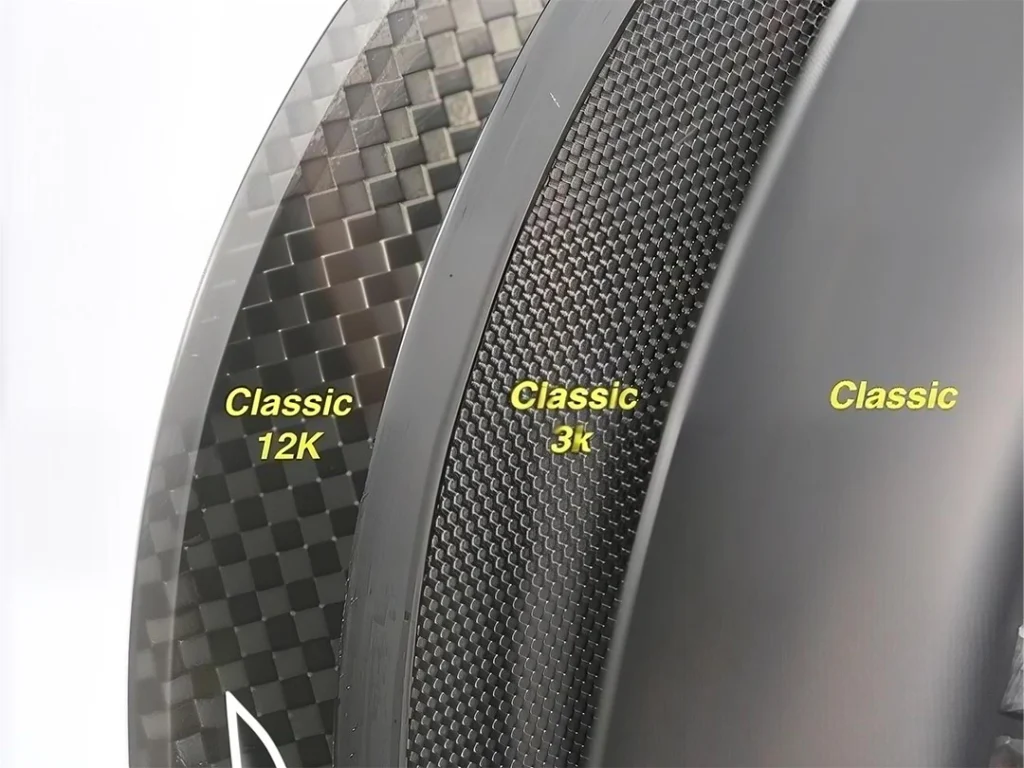
Weave density describes the number of carbon filaments per fiber bundle. This determines the surface texture, visual appearance, and playing characteristics of the face material.
3K Carbon — Control and Precision
Bundle size: 3,000 filaments per tow
Weave: Fine, tight pattern — visible small squares
Playing feel: Controlled, soft-touch, precision-oriented
Best for: Control paddles, touch-game specialists, third-shot drop artists
The 3K weave produces a smoother surface with a fine crosshatch pattern. The smaller bundle size means more weave intersections per square inch — this creates a slightly more “grippy” surface feel without aggressive grit. Players who live at the kitchen line and value soft hands prefer 3K.
From a branding perspective, 3K has excellent visual appeal — the tight, even diamond pattern looks premium in product photography.
OEM positioning: Control-focused SKUs, “touch paddle” positioning, players who prioritize the short game.
12K Carbon — All-Around Performance
Bundle size: 12,000 filaments per tow
Weave: Medium-coarse pattern
Playing feel: Balanced power and control — the “do-everything” face
Best for: All-around paddles, broadest market appeal
12K is the most commercially versatile carbon weave. The larger bundle size creates a slightly coarser surface texture that provides more topspin potential than 3K while maintaining reasonable feel. Most mass-market carbon paddles in the $89–$129 range use 12K faces.
If you’re launching a single-SKU product line or need one paddle to appeal to the widest possible audience, 12K is the safe, correct choice.
OEM positioning: Hero SKU, all-around positioning, Amazon best-seller category play.
18K Carbon — Power and Spin
Bundle size: 18,000 filaments per tow
Weave: Coarse, pronounced texture
Playing feel: Maximum surface grit, aggressive spin, stiff and powerful
Best for: Power paddles, spin machines, competitive attackers
The 18K weave produces a visibly coarser surface that grips the ball more aggressively. This translates to higher spin RPM on serves and drives. The larger bundle size also creates a stiffer face overall — contributing to power alongside the grit advantage.
One important evolution: 3D 18K carbon uses a three-dimensional weave structure that builds surface texture directly into the fiber architecture. Unlike surface coatings (which wear off after heavy use), 3D 18K grit is structural — it doesn’t degrade the same way.
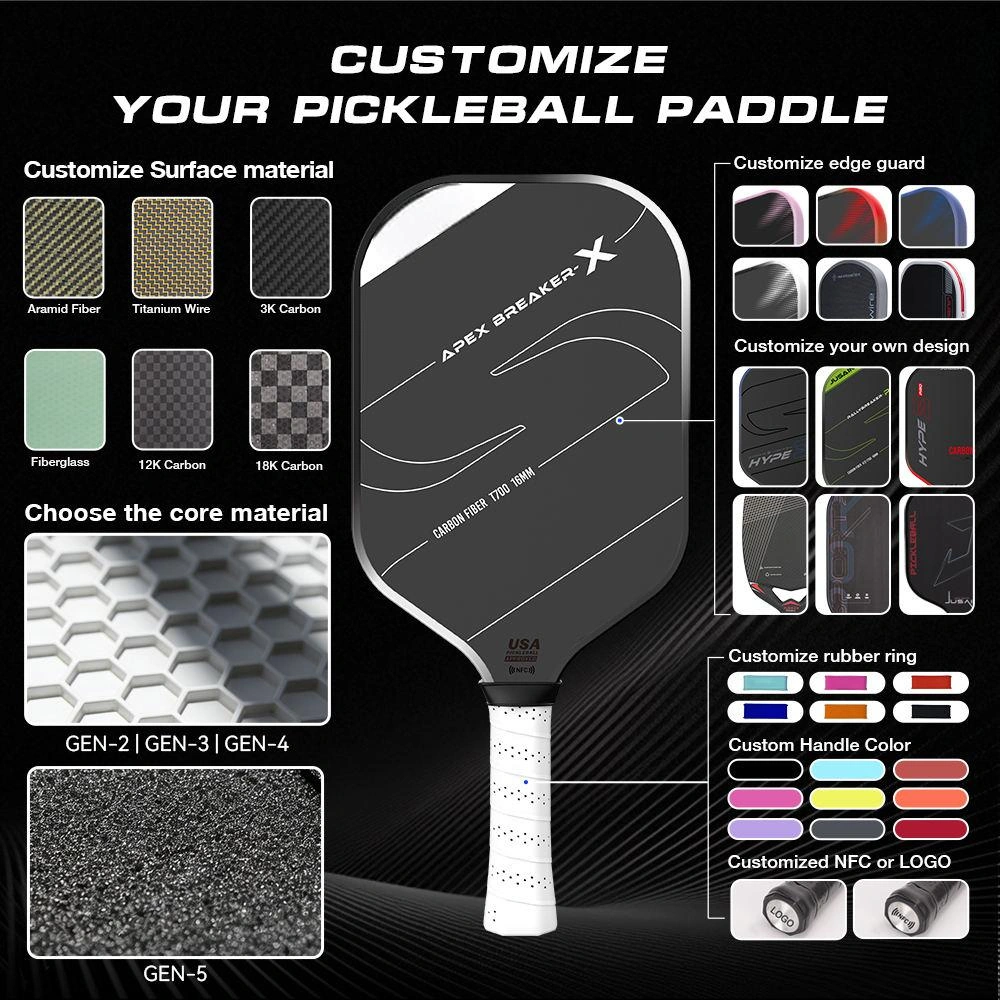
OEM positioning: Spin-first brands, competitive player targeting, “grit that lasts” marketing angle.
👉 Explore NexaPaddle’s Spin Pickleball Paddles for 18K and 3D-weave options.
Part 3: Combining Grade and Weave — Your SKU Mapping Framework
The two axes interact. Here’s the complete decision matrix:
| Tier | T-Grade | Weave | Core | MSRP Range | NexaPaddle Product |
|---|---|---|---|---|---|
| Entry | T300 | 3K | 13–16mm cold press | $49–$79 | Product 1.2 (Cold Press Carbon) |
| Mid | T700 | 12K | 14–16mm thermoformed | $89–$129 | Mold #2, Mold #3 |
| Hero | T700 | 12K or 3K | 13.5–14mm thermoformed | $119–$149 | Mold #7 Hot Press Forged |
| Power | T700 | 18K or 3D 18K | 13–14mm thermoformed | $129–$169 | Mold #7 (18K variant), Foam Filled GEN4 |
| Flagship | T800 | 3D 18K | 13–14mm specialty | $169–$229+ | T800+Ti Thread, GEN5 Gatling |
Part 4: Process Matters as Much as Material
The carbon fiber grade is only one variable. How the face is bonded to the core is equally important:
Cold Press
Face sheets are pressed onto the honeycomb core at room temperature with adhesive. Fast, low-cost, MOQ-friendly (300 pcs at NexaPaddle). The face and core behave somewhat independently — resulting in a softer, more dampened feel. Best for entry and mid tiers.
Thermoforming
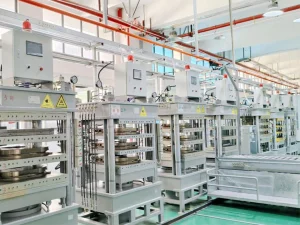
The entire paddle — face, core, and edge band — is formed under heat and pressure as a single unit. This creates unibody stiffness: the face and core vibrate as one, producing the characteristic “pop” that players associate with premium carbon paddles. Required for any paddle you’re positioning as performance or pro-level.
NexaPaddle’s thermoforming projects should control surface finish, construction and power-related performance against the buyer-approved specification and the applicable governing-body requirements. NexaPaddle does not publish verified company-wide Rt or PBCoR internal thresholds for every thermoformed model.
👉 Learn more about NexaPaddle’s Thermoformed Pickleball Paddles process.
Hot Press Forging
A specialized thermoforming variant used in NexaPaddle’s Mold #7. The forging process creates a denser, more uniform face consolidation — the highest consistency of any production method. Ideal for hero SKUs where batch-to-batch consistency is critical.
Part 5: Common Spec Mistakes Brand Owners Make
1. Specifying T700 but accepting cold press construction
T700 cold press paddles feel underwhelming because the construction method (cold press) neutralizes the material’s stiffness advantages. T700’s performance shines in thermoformed construction. If your factory offers “T700 cold press,” either accept the feel compromise or upgrade the process.
2. Assuming 18K = better for everyone
18K is optimized for power and spin. Players who value touch and soft hands — recreational players, kitchen-line specialists — will often prefer 12K or 3K. Don’t 18K your entire lineup just because it sounds more technical.
3. Not locking face spec post-approval
If your paddle is USAPA-listed, any change to the face material, weave, or bonding process requires re-evaluation. A “minor supplier swap” from 12K to 18K on an approved model creates compliance risk. Lock your spec at the factory level.
4. Conflating surface coating with weave texture
Some factories apply surface coatings to simulate grit on smooth faces. This wears off. Structural grit from 3D 18K weave architecture doesn’t. Know what you’re buying.
FAQ
u003cstrongu003eWhat’s the difference between T700 and T700S carbon fiber?u003c/strongu003e
T700S is Toray’s commercial designation for standard T700 grade. In the paddle industry, “T700” and “T700S” refer to the same performance category. When evaluating factory quotes, confirm which specific fiber supplier they source from if batch consistency is critical.
u003cstrongu003eCan I mix T700 face with a foam core instead of PP honeycomb?u003c/strongu003e
Yes. NexaPaddle’s GEN4 Foam Filled paddle uses EPP foam core with a T700 thermoformed face. The foam core adds vibration dampening and edge weight distribution while the T700 face maintains pop. This is a specific performance profile — not universally better, but excellent for power-oriented brands.
u003cstrongu003eDoes higher tensile grade always mean higher USAPA bounce (PBCoR)?u003c/strongu003e
Not automatically. PBCoR is influenced by face stiffness, core thickness, and construction method together. A T800 face on a thick 16mm core may have lower PBCoR than a T700 face on a 13mm thermoformed core. Always test actual paddles, not just spec sheets.
u003cstrongu003eWhat MOQs should I plan for when speccing different carbon grades?u003c/strongu003e
At NexaPaddle: cold press carbon (T300/T700) starts at MOQ 300 pcs. Thermoformed T700 lines start at MOQ 100 pcs. Tier 3 specialty (T800+Ti, GEN5) — contact for MOQ as these involve specialty fiber sourcing.
u003cstrongu003eIs 3D 18K carbon the same as “toray raw carbon”?u003c/strongu003e
No. “Raw carbon” typically refers to an uncoated woven carbon face (any weave density) without paint or film overlay — the carbon texture is visually exposed. 3D 18K refers specifically to a three-dimensionally woven fiber structure with built-in surface relief. They’re different properties; a paddle can be both raw carbon AND 3D 18K simultaneously.
If carbon-grade selection is one part of a broader supplier evaluation, review NexaPaddle’s pickleball paddle manufacturer and factory overview for company, production-footprint and sourcing context.
nnnnFor buyers building a multi-SKU retail or distribution assortment, use the wholesale pickleball paddles sourcing hub to compare product-base, MOQ, sampling, packaging and reorder requirements.
nnnReady to Spec Your Next Carbon Paddle Line?
NexaPaddle manufactures carbon fiber pickleball paddles across all T-grades and weave densities — from cold press entry-level to T800 flagship specialty. Our engineering team will help you match material spec to your target market, price tier, and USAPA compliance needs.
If you are moving from research into a production brief, use the OEM pickleball paddle development hub to compare construction routes, sampling, tooling, packaging, and project-specific requirements.
👉 Request a quote or samples — include your target MSRP, player audience, and volume, and we’ll recommend the right carbon specification for your brand.
See also: OEM Carbon Fiber Pickleball Paddle Factory | Raw Carbon Pickleball Paddles