Every pickleball brand owner, wholesaler, and Amazon FBA seller eventually faces the same foundational decision: which paddle material do I build my product line around?
The short answer is that you should probably build around both — and understanding precisely why is the key to constructing a product matrix that maximizes revenue across multiple customer segments. The longer answer is what this guide is for.
Carbon fiber and fiberglass are not interchangeable. They serve different players, command different price points, move through different retail channels, and require different manufacturing processes. Get the material mix right and you have a self-reinforcing product ecosystem: fiberglass captures volume at the entry level, carbon fiber drives margin and brand equity at the mid-to-premium tier. Get it wrong and you’re either leaving margin on the table or fighting a losing price war in the wrong segment.
This guide pulls directly from NexaPaddle’s factory floor knowledge to give you the honest, spec-grounded breakdown that B2B buyers need — before they submit their first purchase order.
What Are These Materials, Actually?
Before we talk price, performance, and product strategy, it’s worth spending two minutes on the material science. Not academic theory — just the practical facts that explain why each material behaves the way it does on court.
Fiberglass
Fiberglass composite paddle faces are made from randomly oriented glass fibers embedded in a polymer resin matrix. The word “randomly” is important here: because the fibers run in multiple directions, the face distributes stress multi-directionally. This gives fiberglass its characteristic multi-directional flexibility — the paddle face deflects slightly when the ball makes contact, storing and releasing energy in a forgiving, cushioned manner.
The practical result? A “trampoline” effect that is very forgiving for off-center hits. Beginners love it because the ball still travels reasonably well even when they mis-hit. The vibration damping profile is also excellent — fiberglass absorbs medium-frequency vibrations in the 50–200Hz range, making it easy on the arm and wrist during long sessions.
Carbon Fiber
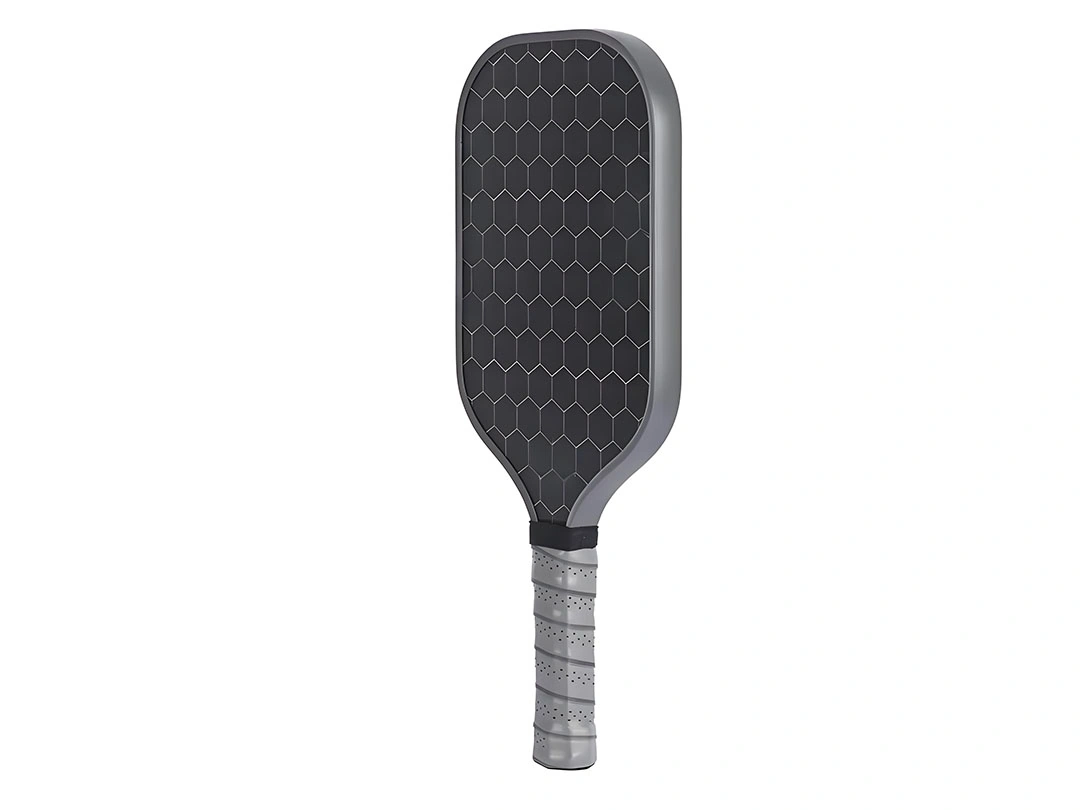
Carbon fiber paddle faces are constructed from ultra-thin carbon strands woven into a tight matrix and bonded with epoxy resin. Unlike fiberglass, carbon fiber has high directional stability — the woven structure channels force along predictable axes rather than dispersing it randomly. The result is faster, more direct energy transfer when the ball contacts the paddle face.
In performance terms: more pop, faster ball exit speed, greater stiffness-to-weight ratio. Carbon fiber also transmits higher-frequency vibrations (200–500Hz) more directly than fiberglass, which is why experienced players describe it as having a crisper, more feedback-rich feel — though this can also mean more arm fatigue if the paddle isn’t properly designed with core dampening.
The Key Trade-Off
| Property | Fiberglass | Carbon Fiber |
|---|---|---|
| Fiber orientation | Random (multi-directional) | Woven / unidirectional (directional) |
| Energy transfer | Gradual, forgiving | Fast, direct |
| Vibration profile | Dampens 50–200Hz | Transmits 200–500Hz |
| Feel | Soft, cushioned | Crisp, responsive |
| Durability failure mode | Gradually loses elasticity | May develop micro-cracks under stress |
Both materials are durable and proven at scale. Understanding their failure modes matters for warranty planning — fiberglass paddles tend to “die slowly” (gradually losing pop), while carbon fiber paddles can fail more suddenly from impact stress on the face.
Head-to-Head Performance Comparison
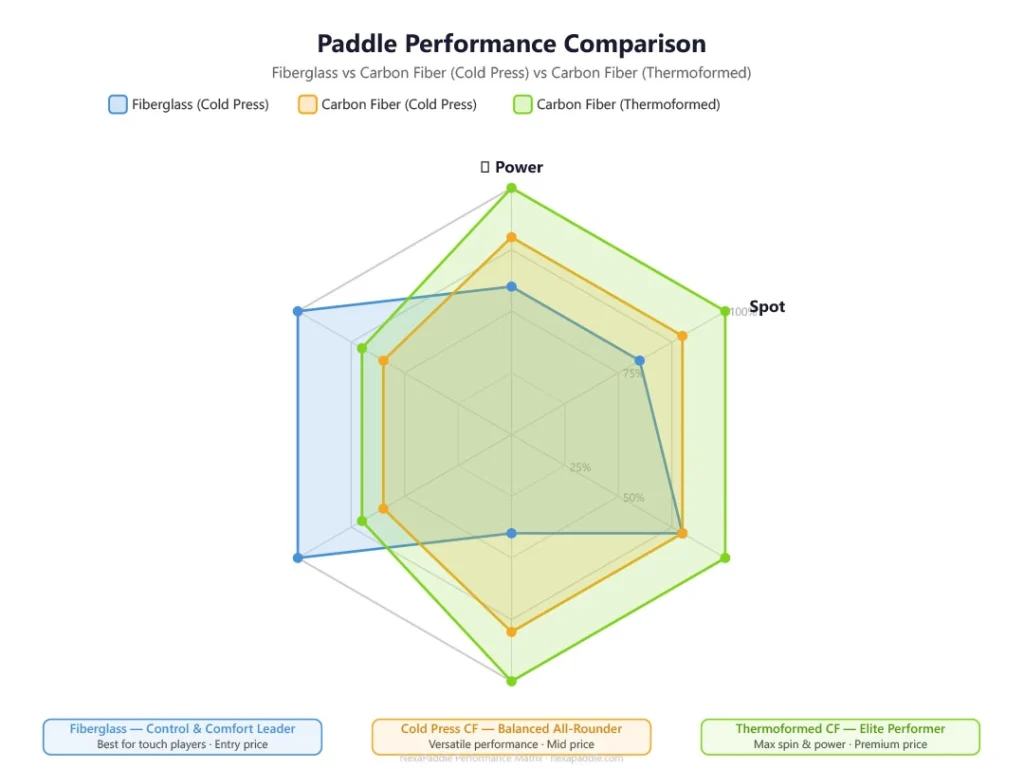
Here’s the full performance matrix, using NexaPaddle’s actual product specifications as the reference point:
| Performance Factor | Fiberglass (Cold Press) | Carbon Fiber (Cold Press) | Carbon Fiber (Thermoformed) |
|---|---|---|---|
| Power / Pop | Good — high elasticity from glass fibers | Better — 8–12% faster ball exit speed | Best — maximum energy return, unibody construction |
| Control / Touch | Excellent — forgiving on mis-hits | Good — stiffer, requires more precision | Good — larger sweet spot compensates for stiffness |
| Spin Potential | Moderate — smooth surface limits texture | High — UD and 3K weave creates natural texture | Highest — T700/T800 raw surface generates 2,300+ RPM |
| Sweet Spot Size | Standard | Larger — even energy distribution | Largest — 15–20% larger than cold press |
| Vibration / Arm Comfort | Excellent — dampens mid-frequency vibration | Good — stiffer, some additional vibration | Varies — depends on core; EPP foam significantly reduces vibration |
| Durability | High — gradual elasticity loss over time | High — risk of micro-cracking on impact | Very High — unibody construction resists delamination |
| Weight Range | 220–245g (7.7–8.6 oz) | 210–235g (7.4–8.3 oz) | 205–230g (7.2–8.1 oz) |
| Price Tier | Entry level | Mid level | Premium to Premium+ |
A Note on Carbon Fiber Variants
Not all carbon fiber is equal, and the specific grade matters significantly to your product story and price positioning:
- T700 Unidirectional (UD): Softer feel, control-focused, excellent spin from peel-ply surface texture. The industry baseline for competition-grade paddles and the face material of choice for T700 carbon fiber paddles in the mid-to-premium tier.
- 3K Woven: A classic woven aesthetic, stiffer than UD, more pop, larger sweet spot — the “middle ground” between feel and power.
- 3D 18K: A complex multi-angle weave that combines structural spin generation with maximum durability and the largest effective sweet spot.
- T800 + Titanium Thread: The premium tier. Aerospace-grade carbon interwoven with titanium delivers maximum spin and power without sacrificing surface texture for top-spin drives.
For B2B purposes, this variant ladder maps directly to your price architecture: T700 cold press for mid-tier, T700/3K thermoformed for premium, T800 for flagship.
Cost and Manufacturing Analysis: The B2B Core
This is where the material comparison stops being academic and starts being about your margin.
Manufacturing Process: Cold Press vs. Thermoformed
The single biggest cost driver in paddle manufacturing is not the face material — it’s the manufacturing process.
Cold Press (both fiberglass and carbon fiber):
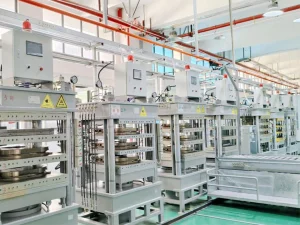
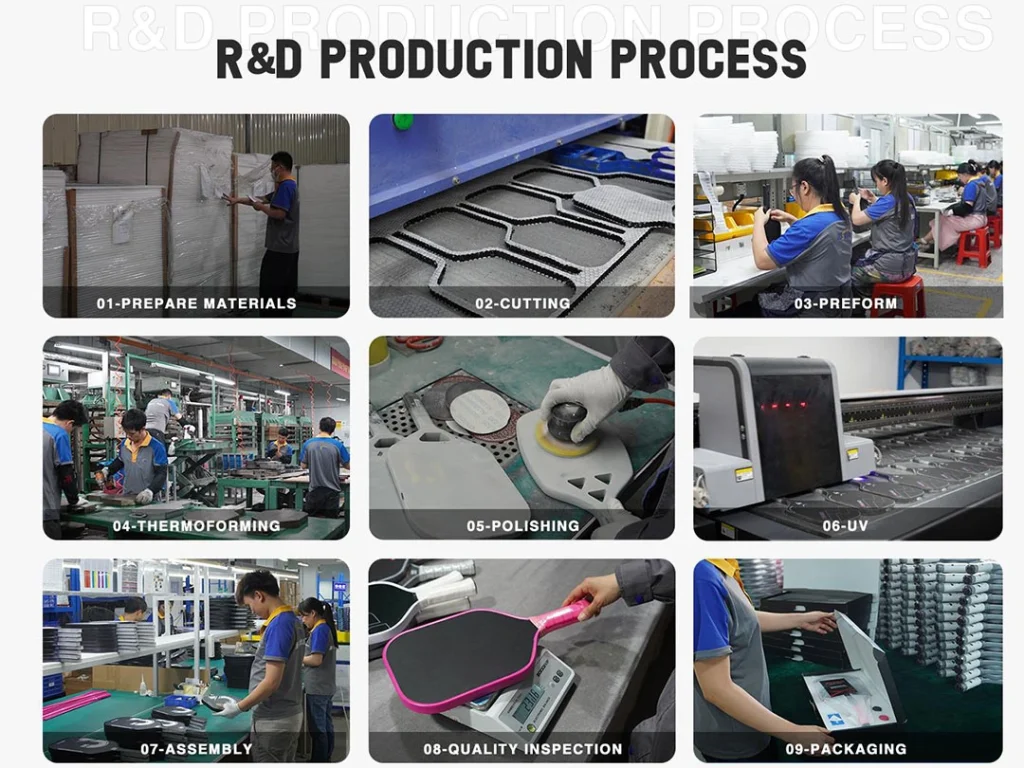
Cold press molding bonds the face sheet to the PP honeycomb core using structural adhesives, then applies high pressure at ambient temperature. No heating or cooling cycles. High throughput, cost-effective, highly scalable. This is the process behind both NexaPaddle’s fiberglass paddles and its cold press carbon fiber series.
Thermoformed (advanced carbon fiber):
The thermoformed process — also called hot press — applies heat and sustained pressure simultaneously, fusing the face material, core, and edge structure into a single-piece (“unibody”) construction. The carbon fiber runs continuously through the handle, eliminating adhesive bond points and dramatically increasing structural integrity and sweet spot size. Thermoformed pickleball paddles represent the premium manufacturing tier.
The cost difference is meaningful:
| Manufacturing Factor | Cold Press (Fiberglass) | Cold Press (Carbon Fiber) | Thermoformed (Carbon Fiber) |
|---|---|---|---|
| Process | Adhesive bonding under pressure | Adhesive bonding under pressure | Heat + pressure, single-piece fusion |
| Energy / Cycle Time | Low | Low | Higher — heating + cooling cycles |
| Throughput | High | High | Lower |
| Face-to-core bond | Adhesive | Adhesive | Molecular fusion |
| MOQ (NexaPaddle) | 300 pieces | 300 pieces | 100 pieces |
| Est. FOB Cost Range* | $8–$15/unit | $15–$28/unit | $28–$55/unit |
| Target Retail Range | $25–$60 | $60–$130 | $130–$280+ |
| Est. Gross Margin | 55–70% | 55–70% | 60–75% |
*FOB cost estimates are approximate and vary based on volume, customization, raw material market conditions, and specifications.
The MOQ Asymmetry: A Critical Detail
One detail that catches many new buyers off-guard: the lower end of the thermoformed carbon fiber tier actually carries a lower MOQ than cold press.
- Cold press fiberglass and carbon fiber: 300 pieces minimum
- Thermoformed carbon fiber: 100 pieces minimum
This counterintuitive dynamic exists because thermoformed paddles are typically sold through more specialized channels (direct-to-consumer, specialty sports retailers, premium brand launches), where buyers need flexibility to test SKUs without large capital commitment. The 100-piece MOQ for thermoformed is specifically designed for brand owners testing a new paddle design before scaling.
Material Cost Hierarchy
From lowest to highest raw material cost per unit:
- Fiberglass composite sheet (lowest)
- Carbon fiber UD / 3K (cold press)
- T700 carbon fiber (thermoformed)
- T800 carbon fiber (thermoformed)
- T800 + Titanium / Kevlar-Aramid blends (highest)
Core materials add another layer: PP honeycomb is the baseline, followed by GEN3, GEN4 EPP foam, and GEN5 as you move up the performance ladder.
Margin Analysis: Volume Play vs. Margin Play
The strategic insight here is simple but powerful:
Fiberglass = volume play. Lower FOB, lower retail price, higher throughput. Win with unit volume, institutional buyers, bundle sets, big-box retail placement, and market penetration.
Carbon fiber = margin play. Higher FOB, higher retail price, stronger brand equity. Win with per-unit margin, direct-to-consumer sales, Amazon mid-to-premium tier, and repeat upgrade purchases.
A well-constructed B2B product line deploys both strategies simultaneously.
Target Audience Mapping: Who Buys What
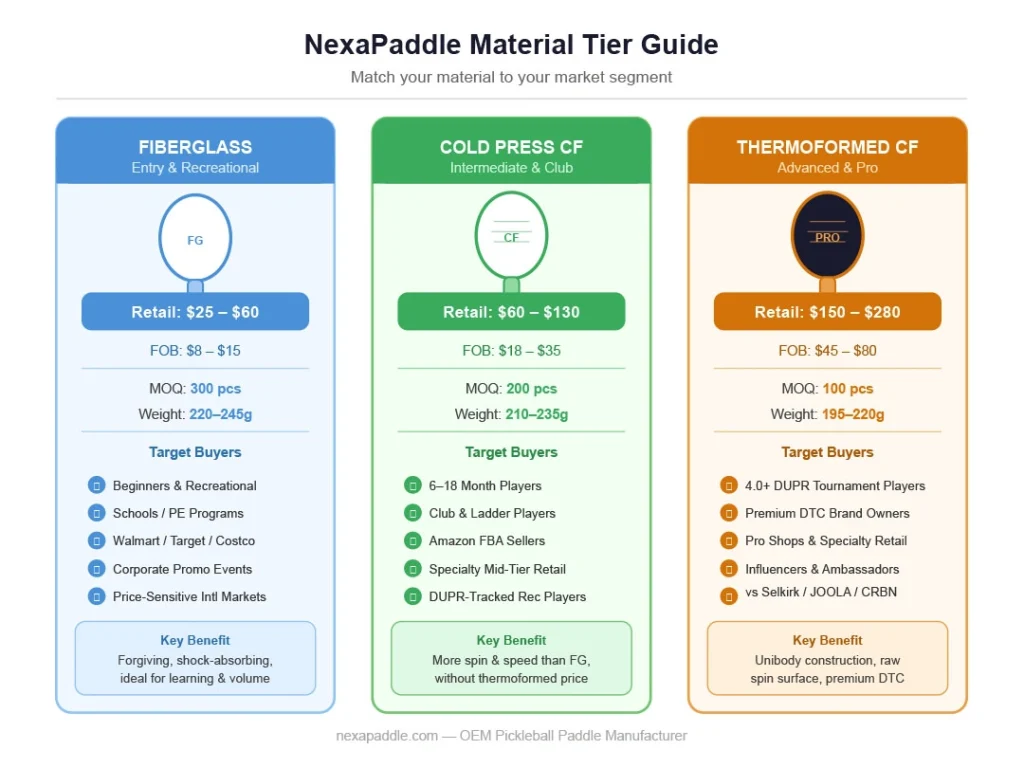
Material choice only makes strategic sense when it’s matched to the actual buyer at the end of the supply chain. Here’s how NexaPaddle maps materials to market segments:
Fiberglass: The Entry & Recreational Market
Who they are:
- True beginners picking up the sport for the first time
- Recreational players who play once or twice a week and prioritize fun over performance
- School PE programs purchasing loaner or tournament paddle sets
- Corporate event organizers buying branded paddles as promotional items
- Big-box retail buyers at Walmart, Target, Costco seeking volume SKUs
- Price-sensitive markets outside the US (Southeast Asia, Latin America, Eastern Europe)
Why fiberglass works for them:
Fiberglass’s forgiving nature and excellent shock absorption make it the ideal learning tool. Players who aren’t sure whether they’ll stick with the sport are unwilling to spend $100+ on equipment. The 220–245g weight range is comfortable across a wide demographic. And at FOB prices of $8–$15, the retail economics work at price points where volume sells itself.
For brand owners targeting this segment, the 300-piece MOQ is the accessible on-ramp. Explore fiberglass composite pickleball paddles to see the full range of cold press options.
Cold Press Carbon Fiber: The Intermediate & Club Market
Who they are:
- Players who’ve been playing 6–18 months and are ready to invest in better equipment
- Club players who compete in local ladders and DUPR-tracked recreational matches
- Amazon FBA sellers targeting the $60–$130 bracket — the single highest-volume price band for branded paddles
- Specialty retailers building out their mid-tier shelf
Why cold press carbon works for them:
This segment wants real performance — more spin, more power, faster ball speed — without paying the premium price of a thermoformed paddle. Cold press carbon fiber pickleball paddles hit the sweet spot: meaningfully better than fiberglass, meaningfully more accessible than thermoformed. The 210–235g weight range is lighter than fiberglass, which intermediate players perceive as a quality upgrade.
Thermoformed Carbon Fiber: The Advanced & Pro Market
Who they are:
- Competitive players rated 4.0+ DUPR who play in sanctioned tournaments
- Athletes comparing your brand against Selkirk, JOOLA, and CRBN
- Premium brand owners building DTC brands in the $150–$280 retail tier
- Specialty pickleball retailers and pro shops
- Influencers and ambassador teams who showcase gear on social media
Why thermoformed carbon works for them:
Performance, period. The unibody construction, larger sweet spot, raw surface texture for spin, and premium aesthetics (edgeless designs, water decal graphics) justify the price point for this buyer. For B2B purposes, the 100-piece MOQ enables premium brand launches with limited capital risk.
Building Your Product Matrix: The Good-Better-Best Strategy
The most resilient B2B product lines in pickleball don’t sell a single paddle — they sell a system. Here’s how to construct one using both materials.
The “Good-Better-Best” Framework
| Tier | Face | Core | Process | Retail Target | Channel Fit |
|---|---|---|---|---|---|
| Good | Fiberglass | PP Honeycomb | Cold Press | $25–$60 | Big-box, bundles, institutional |
| Better | Carbon Fiber UD/3K | PP Honeycomb | Cold Press | $60–$130 | Amazon FBA, sporting goods retail |
| Best | T700/T800 Carbon Fiber | GEN3–GEN5 | Thermoformed | $130–$280+ | DTC, specialty retail, premium brand |
Suggested 4–6 SKU Lineup
A practical launch lineup that covers the full market without over-extending:
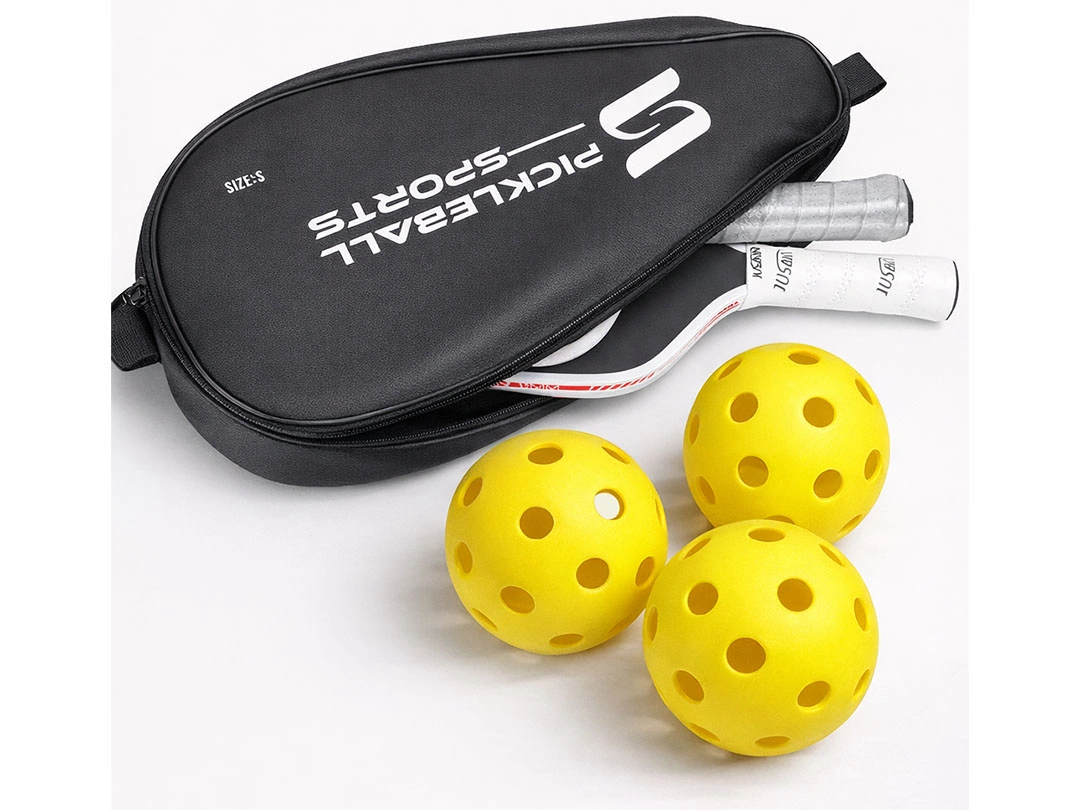
- Entry Fiberglass Bundle Set — 2 fiberglass paddles + 4 balls + nylon bag (retail $35–$55). Highest volume, lowest barrier, customer acquisition SKU.
- Recreational Fiberglass Single — 1 paddle, custom branding, 13mm or 16mm thickness (retail $30–$45). Shelf staple for big-box channels.
- Mid-Tier Carbon Fiber (Control Shape) — Cold press UD carbon, 13mm PP honeycomb, 400×195mm (retail $65–$90). Amazon best-seller tier.
- Mid-Tier Carbon Fiber (Power Shape) — Cold press 3K carbon, 16mm PP honeycomb, 417×188mm (retail $80–$110). Intermediate upgrade path.
- Premium Thermoformed T700 — Thermoformed, GEN3 or GEN4 core, edgeless option (retail $130–$180). Brand flagship, drives credibility.
- Pro Thermoformed T800 — Thermoformed, GEN5 Gatling core, water decal graphics (retail $180–$250+). Competition tier, social proof anchor.
Using Fiberglass as Customer Acquisition and Carbon Fiber as Upsell
The most powerful dynamic in this matrix is the upgrade path. A buyer who enters your brand at the fiberglass tier is a warm prospect for your carbon fiber tier six to twelve months later — if you’ve built brand trust at the entry level.
This is why the quality of your fiberglass paddle matters more than many buyers assume. A substandard entry paddle earns you a bad review, a return, and a lost customer. A well-manufactured fiberglass paddle earns you a customer who trusts your brand when they’re ready to spend $100.
The financial logic: your fiberglass SKU has a marketing cost built in (it’s your lowest-margin acquisition vehicle). Your carbon fiber SKU is where you recapture that cost with margin.
Private Label and Customization Options
Both material tiers support full private label customization at NexaPaddle. For cold press fiberglass and carbon fiber (300-piece MOQ), this includes full-color UV printing, custom grip colors, branded end caps, and retail packaging design. For thermoformed carbon fiber (100-piece MOQ), options expand to include water decal graphics, edgeless construction, adjustable grit spray surface treatment, and premium retail box design.
Brands looking to establish a strong visual identity across multiple price tiers can explore private label paddles and custom OEM pickleball paddles to understand the full scope of what’s possible.
Beyond the Face: Core and Construction Matter Too
Material selection doesn’t end at the face. Your core choice is the other half of the performance equation — and it directly affects your cost structure.
Core Options and Their Role
PP Honeycomb Core (Standard)
The industry workhorse. Polypropylene honeycomb provides a reliable, cost-effective balance of power and control across both fiberglass and cold press carbon fiber paddles. NexaPaddle uses PP honeycomb as the standard core in its cold press series, available in 10mm, 13mm, and 16mm thicknesses. Thinner cores (10mm) tend toward power; thicker cores (16mm) toward control and feel.
GEN3 Honeycomb Core (Advanced)
An engineered evolution of PP honeycomb. GEN3 cores deliver enhanced elasticity and improved pop response, making them the right choice for buyers building out their mid-range carbon fiber series. Often paired with T700 thermoformed construction.
GEN4 EPP Foam Core (Premium)
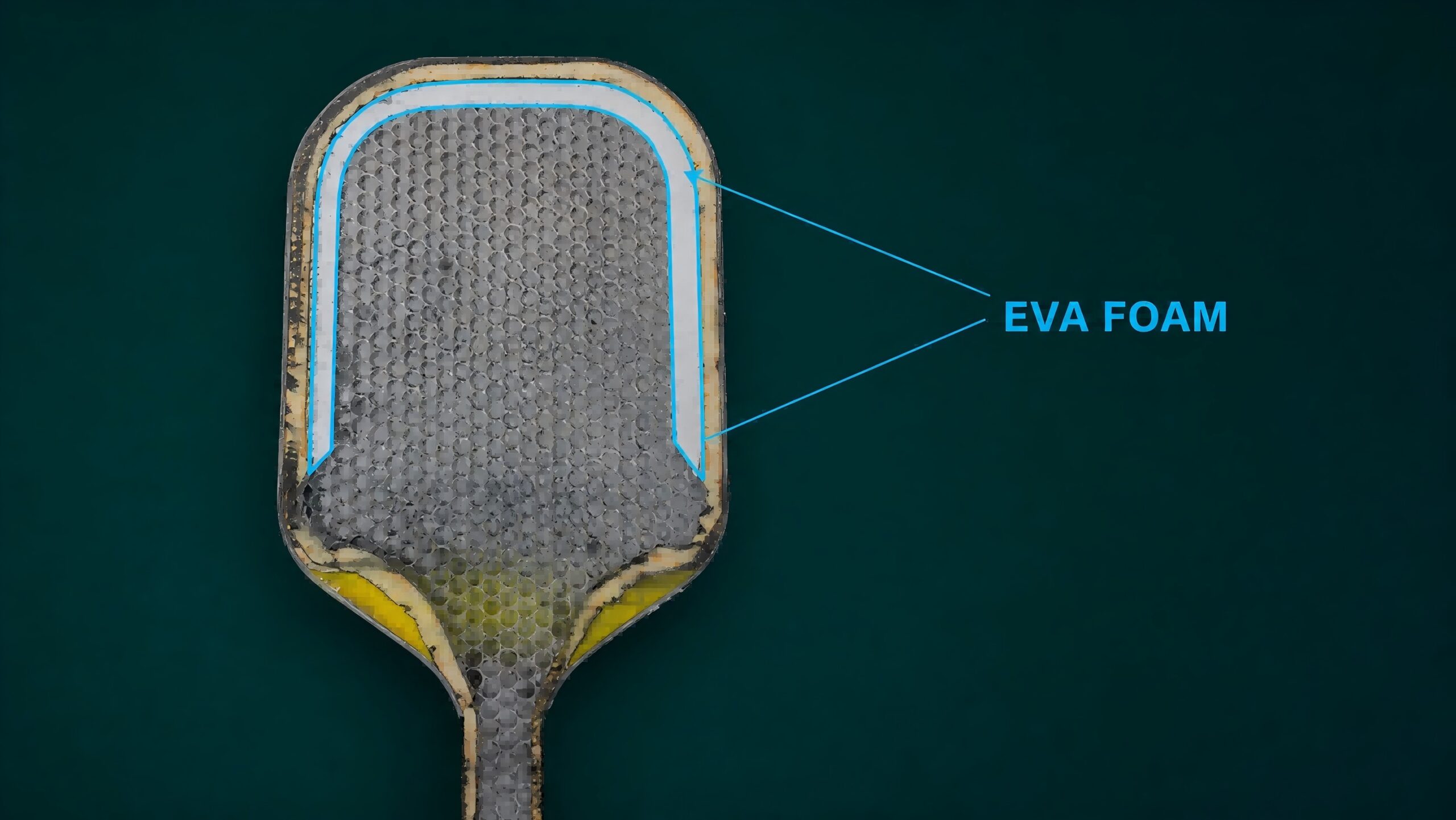
Expanded polypropylene foam eliminates the traditional “core crush” issue in high-frequency thermoformed use. EPP foam significantly reduces vibration transmission — ideal for noise-sensitive communities and players prone to arm fatigue. Commands a meaningful price premium and justifies a higher retail position.
GEN5 “Gatling” Polymeric Mesh Core (Flagship)
NexaPaddle’s most advanced core technology. Designed for maximum energy return at the outer limits of USAPA compliance. The right choice for your top-of-range SKU where performance is the primary sales message.
Cold Press vs. Thermoformed: The Construction Summary
For B2B buyers who need a simple framing device:
- Cold press = materials bonded with adhesive under pressure = lower cost, reliable quality, accessible MOQ of 300, right choice for fiberglass and mid-range carbon fiber
- Thermoformed = materials fused with heat and pressure = higher performance, unibody construction, lower MOQ of 100, right choice for premium carbon fiber
When building your SKU lineup, the construction method determines the tier ceiling. You cannot make a truly premium paddle with cold press construction — and you don’t need to, because the performance difference justifies the additional cost that thermoforming adds.
Frequently Asked Questions
Can I mix fiberglass and carbon fiber paddles in one order?
Yes. NexaPaddle processes mixed-material orders routinely for B2B buyers building out multi-tier product lines. Your fiberglass and cold press carbon fiber SKUs can be consolidated into a single production run (both carry a 300-piece MOQ per SKU). Thermoformed carbon fiber carries a separate 100-piece MOQ per design and typically runs on a separate production schedule. Contact NexaPaddle to structure a combined order that meets your inventory targets across all tiers.
What’s the MOQ difference between fiberglass and carbon fiber paddles?
Cold press fiberglass and cold press carbon fiber both start at u003cstrongu003e300 pieces per SKUu003c/strongu003e. This applies regardless of whether you’re ordering standard catalog designs or fully custom private label versions. Thermoformed carbon fiber paddles — the premium tier — start at u003cstrongu003e100 pieces per designu003c/strongu003e, which is significantly lower than the industry historical standard of 300–500 units. This lower thermoformed MOQ is designed specifically for brand owners testing a premium SKU before committing to a full production run.
Which material is better for USAPA certification?
Both fiberglass and carbon fiber paddles can achieve USAPA certification, and NexaPaddle designs all OEM products to meet USA Pickleball Equipment Standards from day one. The certification process — which costs $500–$1,200 per design and takes approximately 4–6 weeks — tests for dimensions, surface texture, and the critical Coefficient of Restitution (PBCoR) standard, not the face material itself. NexaPaddle offers pre-certification in-house testing to validate compliance before official submission, dramatically reducing failure risk. Thermoformed paddles require more careful engineering to stay within the PBCoR limit at peak performance, which is why pre-testing is especially valuable at the premium tier.
How do I decide the right ratio of fiberglass to carbon fiber in my inventory?
Start with your primary sales channel:u003cbru003eu003cbru003eu003cstrongu003eBig-box retail or institutional supply:u003c/strongu003e Weight toward fiberglass (70–80% of your SKU count). These channels are volume-driven and price-sensitive.u003cbru003eu003cbru003eu003cstrongu003eAmazon FBA mid-tier:u003c/strongu003e Weight toward cold press carbon fiber (your best-seller price band will likely be the $60–$130 range). A 50/50 fiberglass-to-carbon split gives you coverage across both entry and mid segments.u003cbru003eu003cbru003eu003cstrongu003eDTC / specialty retail:u003c/strongu003e Weight toward thermoformed carbon fiber (50–70% of your premium SKUs). Your brand story needs to be anchored in performance.u003cbru003eu003cbru003eu003cstrongu003eWholesale brand owner building a full product line:u003c/strongu003e Use the Good-Better-Best framework — one or two fiberglass SKUs, two to three cold press carbon SKUs, one to two thermoformed SKUs. This distributes risk, covers multiple buyer segments, and creates a natural upsell ladder.
Can the same paddle design be produced in both fiberglass and carbon fiber?
Yes, with caveats. The same paddle shape (mold), dimensions, and handle specifications can be manufactured in both fiberglass and carbon fiber face materials using the cold press process. This is a very practical strategy for brand owners who want to offer a “good” and “better” version of the same paddle form factor under consistent branding. The core will typically remain PP honeycomb across both. Note that the same paddle design cannot be directly replicated in thermoformed construction — thermoforming requires specific mold engineering and the unibody construction process produces a structurally different paddle, not just a face material swap. Explore u003ca href=u0022https://nexapaddle.com/custom-paddles/u0022 target=u0022_blanku0022 rel=u0022noreferrer noopeneru0022u003ecustom paddlesu003c/au003e to discuss design-to-material configuration options.
Conclusion: Two Materials, One Strategy
Carbon fiber and fiberglass are not competing choices — they are complementary tools in a well-constructed product strategy.
Fiberglass is your volume anchor: the paddle that wins shelf space at big-box retailers, moves in bundle sets, and introduces new players to your brand at an accessible price point. Carbon fiber is your margin engine: the paddle that builds brand credibility, justifies premium positioning, and captures the growing segment of serious players willing to spend real money on equipment they trust.
The wholesalers and brand owners who build durable businesses in pickleball aren’t the ones who pick a side. They’re the ones who understand that a beginner buying a $35 fiberglass paddle today is a potential $120 carbon fiber upgrade customer in twelve months — and they design their product line around that journey.
If you’re ready to build that product line, NexaPaddle’s factory team is ready to work through the specifications with you: material selection, thickness, shape, core, graphics, packaging, and the MOQs that make the unit economics work.
nIf you are building a multi-SKU retail or distribution assortment, review the wholesale pickleball paddles program for MOQ, sampling, packaging, product-base and reorder planning.
nnnSources
Material science performance data based on NexaPaddle in-house testing comparing cold press carbon fiber face paddles against fiberglass equivalents of identical core and construction specifications. Ball exit speed improvement of 8–12% reflects controlled testing at comparable swing velocities.
Spin RPM data based on raw surface texture testing on T700 and T800 carbon fiber faces in thermoformed construction. USA Pickleball Equipment Standards specify surface roughness (coefficient of friction) limits that naturally correlate with spin generation capacity.
Sweet spot expansion of 15–20% for thermoformed construction compared to cold press equivalents is based on NexaPaddle’s structural analysis of unibody construction versus adhesive-bonded construction. Continuous carbon fiber through the handle increases torsional stiffness and distributes impact energy more evenly across a larger face area.
USA Pickleball. (2024–2025). Equipment Standards Manual and Certification Submission Guidelines. usapickleball.org. Certification cost and timeline ranges are current as of 2025 submission cycle data.