Introduction: Power Is an Engineering Problem
When a player picks up a paddle and says “this one has serious pop” — they’re describing physics. Specifically, the interaction of three measurable variables: face stiffness, core geometry, and swing weight.
For brand owners and OEM buyers, understanding this engineering context isn’t just academically interesting — it’s commercially essential. Power paddles represent the dominant segment in the current market, and building one that actually performs requires making the right manufacturing decisions, not just using the right marketing language.
This guide breaks down the science, maps it to real NexaPaddle products, and gives you the framework to spec a genuinely powerful paddle — not just one that sounds powerful.
Part 1: Why Power Paddles Are Winning the Market
The Numbers Don’t Lie
The pickleball market’s center of gravity has shifted toward power play — and it’s accelerating:
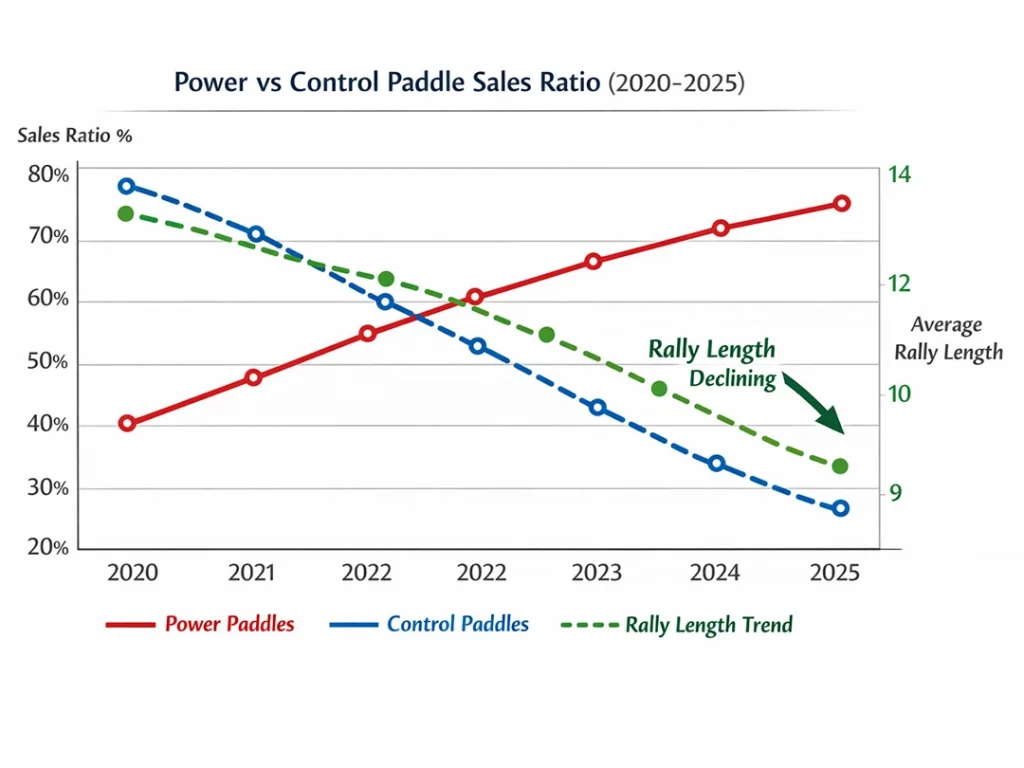
- Power paddles outsell control paddles 1.7:1 in current market data
- Average rally length dropped from 5.8 hits (2022) to 4.1 hits (2024) — a 29% reduction as players prioritize aggressive driving over dink exchanges
- The global pickleball market is projected to grow from $1.5B to $4.4B by 2033, CAGR 11.3% — with power-oriented equipment leading growth
This isn’t a coincidence. As the player base matures and more racket sport converts enter (tennis, squash, badminton players), they bring aggressive playing styles. These players aren’t shopping for a “beginner-friendly” paddle — they want maximum ball exit velocity and spin with enough control to stay in bounds.
The brands that understand power paddle engineering are capturing this segment. The brands that treat “power” as a marketing tag rather than an engineering specification are getting left behind.

Part 2: The Power Formula — Three Engineering Variables
Variable 1: Face Stiffness
What it is: The resistance of the hitting face to deformation under impact. A stiffer face deflects less when the ball strikes it.
Why it creates power: When the face deflects (bends inward), it absorbs energy from the ball — energy that is partially dissipated as heat and sound rather than returned to the ball. A stiffer face deflects less, retains more of the ball’s kinetic energy in the elastic collision, and returns more of it as ball velocity.
This is the physical basis for why carbon fiber faces generate more power than fiberglass faces. Carbon fiber has a significantly higher tensile modulus (stiffness) than fiberglass. The face deflects less per unit of impact force, so more energy goes back into the ball.
Within carbon grades:
- T300: Lowest stiffness among carbon grades — soft feel, least power return
- T700: Mid-high stiffness — the power/control balance that makes it the pro standard
- T800: Highest stiffness — maximum power, requires skill to control
Manufacturing impact: Thermoformed construction increases effective face stiffness by bonding face, core, and edge into a unibody structure. A thermoformed T700 paddle has meaningfully higher effective face stiffness than a cold-press T700 paddle using the same materials — because the face and core can no longer flex semi-independently.
Variable 2: Core Thickness — The Counter-Intuitive Relationship
The insight: Thinner cores generate more power, not thicker ones.
This surprises many brand owners who assume “more padding = more pop.” The physics works differently:
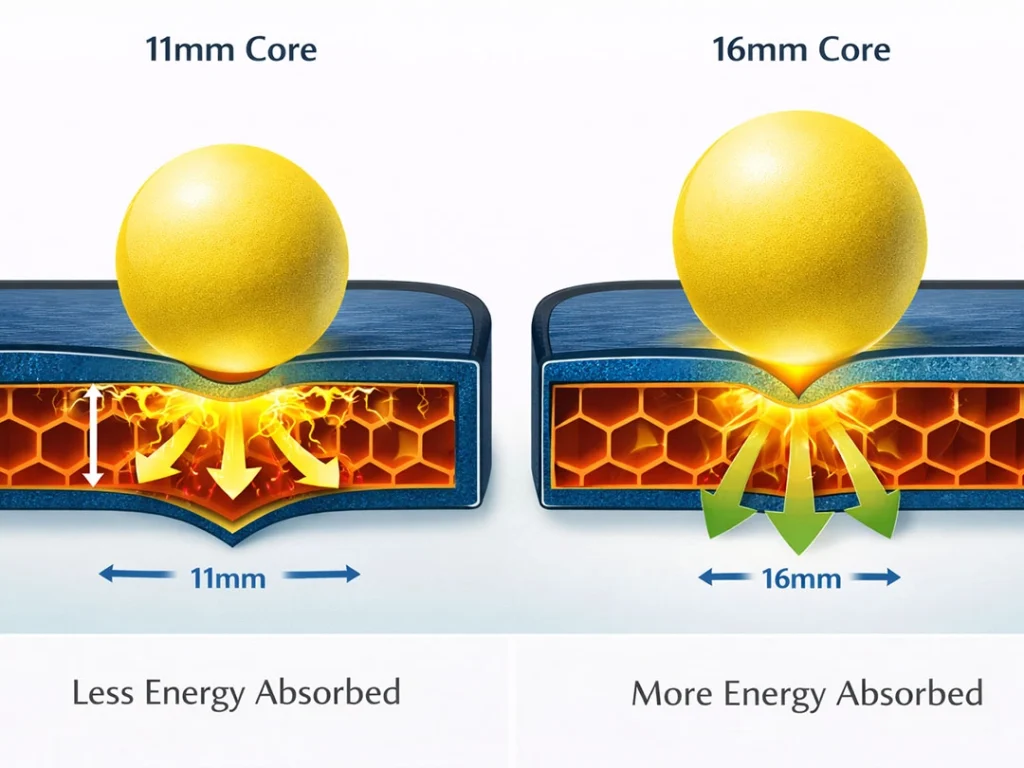
A thick core (16mm) compresses more on impact, absorbing more energy before the face and ball interact. A thin core (11–14mm) compresses less — the ball “feels” the stiffness of the face more directly, and more energy is returned.
Power core thickness range: 11–14mm
Control/stability range: 15–16mm
This creates a design tension: thinner cores deliver more power but less stability and a smaller sweet spot. The sweet spot in the power paddle market is currently 13–14mm — enough thinness to generate genuine power, enough thickness to maintain consistency for intermediate-to-advanced players.
| Core Thickness | Feel | Power | Control | Target Player |
|---|---|---|---|---|
| 10–11mm | Very stiff, punchy | Very High | Low | Pro/power specialists |
| 13–14mm | Crisp, responsive | High | Medium-High | Intermediate+ |
| 15–16mm | Soft, forgiving | Medium | High | Beginners/control players |

Variable 3: Swing Weight — The Most Under-Specified Variable
What it is: Swing weight (measured in kg·cm²) is the rotational moment of inertia of the paddle around the wrist. It measures how much mass is located farther from the grip — not just total paddle weight.
Why it matters for power: Swing weight is the single most predictive metric of power output. A paddle with high swing weight carries more momentum through the swing — ball exit velocity increases measurably.
Key data:
- Target swing weight for power paddles: >125 kg·cm²
- Every 5 kg·cm² increase in swing weight ≈ +0.8 mph ball speed gain
- Power paddles like the Paddletek Bantam TKO-C (SW 130) and CRBN 1X Power Series (SW 135) illustrate the range
Manufacturing impact: Swing weight is influenced by:
- Paddle dimensions — longer paddle = higher SW (same weight, but farther from grip)
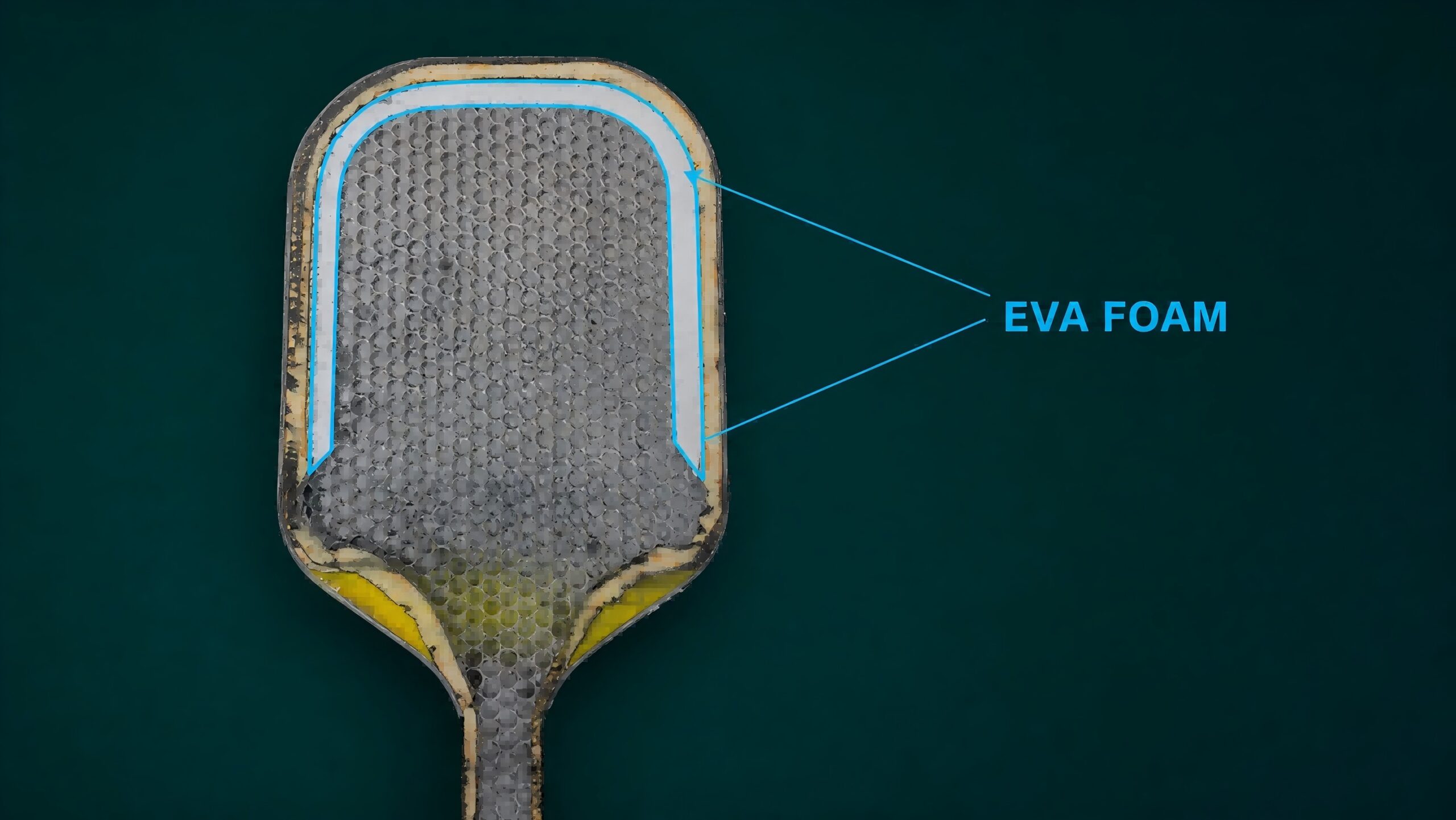
- Edge construction — thermoformed paddles with perimeter foam edge concentrate mass at the paddle periphery, increasing SW relative to face weight
- Lead tape position — 2–4g at the 3 and 9 o’clock positions adds approximately +5 kg·cm² SW (+0.8 mph ball speed)
This explains why power brands often use extended-length paddles (420–425mm) — the additional length pushes mass farther from the grip, increasing swing weight without necessarily adding total paddle weight.
NexaPaddle’s Mold #7 Hot Press Forged (420–425mm length, 13.5–14mm core) is engineered precisely in this sweet spot: long enough to push SW into the power zone, thin enough to maximize face energy return.
Part 3: How Construction Method Amplifies (or Undermines) the Formula
Cold Press — The Power Ceiling
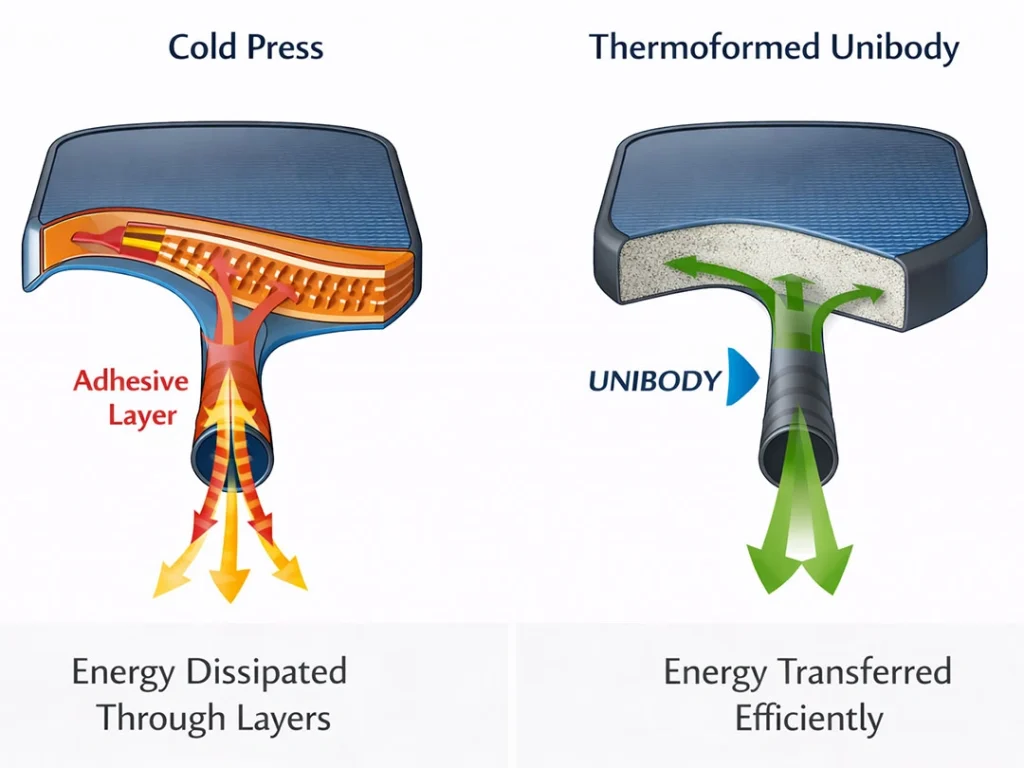
Cold press construction — where face sheets are adhesive-bonded to the core at room temperature — creates a paddle where the face and core can flex semi-independently. This reduces effective face stiffness by approximately 15–25% compared to thermoforming (estimate based on manufacturing industry data).
Result: Cold press paddles, regardless of material grade, have a power ceiling that thermoformed paddles don’t. You can put T700 carbon on a cold press construction, but the adhesive bond layer dampens the energy transfer between face and core.
Cold press is appropriate for: Entry and mid-tier paddles where power is secondary to price, weight, or durability. It is not the construction method for a genuinely powerful premium paddle.
Thermoforming — The Power Enabler
In thermoformed construction, the entire paddle — face, core, and edge band — is formed under heat and pressure as a single integrated unit. There is no adhesive layer between face and core. They are bonded at the molecular level, behaving as one stiff structure.
Result: The face stiffness the material is capable of is fully realized. The 28% price premium that thermoformed paddles command over comparable cold press products is justified by the measurable performance difference — and the market has validated this with its purchasing behavior.
NexaPaddle’s thermoformed T700 paddles (Molds #2, #3, #7) and the Hot Press Forged Mold #7 represent the standard production approach for all power-tier products.

Foam Core Construction — Power + Vibration Management
A newer development in power paddle engineering: foam core injection using EPP (Expanded Polypropylene) foam.
Standard PP honeycomb cores deliver power, but their hexagonal structure transmits vibration efficiently — which some players find uncomfortable in aggressive power paddles. EPP foam cores offer:
- Edge weight concentration — foam distributes mass to the paddle perimeter, raising swing weight
- Vibration dampening — foam absorbs high-frequency vibration that honeycomb transmits
- Stable sweet spot — the uniform foam structure creates more consistent ball response across the face
NexaPaddle’s GEN4 Foam Filled paddle uses EPP core with a T700 thermoformed face. This combination targets players who want explosive power but find pure honeycomb paddles too harsh on the arm — a growing segment as the sport ages.
👉 Explore NexaPaddle’s Foam Core Pickleball Paddles for GEN4 foam options.
Part 4: Real-World Power Paddle Benchmarks (2025 Market)
For brand owners positioning their line, here’s where the market’s validated power paddles sit on the spec map:
| Paddle | Core Thickness | Swing Weight | Lab-Tested Speed |
|---|---|---|---|
| Paddletek Bantam TKO-C | 13mm | 130 kg·cm² | 57.2 mph |
| CRBN 1X Power Series | 14mm | 135 kg·cm² | 56.8 mph |
| Vatic Pro V7 14mm | 14mm | 128 kg·cm² | 55.0 mph |
The pattern is consistent: 13–14mm core, SW 125–135 kg·cm², thermoformed T700 or T800 construction defines the current power paddle performance envelope.
NexaPaddle’s Mold #7 Hot Press Forged (13.5–14mm, T700) is engineered to compete directly in this range. The forging process ensures higher face-to-core bond density than standard thermoforming — producing maximum stiffness consistency batch-to-batch.
Part 5: The Spin Connection — Power and Spin Are Not Opposites
The highest-performing power paddles in 2025–2026 don’t sacrifice spin — they optimize for both.
How surface grit generates spin:
Carbon fiber surface roughness (measured as Rt in µm) determines how much the ball grips the face during contact. Higher Rt = more grip = more spin RPM potential.
NexaPaddle’s internal QA target of Rt ≤ 35µm ensures surface consistency — but for paddles specifically targeted at spin-power combination, the T800 + Titanium Thread construction adds structural surface texture that doesn’t wear off.
The Ti Thread weave integrates titanium fiber into the carbon matrix, creating permanent microscopic ridges in the face surface. Unlike spin coatings (which wear off after 50–100 hours), titanium thread grit is architectural — it’s part of the face structure itself.
Dimensions: 413×195mm — the wider profile provides a larger “grit zone” for spin generation.
Best for: Brands targeting 4.0+ players who want a spin-power weapon. The T800+Ti construction justifies $180–$230 MSRP positioning.
👉 See NexaPaddle’s Spin Pickleball Paddles and Power Pickleball Paddles for spin-power combination options.
Part 6: Building Your Power Paddle Line — OEM Specification Checklist
When briefing your factory on a power paddle, these are the spec elements that determine whether you get a genuinely powerful paddle or just a “power paddle” in the marketing:
Face Specification:
- Carbon fiber grade: T700 minimum, T800 for flagship (not T300)
- Weave: 12K all-around, 18K or 3D 18K for max power/spin
- Construction: Thermoformed only (not cold press)
- Surface Rt: Request measurement — target 28–45µm for power range
Core Specification:
- Thickness: 13–14mm (not 16mm for power)
- Material: PP honeycomb (standard) or EPP foam (premium power + arm-friendly)
- Cell size: Smaller cells = more stiffness; confirm with factory
Swing Weight Specification:
- Target: >125 kg·cm²
- Paddle length: 420–425mm (longer = higher SW at same weight)
- Edge construction: Perimeter foam edge (concentrates peripheral mass, raises SW)
Quality Verification:
- Request pre-shipment PBCoR measurement
- Request swing weight measurement for production batch
- Request surface Rt measurement for face QC
FAQ
If I add lead tape to any paddle, does it become a power paddle?
Lead tape (2–4g at 3+9 o’clock) adds approximately +5 kg·cm² swing weight and ~0.8 mph ball speed. It can meaningfully improve power output. However, it only amplifies what the paddle construction is already capable of — a cold press fiberglass paddle with lead tape still has a power ceiling that a thermoformed carbon paddle without tape exceeds. Lead tape is a fine-tuning tool, not a substitute for correct specification.
Does a heavier paddle always mean more power?
Not necessarily. Total paddle weight and swing weight are related but different. A heavier paddle uniformly distributed (weight at the grip as much as the head) may have lower swing weight than a lighter paddle with mass concentrated at the periphery. Swing weight — not total weight — is the more accurate predictor of power.
Why do some “power paddles” still feel underpowered to advanced players?
Usually because one of the three variables is misspecified. Common issues: correct thickness but cold press construction (face stiffness lost at the bond layer), correct construction but thick 16mm core (energy absorbed by core), or correct face and core but low swing weight (not enough momentum in the swing). All three variables must be optimized together.
Can I position a power paddle for both power and control players?
The 14mm core with T700 thermoformed construction is genuinely versatile — enough power for attackers, enough stability for players who transition between offense and defense. The Mold #7 at 14mm is positioned exactly here. True power specialists will want the 13mm version; control specialists will want 16mm. The 14mm splits the difference well for broad market appeal.
What’s the cost difference between a power-spec thermoformed paddle and a standard cold press paddle at NexaPaddle?
Thermoformed construction carries a meaningful premium over cold press — generally 50–80% higher production cost for similar materials, with smaller MOQ (100 vs 300 pcs). The MSRP differential is typically 2–3× (thermoformed T700 retails $99–$149 vs cold press carbon at $49–$79). The higher margin per unit on thermoformed generally compensates for the higher production cost. Contact us for current pricing at your target volume.
Ready to Build a Paddle That Actually Performs?
NexaPaddle manufactures power pickleball paddles and thermoformed paddles engineered to the specifications above — including Mold #7 Hot Press Forged, GEN4 Foam Filled, T800+Ti Thread, and the GEN5 Gatling flagship.
👉 Contact NexaPaddle to spec your power paddle line. Share your target player profile, MSRP, and volume, and we’ll recommend the right mold, carbon grade, and construction method.
See also: Forged T700 Carbon Pickleball Paddle Factory | High End Pickleball Paddles Factory Supplier | T800 Carbon Pickleball Paddles Wholesale