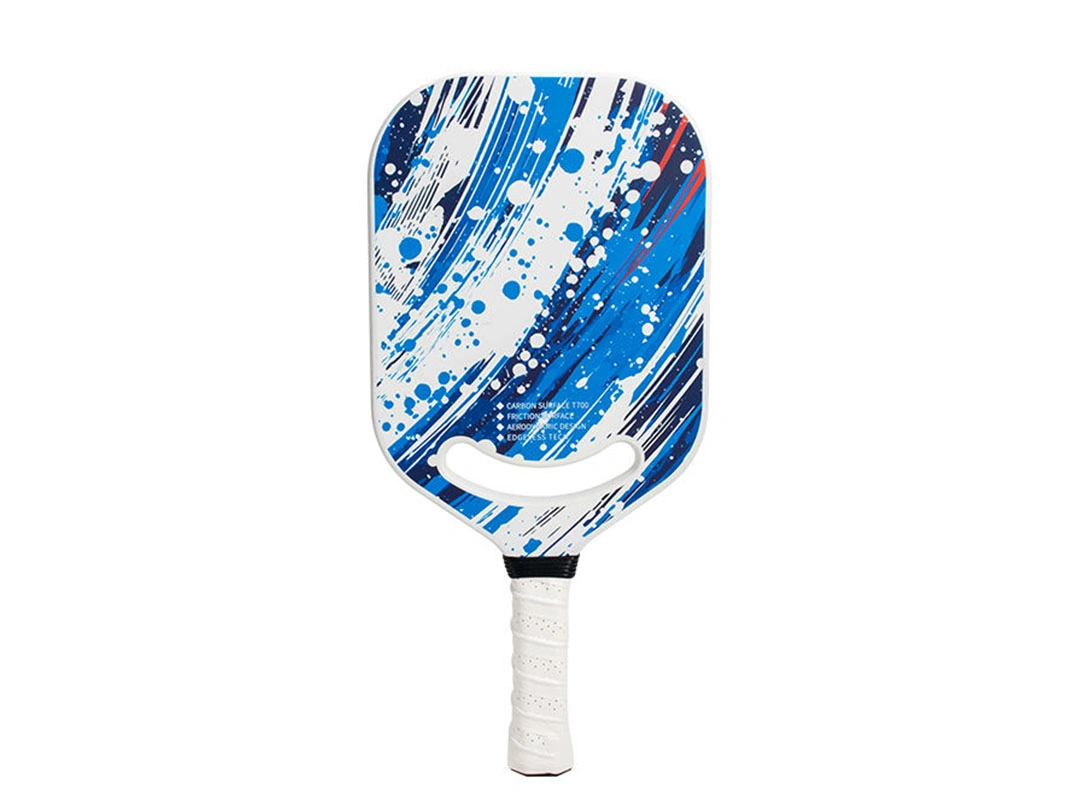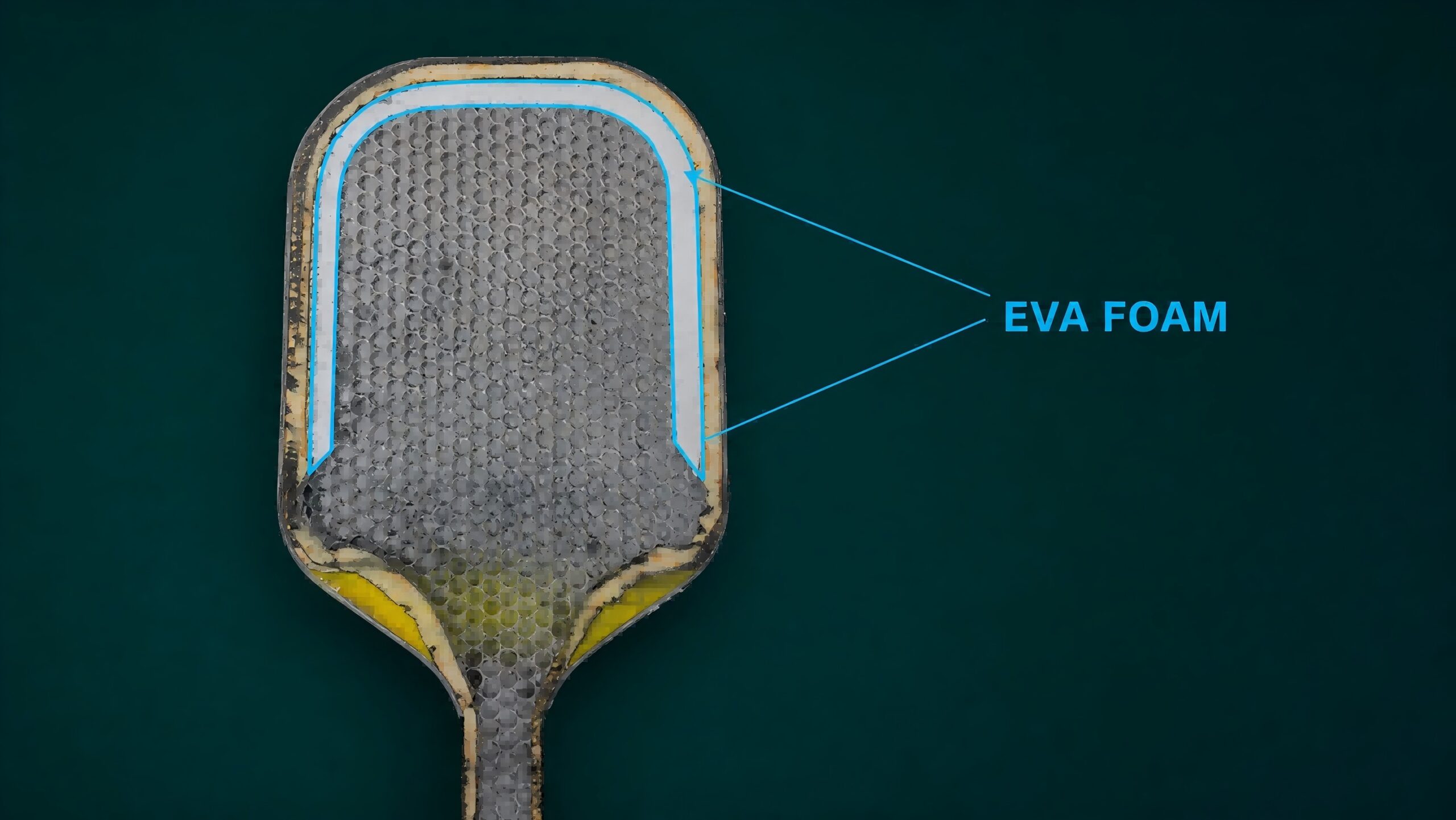
Spin is the single most consequential performance variable in modern competitive pickleball.
Not power. Not control. Spin.
Topspin drives that dip sharply at the kitchen line. Sidespin returns that angle away from an opponent’s reach. Kick serves that bounce unpredictably off the court surface. These are the mechanics that separate a 4.5 player from a 3.5 player, and they all originate at one place: the friction interface between the paddle face and the ball during the milliseconds of dwell time at impact.
For brand owners, retailers, and distributors evaluating paddle specifications for their product lines, this creates a very specific engineering question: how do you design spin performance into a paddle at the manufacturing level, and which technology approach delivers the best long-term result?
The answer comes down to two primary technologies that dominate the current market: raw carbon fiber friction faces (T700 and T800 grade) and Teflon coating. They operate through different mechanisms, serve different positioning strategies, and have different compliance profiles under USA Pickleball’s Equipment Standards. Getting the comparison right is the difference between sourcing a paddle that holds its spin performance for a year and one that degrades within three months.
This article is the technical foundation for making that call. We’ll cover the physics, the materials, the manufacturing implications, and the USAPA regulatory environment — with specific product specifications for each technology tier so you can match the right approach to your brand’s positioning.
Section 1: The Science of Spin Generation in Pickleball
Before evaluating specific technologies, it’s worth establishing exactly what “spin” means at the physics level — because the engineering decisions follow directly from the mechanism.
The Friction-Dwell Equation
Spin generation at the paddle-ball interface is governed by a straightforward relationship:
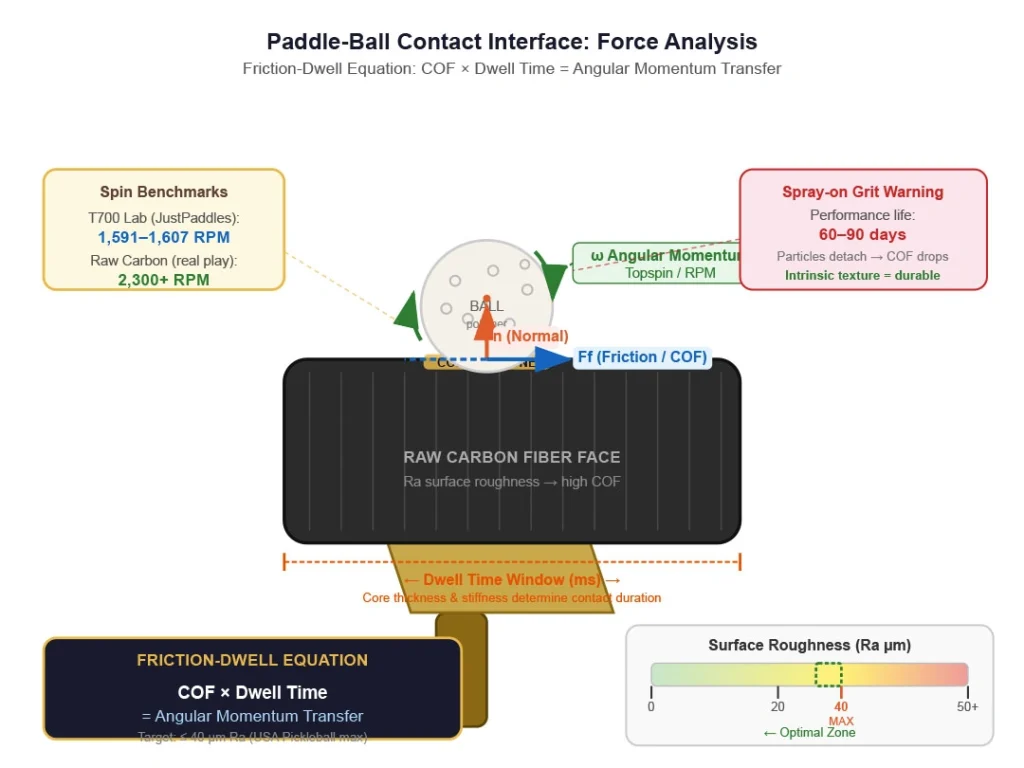
Coefficient of Friction × Dwell Time = Angular Momentum Transfer
The coefficient of friction (COF) is a material property of the paddle face surface — specifically, how much resistance it creates against the ball’s polymer surface during contact. Higher COF means more tangential force is applied to the ball’s surface relative to its center, which is the definition of imparted angular velocity.
Dwell time is the duration of paddle-ball contact, typically measured in milliseconds. Core thickness and material stiffness both influence dwell time — a thicker or slightly softer core keeps the ball in contact with the face slightly longer, allowing more friction force to act on it. This is why the core architecture matters alongside the face material; they are interdependent variables in the spin equation.
The practical upshot: if you want to maximize spin, you need both a high-COF face surface and sufficient dwell time to let that friction do its work.
Surface Roughness: The Measurable Variable
Surface friction at the paddle-ball interface is directly correlated with surface roughness — specifically the Ra value (arithmetic mean roughness) measured in micrometers. A surface with higher Ra creates more physical engagement with the ball’s polymer skin during dwell time, translating to more angular momentum transfer.
The engineering goal for the best pickleball paddles for spin is therefore clear: maximize surface roughness (and therefore COF) within the limits set by USA Pickleball’s Equipment Standards.
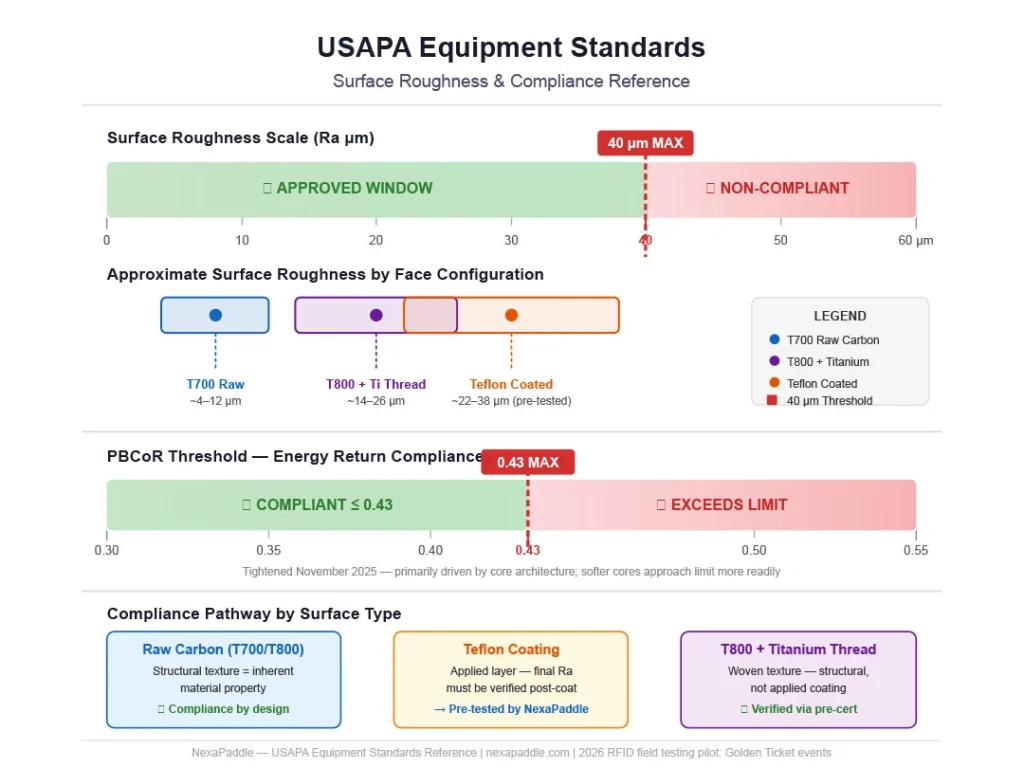
USA Pickleball’s current standards specify a maximum surface roughness of 40 micrometers Ra. That upper limit exists precisely because spin capability was creating competitive imbalances — paddles with aggressive grit sprays were effectively functioning as ball-modification tools. Any compliant paddle must operate below that ceiling, and manufacturers seeking maximum spin performance engineer their surfaces as close to that ceiling as possible without exceeding it.
Intrinsic vs. Applied Surface Texture: Why the Distinction Matters
Here is the most important design principle for spin-optimized paddle engineering, and the one most often glossed over in marketing copy:
Surface texture must be intrinsic to the material structure, not applied on top of it.
Spray-on grit treatments — abrasive particles bonded to a paddle face with adhesive — can generate excellent spin performance out of the box. The problem is structural: adhesive-bonded particles are not part of the face material. They are attached to it. Under repeated ball impacts, the bond between grit particles and paddle surface degrades. The particles break off or smooth down. Industry testing and player reports consistently place spray-on grit performance life at 60–90 days of regular play before measurable spin performance decay begins.
After that window, the player is using a paddle that was priced for premium spin performance and is delivering mid-tier spin performance. For brands selling at $150+ retail, that degradation timeline creates returns, negative reviews, and customer lifetime value problems.
The two technologies examined in this article — raw carbon fiber surfaces and Teflon coating — solve the durability problem through different mechanisms. Understanding how each one works determines which is right for your product specification.
Benchmarking Spin Performance
JustPaddles Paddle Lab measured top-tier T700 paddles generating 1,591–1,607 RPM in controlled laboratory conditions. Those are strong numbers for paddles tested under standardized, moderate swing conditions.
Raw carbon fiber surfaces achieve 2,300+ RPM in real play conditions, where swing mechanics, topspin technique, and surface engagement under full stroke velocity create a different performance ceiling than the lab environment captures. The gap between lab conditions and real play is a known variable — but the directional conclusion is consistent: raw carbon fiber surfaces perform at the higher end of the spin spectrum.
Section 2: Raw Carbon Fiber Friction Face Technology
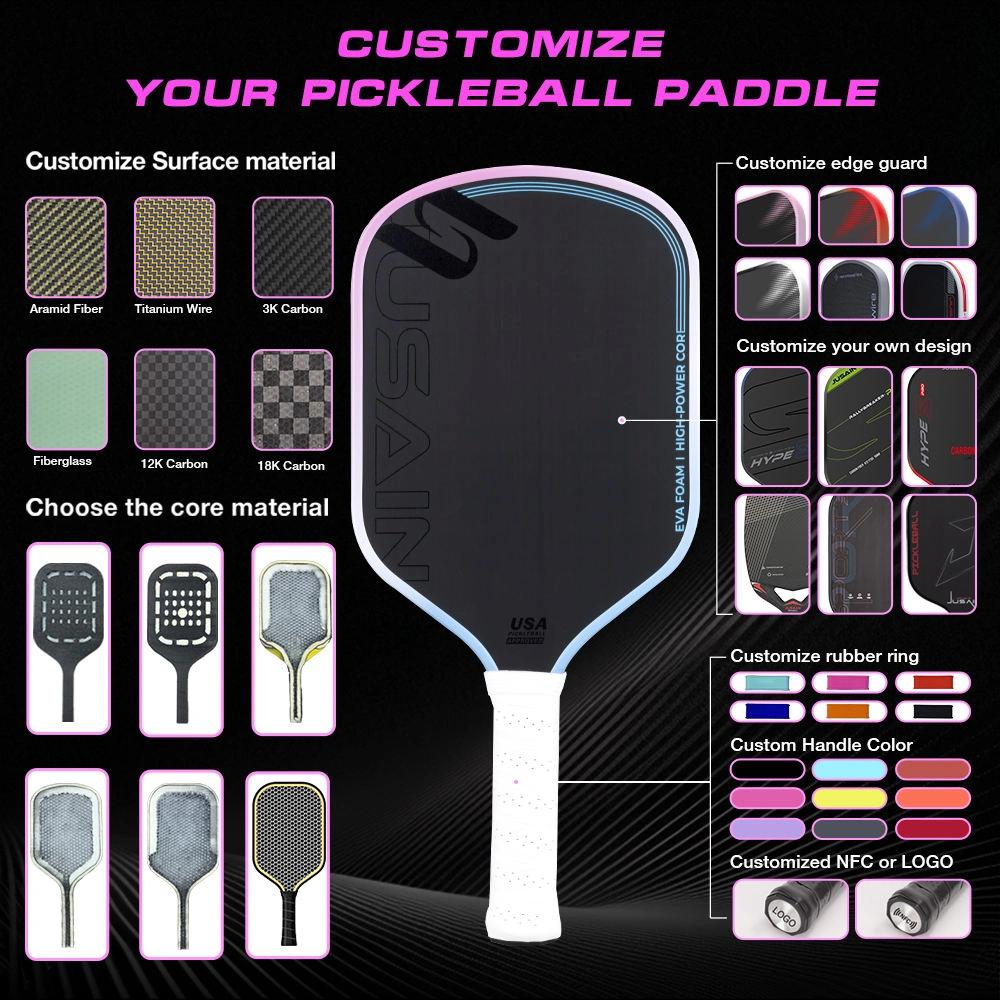
Raw carbon fiber friction faces are the dominant spin-generation technology in the current premium paddle market. Every major brand — Selkirk, JOOLA, CRBN, Vatic Pro — has converged on carbon fiber faces, and the reason is not aesthetic. It is material science.
How T700 Carbon Fiber Creates Spin
Toray’s T700SC carbon fiber — the industry-standard specification — is built from filaments with a 7-micrometer diameter. To visualize that: approximately 1/10th the width of a human hair. When these filaments are laid up in either a unidirectional (UD) or 3K woven pattern and cured without a smooth surface coating, the resulting face has a characteristic micro-texture at the scale of those filament bundles.
That micro-texture is not a coating applied after manufacture. It is the fiber itself, exposed at the surface. When the ball contacts this surface, those microscopic fiber ridges engage the ball’s polymer skin during dwell time, generating the friction that produces angular momentum.
The T700 carbon fiber paddle for spin is the material science embodiment of intrinsic surface texture.
UD vs. 3K Weave: Engineering for Spin Direction
The geometry of how T700 fibers are arranged at the face level creates meaningful differences in spin characteristics:
Unidirectional (UD):
Fibers run parallel in a single direction. This produces a surface with directionally consistent texture — the micro-ridges are aligned, creating stronger engagement in one axis. UD surfaces are optimized for consistent-angle strokes: forehand drives, topspin serves, and shots where the swing path is predictable. Players who rely on a technically precise topspin forehand often prefer UD faces because the directional texture reinforces their natural stroke mechanics.
3K Woven:
Three-filament bundles are interlaced in a plain weave, creating the classic crosshatch carbon fiber pattern. The omnidirectional crosshatch creates more uniform texture engagement across varied swing angles. 3K is better suited for players who use a wider range of spin techniques — slice, sidespin, and low-dwell punch shots — because the friction profile doesn’t have a preferred direction.
For product specification purposes: UD is the choice for a spin-forward positioning story built around topspin drives and serves. 3K is the choice for versatility — a paddle that performs well across the full range of spin techniques a competitive player deploys.
Why Raw Carbon Spin Performance Is Permanent
This is the core durability argument for raw carbon pickleball paddles: the micro-texture is the fiber.
T700 carbon fiber has a tensile strength of 4,900 MPa. To degrade the surface texture of a raw carbon face through normal ball impacts, you would need to mechanically abrade the carbon filaments themselves — which requires forces far beyond what a pickleball generates. The spray-on grit degradation problem is entirely absent because there is no adhesive bond to fail. There is no surface treatment to wear away. The spin-generating geometry is a structural property of the material.
Industry observation places raw T700 carbon fiber surface performance as stable across the functional lifespan of the paddle, with maintenance limited to periodically erasing polymer debris from the ball that embeds in the surface texture — a process that takes seconds and restores full spin capability.
T800: Higher Modulus, Higher Spin Ceiling
T800 carbon fiber takes the T700 formula a step further in two relevant dimensions:
Higher tensile modulus (294 GPa vs. 230 GPa — a 28% increase): A stiffer face deforms less at ball contact, which means less energy is absorbed into face deflection and more is returned to the ball as exit velocity. For power-forward positioning, T800 is the specification.
Finer filament diameter (~5 μm vs. 7 μm): Tighter filament packing allows for denser weave architectures and creates a more uniform face surface at the micro level.
T800 + Titanium Thread: The Highest Spin Ceiling Available
NexaPaddle’s most advanced face construction takes T800 further still by weaving fine-gauge metallic titanium threads directly into the T800 carbon matrix during the composite fabric production stage. This is not a coating. The titanium threads are structural — integral to the weave.
The result: micro-ridges woven into the composite matrix that exceed the friction profile achievable with carbon fiber alone. Titanium is significantly harder than carbon fiber, meaning the surface contact points maintain their geometry under repeated ball impacts. The structural texture never degrades because it is architecturally the same as the paddle face itself.
The T800+Titanium Thread construction represents the maximum spin ceiling currently available from any NexaPaddle production face — and it achieves that ceiling through structural texture that is permanent by design.
You can explore the full range of T700 carbon fiber paddles and the T800+Ti specialty tier within NexaPaddle’s catalog to understand how these material grades translate into specific product SKUs.
Section 3: Teflon Coating Technology
Teflon coating operates through a different mechanism than raw carbon fiber, and it is a legitimate spin-performance technology — not a marketing workaround.
How Teflon Coating Works
Teflon (polytetrafluoroethylene, PTFE) applied to a paddle face functions as a coherent coating layer that modifies the surface friction characteristics of the underlying face material. This is categorically different from spray-on grit:
- Spray-on grit consists of discrete abrasive particles bonded to the face surface with adhesive. The particles are not continuous with the face; they are attached to it.
- Teflon coating is a continuous polymeric coating layer that bonds to and modifies the face surface at the material level. It behaves as a modified face surface, not a particle attachment.
The practical consequence of this distinction is durability. A coherent coating layer that modifies the surface maintains its friction characteristics as long as the coating itself remains intact — which is a significantly longer performance window than adhesive-bonded particles subject to shear loading from ball impacts.
Teflon coating also provides a secondary structural benefit: the coating reinforces the surface integrity of the underlying carbon fiber, adding resistance against micro-abrasion and maintaining face geometry through heavy use cycles. For brands building products intended for intensive play environments — training academies, club programs, competitive rental fleets — this reinforcement effect has real product longevity value.
Teflon Coating in NexaPaddle’s Product Lineup
NexaPaddle uses Teflon coating in two primary configurations:
Mold #8 Silent Series (T700 + Teflon): A 14mm thermoformed paddle built on the NCT-BV Core. The Teflon coating enhances the spin characteristics of the underlying T700 face while the Silent designation refers to the NCT-BV core’s noise-reduction properties. This is NexaPaddle’s primary offering for players and clubs in noise-sensitive environments — a segment that represents a growing share of the recreational pickleball market.
Mold #4 Hybrid: Available with either Carbon+Teflon or T700 face, with PP Honeycomb or GEN4 core options. The Mold #4’s dual face material availability makes it one of NexaPaddle’s most flexible configurations for brand owners building product ladders — the same mold geometry with different performance tiers.
GEN5 “Gatling” Flagship: T800 + Teflon-Weave
The GEN5 “Gatling” represents NexaPaddle’s complete integration of Teflon technology with T800 carbon fiber at the flagship level. The face specification — T800+Teflon-weave — is distinct from a simple Teflon coating applied over a finished face. The Teflon is woven into the T800 fabric itself during the composite production stage, creating a hybrid surface that delivers T800’s structural stiffness and energy return alongside enhanced surface friction from the Teflon weave.
The performance profile of the Gatling is positioned differently from the T800+Titanium Thread face: optimized for power and speed with excellent control rather than the maximum-friction spin profile of the titanium construction. Paired with NexaPaddle’s GEN5 Polymeric Mesh Core — which replaces standard honeycomb’s hexagonal cell architecture with an energy-return mesh structure that distributes impact force more uniformly — the Gatling delivers the largest functional sweet spot in NexaPaddle’s lineup and maximum energy return at USAPA compliance limits.
Teflon + Laser Engraving: Performance and Visual Differentiation
One of Teflon coating’s underappreciated advantages for B2B buyers is its compatibility with laser engraving as a combined customization strategy. Laser engraving on a Teflon-coated face creates precisely defined surface texture patterns — logos, brand graphics, geometric designs — that simultaneously serve as visual differentiation elements and additional spin-generating surface features.
The combination is compelling for brand owners for two reasons:
- Performance story: The surface treatment is visually verifiable and performance-functional.
- Brand identity: Laser-engraved graphics on a Teflon face are significantly more distinctive than a standard carbon weave — relevant for DTC brands, ambassador programs, and limited-edition drops where visual differentiation is part of the SKU’s value proposition.
USAPA compliance is not impaired by Teflon coating when the final surface roughness remains within the 40 μm Ra maximum. NexaPaddle pre-tests all Teflon-coated designs against surface roughness specifications before production to confirm compliance.
Section 4: Teflon Coating vs. Raw Carbon Fiber — Head-to-Head Comparison
The table below consolidates the key decision variables for brand owners choosing between spin-technology approaches:
| Feature | Raw Carbon Fiber (T700) | Teflon Coating (T700/T800) | T800 + Titanium Thread |
|---|---|---|---|
| Spin Ceiling (RPM) | 2,300+ RPM | High (enhanced COF over base carbon) | Highest available (structural Ti micro-ridges) |
| Surface Texture Type | Intrinsic (fiber geometry) | Applied coherent coating layer | Intrinsic (woven composite matrix) |
| Texture Durability | Permanent (texture IS the fiber) | Excellent (coherent coating; no particle loss) | Permanent (structural Ti never degrades) |
| Degradation Risk | None under normal play | Minimal (coating can eventually thin with heavy use) | None (structural texture) |
| Feel Profile | Crisp, direct, high-feedback | Slightly modified surface feel; controls ball well | Most precise energy return; flagship feel |
| USAPA Compliance | Within approved roughness window (verified) | Within approved window when pre-tested | Within approved window (NexaPaddle pre-tested) |
| Visual Differentiator | Carbon weave pattern | Matte coating; laser engraving-compatible | Distinct metallic Ti thread visual texture |
| Cost Tier | Mid (T700) to High (T800) | Mid (Teflon on T700) to High (Teflon-weave on T800) | Premium (T800+Ti specialty tier) |
| Best For | Spin specialists, competitive players, value-premium brands | Control + spin balance, brand customization, noise-sensitive markets | Flagship SKUs, ambassador programs, $249+ retail |
| MOQ | 100 pcs (thermoformed), 300 pcs (cold press) | 100 pcs (thermoformed), 300 pcs (cold press) | 100 pcs (thermoformed) |
The core positioning insight from this comparison: raw carbon fiber and Teflon coating are not competing technologies so much as complementary tools for different market segments. Raw carbon is the optimal choice when spin performance is the primary metric and the buyer wants the simplest, most direct performance story. Teflon coating is the optimal choice when spin performance needs to be combined with visual differentiation, brand customization, or noise-reduction requirements. T800+Titanium Thread is reserved for flagship tier where maximum performance ceiling and premium positioning justify the cost.
Section 5: How to Specify Spin-Optimized Paddles for Your Brand
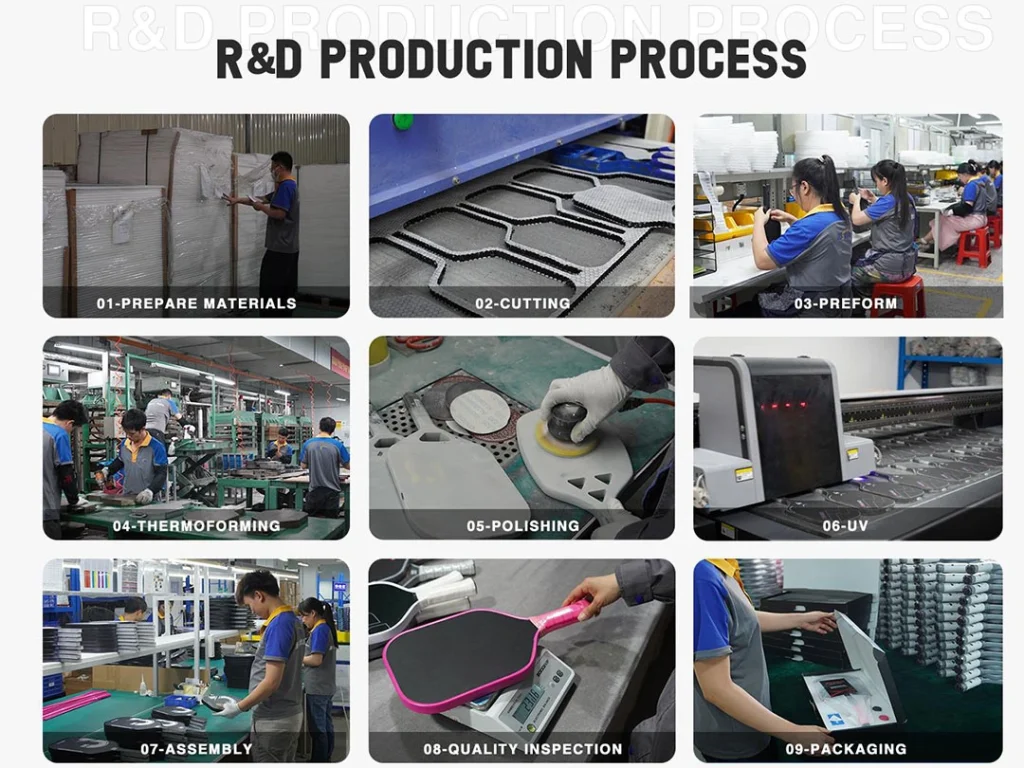
For B2B buyers building a product line, spin technology selection is an upstream specification decision that determines the entire performance and positioning architecture of a SKU. Here is how the NexaPaddle catalog maps to specific brand strategies:
Tier 1: Entry Point for Spin-Focused Lines
Cold Press Carbon + Teflon Spin (Product 1.3)
For brands entering the spin-focused market at a lower MOQ threshold and competitive unit economics, the cold press Carbon+Teflon Spin configuration is the accessible starting point.
- Face: Carbon + Teflon coating
- Core: 16mm PP Honeycomb
- Dimensions: 417×188mm
- Construction: Cold press
- MOQ: 300 pcs
- Positioning: Entry-level spin performance with Teflon durability; retail $50–$90 tier
The cold press construction at this tier is appropriate for brands building volume at accessible price points. The Teflon coating ensures spin performance holds through the product’s full retail lifecycle — a meaningful advantage over cold press paddles with spray-on grit that will generate returns.
Tier 2: Thermoformed Mid-Premium
Thermoformed Mold #4 Hybrid
The Mold #4 is NexaPaddle’s most configurable spin-optimized platform, offering face and core flexibility that allows brand owners to build differentiated SKUs within the same mold geometry.
- Face options: Carbon+Teflon or T700 raw carbon
- Core options: PP Honeycomb or GEN4 core
- Construction: Thermoformed
- MOQ: 100 pcs
- Positioning: Mid-premium ($120–$180 retail); ideal for product ladder builds where one mold supports multiple price points
Thermoformed Mold #8 Silent Series
- Face: T700 + Teflon coating
- Core: NCT-BV Core (noise-reduction optimized)
- Thickness: 14mm
- Construction: Thermoformed
- MOQ: 100 pcs
- Positioning: Premium noise-conscious market; indoor facilities, residential communities, club programs with noise ordinances; retail $150–$200
Explore the full spin pickleball paddles lineup to see how these configurations map to current production SKUs.
Specialty Tier: Maximum Spin Performance
T800 + Titanium Thread (Product C2)
- Face: T800 carbon + Titanium Thread weave
- Core: GEN3 Core
- Dimensions: 413×195mm
- Handle: 145mm
- Construction: Thermoformed
- MOQ: 100 pcs
- Positioning: Flagship spin-maximalist SKU; tournament players; $200–$249 retail
This is the specification for brands positioning at the highest performance tier and wanting the most differentiated technical narrative. The T800+Ti surface texture is structurally permanent, visually distinctive, and generates the highest surface COF in NexaPaddle’s lineup.
Flagship Tier: Power + Spin + Sweet Spot
GEN5 “Gatling” (T800 + Teflon-Weave Face + GEN5 Core)
- Face: T800 + Teflon-weave
- Core: GEN5 Polymeric Mesh Core
- Dimensions: 419.5×188mm
- Thickness: 16mm standard (14mm available)
- Construction: Thermoformed
- MOQ: 100 pcs
- Positioning: $249–$319 retail; directly competitive with Selkirk Vanguard 2.0 and JOOLA Perseus Pro IV; 60–72% gross margin at OEM cost
For brands seeking the largest sweet spot and highest energy return at USAPA compliance limits, the Gatling is the optimized answer. The T800+Teflon-weave face delivers excellent spin performance, power, and control simultaneously — the balanced flagship configuration versus the maximum-friction specialization of the T800+Ti face.
For carbon fiber pickleball paddles across all these tiers, the common thread is USAPA-verified surface compliance and structural spin performance that holds across the product’s intended lifespan.
Section 6: USAPA Compliance and Surface Roughness Regulations
Compliance is not a checkbox. For B2B buyers, it is a product liability and market access question. A paddle that fails USAPA approval cannot be used in sanctioned tournament play — and increasingly, competitive recreational players are evaluating paddles on the approved list before purchasing.
Surface Roughness Maximum: 40 Micrometers
USA Pickleball’s Equipment Standards specify a maximum surface roughness of 40 micrometers Ra for approved paddles. Paddles exceeding this threshold are not approved regardless of other specifications.
The standard is designed to prevent the most aggressive spray-on grit treatments from creating spin capabilities that distort competitive balance. Notably, the regulation targets excessive roughness — not roughness itself. The approved window includes substantial surface texture capability; the constraint is the ceiling, not the floor.
PBCoR: ≤ 0.43 (Tightened November 2025)
The Pickleball Coefficient of Restitution (PBCoR) threshold was tightened to ≤ 0.43 in November 2025. This parameter measures energy return — how much energy a paddle returns to the ball versus absorbs. The tightening reflects USA Pickleball’s response to paddle power inflation, with thermoformed paddles at the compliance boundary creating shots that were outpacing defensive play capabilities at the competitive level.
For brand owners, the PBCoR constraint is primarily a core architecture design consideration — softer cores that return more energy to the ball are more likely to approach the limit. Face material selection also influences PBCoR but to a lesser degree than core construction.
Woven (Structural) vs. Applied (Coating): The Regulatory Distinction
USA Pickleball’s current standards are specifically oriented toward applied surface treatments — coatings and particles added to a surface after composite fabrication. Structural surface texture — the kind created by woven carbon fiber and titanium thread composites — falls into a different regulatory category because it is a property of the material, not an addition to it.
This distinction has material implications for compliance risk:
- Raw carbon fiber faces (T700, T800): The natural surface roughness of these materials is within the approved window. Compliance is a design property, not something that requires optimization after the fact.
- Teflon coating: A coherent coating layer that must be pre-tested to verify final surface roughness is within the 40 μm Ra maximum. NexaPaddle conducts this testing for all Teflon-coated designs before production.
- T800+Titanium Thread: The structural texture from titanium weaving operates within the approved roughness window — verified through NexaPaddle’s pre-certification process.
2026 Field Testing: RFID Pilot at Golden Ticket Events
USA Pickleball is piloting RFID-based field testing at Golden Ticket events in 2026 — a significant regulatory evolution. Paddles embedded with RFID chips allow on-site verification of compliance data, shifting tournament enforcement from visual inspection toward data-verified compliance.
For brand owners, this development has one clear implication: compliance documentation needs to be airtight before the product launches. Paddles that pass initial lab testing but are borderline on surface roughness or PBCoR are more likely to face scrutiny as real-time testing becomes more common in sanctioned play.
NexaPaddle’s Pre-Testing Protocol
NexaPaddle pre-tests all paddle designs against USA Pickleball’s equipment standards before formal USAPA submission, covering:
- Surface roughness (Ra μm) — confirming all face configurations are within the 40 μm maximum
- PBCoR — verifying energy return compliance with the ≤ 0.43 threshold
- Dimensional compliance — face dimensions, thickness, handle length
Formal USAPA certification costs $500–$1,200 per design and takes 4–6 weeks from submission. For brand owners on launch timelines, starting the certification process in parallel with production planning is standard practice. NexaPaddle’s pre-testing protocol minimizes first-submission failure risk and reduces timeline uncertainty.
For reference, explore USAPA-approved paddles to review what compliance-verified designs look like in production.
Frequently Asked Questions
What makes a pickleball paddle spin-friendly?
Spin performance originates at the friction interface between paddle face and ball. The key variables are: surface coefficient of friction (higher = more spin), surface micro-texture (intrinsic texture engages the ball’s polymer surface during dwell time), and dwell time (core thickness and stiffness influence how long the ball stays in contact with the face). The best spin-optimized paddles combine a high-COF face material — raw carbon fiber or Teflon-coated carbon — with an appropriate core architecture that allows sufficient dwell time for maximum angular momentum transfer.
How long does spin performance last on raw carbon vs. spray-on grit vs. Teflon coating?
The performance windows are meaningfully different:
Raw carbon fiber (T700/T800): Permanent intrinsic texture. The micro-texture IS the carbon fiber filaments — tensile strength 4,900 MPa (T700) or 5,490 MPa (T800). Nothing to degrade under normal play conditions. Performance is stable for the paddle’s full functional lifespan.
Spray-on grit: 60–90 days of regular play before measurable spin decay. Adhesive-bonded particles shear off under repeated ball impact. The most common cause of premium paddle disappointment.
Teflon coating: Excellent durability. A coherent coating layer rather than discrete bonded particles — no shear failure mechanism. Performance maintenance significantly exceeds spray-on grit. Light use of an eraser tool periodically maintains performance.
Is Teflon coating USAPA approved?
Yes, when the final surface roughness remains within USA Pickleball’s 40 μm Ra maximum. Teflon coating itself is not a banned treatment — the regulation governs surface roughness outcomes, not specific coating materials. NexaPaddle pre-tests all Teflon-coated designs against surface roughness specifications before production, and all designs targeting USAPA-approved status go through formal certification testing before launch.
What’s the difference between T700 and T800 carbon fiber for spin performance?
T700 (Toray T700SC): 4,900 MPa tensile strength, 230 GPa modulus, 7 μm filament diameter. Excellent intrinsic surface texture, permanent spin performance, industry-standard specification for pro-tier paddles.
T800 (Toray T800S): 5,490 MPa tensile strength, 294 GPa modulus (~5 μm filament diameter). The 28% higher modulus makes the face stiffer at contact — less energy absorbed by face deflection, more energy returned to ball. This translates to faster exit velocity on drives and more precise energy return on all strokes. T800+Titanium Thread further extends the spin ceiling by adding structural Ti micro-ridges to the composite weave.
For spin-forward positioning: T700 is excellent and cost-optimized. T800 adds a power and precision dimension. T800+Ti is the maximum-performance specification.
Can I combine Teflon coating with other customizations for my brand?
Yes — and the Teflon + laser engraving combination is NexaPaddle’s recommended premium customization stack for brand owners seeking both performance and visual differentiation. Laser engraving on a Teflon-coated face creates custom surface texture patterns that function as both brand graphics and additional spin-generating surface features. The custom paddle specifications process at NexaPaddle supports this combination across all Teflon-coated SKUs in the catalog, with full USAPA pre-testing to confirm the combined surface treatment remains within approved roughness parameters.
Build Your Spin-Optimized Paddle Line with NexaPaddle
The engineering principles covered in this article translate directly into specific manufacturing decisions that B2B buyers can act on today.
Summary of key specifications:
- Cold Press Carbon+Teflon Spin: MOQ 300 pcs, entry-level spin performance with Teflon durability
- Thermoformed Mold #4 Hybrid: MOQ 100 pcs, configurable face and core for product ladders
- Thermoformed Mold #8 Silent (T700+Teflon): MOQ 100 pcs, noise-conscious premium market
- T800+Titanium Thread: MOQ 100 pcs, maximum spin ceiling, flagship positioning
- GEN5 “Gatling” (T800+Teflon-weave): MOQ 100 pcs, largest sweet spot, power+spin+control
NexaPaddle manufactures spin-optimized paddles at MOQ 100 pcs for thermoformed configurations and 300 pcs for cold press. All designs include pre-testing against USAPA Equipment Standards for surface roughness, PBCoR, and dimensional compliance.
Start with custom paddles to explore which spin technology approach fits your brand’s positioning. For pre-configured spin-optimized catalog options, browse spin pickleball paddles to see production-ready SKUs across all performance tiers.
Whether your brand needs the clean simplicity of a raw carbon spin story, the visual differentiation of Teflon plus laser engraving, or the technical narrative of a T800+Titanium Thread flagship — the manufacturing foundation is ready. The question is how you build on it.
Sources & Citations
Toray Industries. T700S / T700SC Technical Data Sheet. Tensile Strength: 4,900 MPa; Tensile Modulus: 230 GPa; Filament Diameter: 7 μm.
JustPaddles Paddle Lab. Best Pickleball Paddles for Spin — Lab-Measured RPM Rankings. January 2026.
USA Pickleball. Equipment Standards & Approved Paddle List — Surface Roughness Specifications.
Helios Pickleball. Carbon Fiber Pickleball Paddle Guide: T700, Grades & Surface Tech. September 2025.
NexaPaddle. Internal Product Testing Data: Surface Friction and Spin RPM by Face Material (2025).
Looking to source or customize spin-optimized pickleball paddles for your brand? NexaPaddle manufactures thermoformed and cold press spin paddles with MOQ 100–300 pcs depending on construction tier. Explore the full range of carbon fiber pickleball paddles and custom spin pickleball paddles built on the T700, T800, and T800+Titanium Thread engineering principles covered in this article.