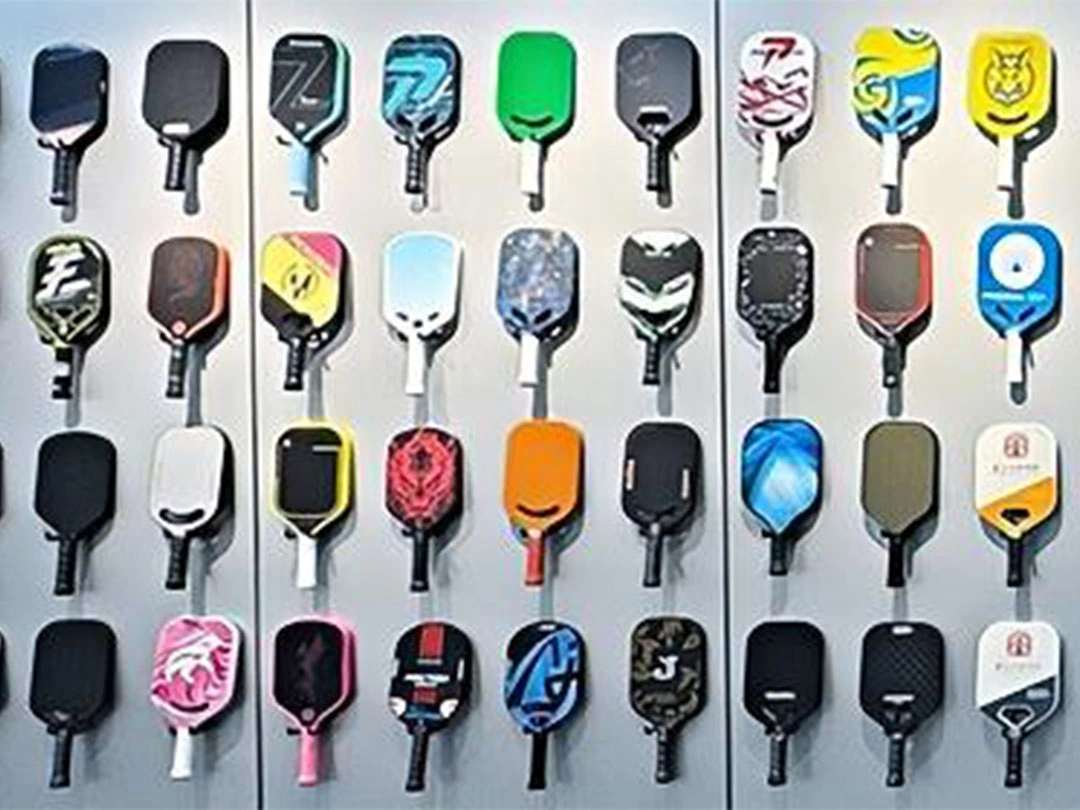
When brand owners come to us with complaints from their customers, the most common theme isn’t cracked faces or delaminating cores. It’s players holding two paddles from the same SKU that feel completely different in the hand.
That’s a weight problem — and it’s almost always a manufacturing problem.
In this guide, we’re going to talk about pickleball paddle weight from the perspective of people who actually build paddles at scale: what the numbers mean, what causes variation on the production floor, and what to look for when you’re vetting a supplier. If you’re a brand owner, Amazon seller, or distributor sourcing from China, this is the article you wish you’d read before your first large order.
1. Why Pickleball Paddle Weight Matters More Than You Think
Here’s a scenario we’ve seen more times than we can count. A US brand places a 500-unit order. The paddles arrive. Most customers are happy. Then the 1-star reviews start trickling in: “Feels heavier than the one I tried at my club.” “Bought two for doubles — they feel completely different.” “Returned it. Not what I expected.”
The brand owner goes back to the factory. “Our spec says 8.0 oz.” The factory says “Yes, within tolerance.” But nobody defined what “tolerance” actually meant — and nobody checked every paddle.
Weight is the #1 complaint trigger in pickleball paddle returns. Not because the number is wrong, but because it’s inconsistent. Players — especially experienced ones — are acutely sensitive to swing weight and balance point. A difference of 8–10 grams isn’t theoretical. It changes how the paddle feels at contact, how quickly it accelerates, and whether the player’s arm gets tired after a long session.
For brand owners, this creates a hidden liability. You can source the right carbon fiber. You can nail the aesthetic. But if your factory can’t deliver consistent pickleball paddle weights across every unit in a batch, your brand pays the price on review pages and return portals.
2. Pickleball Paddle Weight Categories: A Quick Reference
Before we get into manufacturing, let’s establish a shared vocabulary. The industry generally divides pickleball paddle weights into three categories:
Light Paddles: Under 7.5 oz (Under 213g)
Lightweight paddles are favored by players who prioritize quick hands, fast reaction time at the kitchen, and reduced arm fatigue. They’re popular with women players, seniors, and finesse-oriented dink-game specialists.
One important nuance: there’s a lightweight paradox that doesn’t get discussed enough. Ultra-light paddles — those under 7.3 oz (about 207g) — can actually increase arm strain for some players. The paddle’s low mass forces the arm to absorb more vibration at contact, rather than letting the paddle’s weight dampen the shock. This is worth flagging in your product descriptions if you’re going lighter than standard.
Mid-Weight Paddles: 7.5–8.4 oz (213–238g)
This is the sweet spot for most recreational and intermediate players. Mid-weight paddles offer a balance of power, control, and manageability. They’re the most popular segment for brand owners building an all-around SKU, and they’re the category where most custom pickleball paddles are specified.
Our production data puts the most common order weights in this range: Cold Press Carbon Fiber at 210–235g and Extended Handle Mold#5 at 215–230g both fall squarely here.
Heavy Paddles: Over 8.4 oz (Over 238g)
Heavy paddles generate more power with less swing effort. They suit baseline players, doubles players who like a firm block, and stronger athletes who can sustain the added swing weight over long matches. Cold Press Fiberglass at 220–245g sits at the upper edge of mid and into heavy territory depending on build specs.
A Note on Regulations: No USA Pickleball Weight Limit
This surprises a lot of brand owners: USA Pickleball has no official weight limit for paddles as of the 2025 Equipment Standards Manual, Revision 3.0. The standards focus on size (length + width ≤ 24 inches), surface texture, material restrictions, and deflection — not weight. So if you’re building a USAPA approved paddles line, weight is entirely a market decision, not a compliance one.
3. What Causes Weight Variation in Paddle Manufacturing
This is where most brand owners have blind spots. You spec a weight. The factory confirms it. But paddles come in all over the place. Why?
Material-Level Variables
Every paddle is a stack of materials, and each layer introduces its own variance:
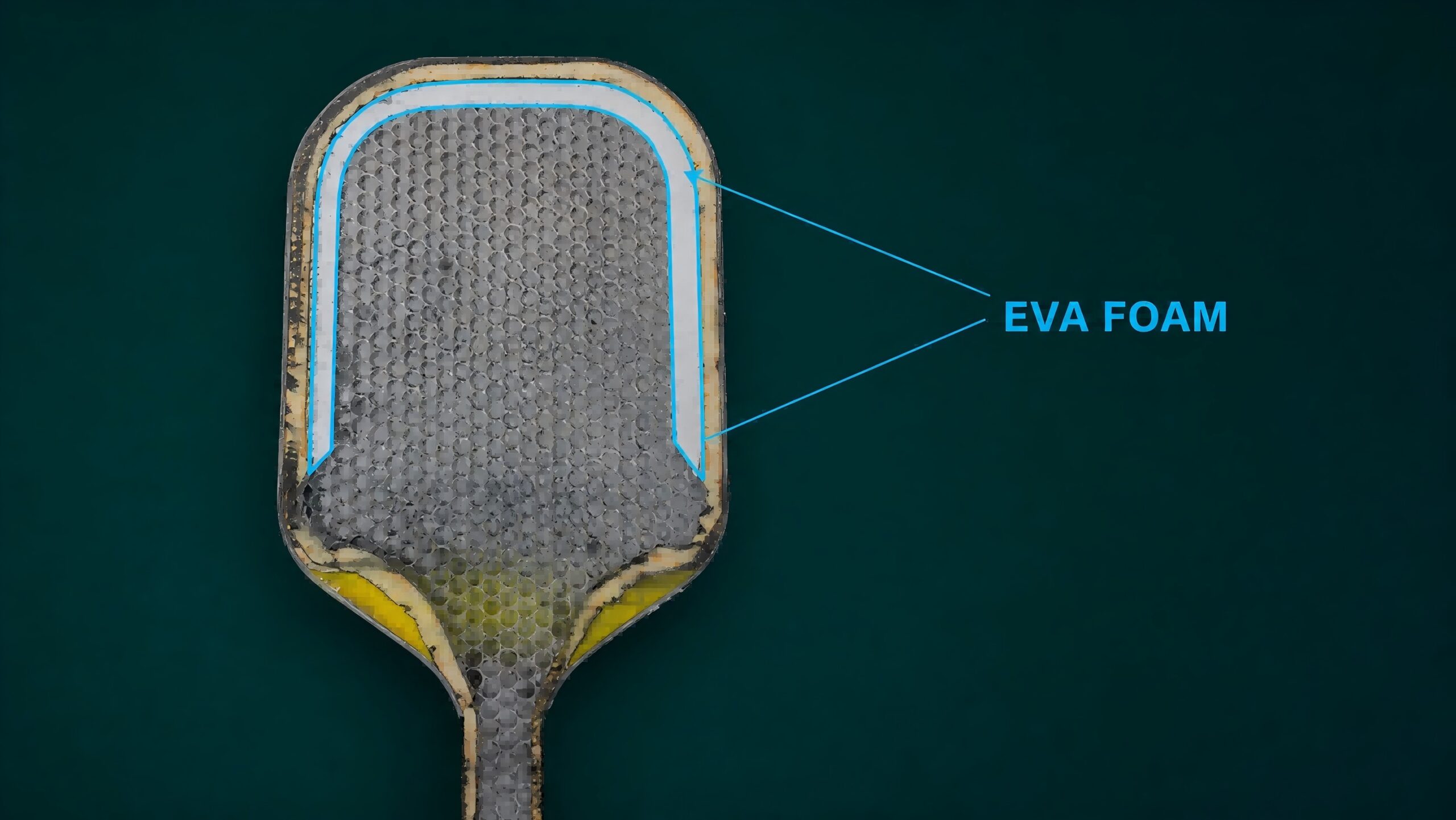
- Honeycomb core density: Polymer honeycomb cores — even from the same roll — can have micro-variations in cell wall thickness. A small change in density across a sheet means some cores weigh slightly more, some slightly less.
- Carbon fiber prepreg sheets: Sheet weight is rated by gsm (grams per square meter), but actual sheet weights vary by ±3–5% even in certified materials. Multiply that across two or four face layers and the variance compounds.
- Adhesive application: Many factories apply edge seal adhesive, face bonding adhesive, and handle adhesive by hand or with semi-automated dispensers. Inconsistent adhesive volume adds weight unevenly across units.
- Handle filler and grip: Handle construction uses foam, fiberglass tube, and wrapped grip tape. Each element adds grams, and each varies based on operator technique.
Process-Level Variables
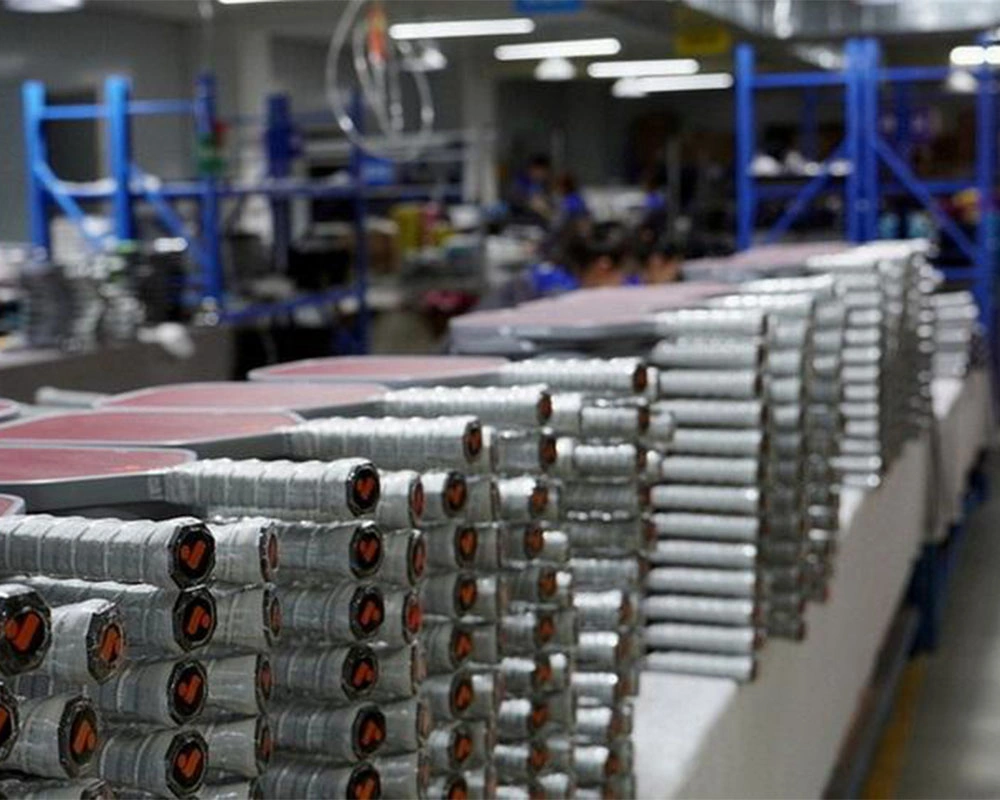
The manufacturing method itself matters enormously. Cold press production — where paddle layers are stacked and pressed at room temperature — typically produces more variance than thermoformed production, where heat and pressure are applied in a controlled mold cycle.
With thermoformed pickleball paddles, the mold geometry constrains the final dimensions more tightly, which reduces weight spread. But even thermoforming isn’t variance-free: mold temperature consistency, press cycle duration, and material prep all feed into the final number.
Environmental Factors
Humidity matters more than most people expect. Carbon fiber composites and polymer honeycomb cores are hygroscopic — they absorb moisture from the air. A paddle produced on a humid day in Guangdong in July genuinely weighs slightly more than the same design produced in a climate-controlled facility in winter. Budget factories working in open-bay production environments have no way to control for this.
The Result: ±5–15g Variance at Budget Factories
In our experience sourcing and auditing production across the industry, budget factories with no systematic QC routinely deliver weight variance of ±10–15g within a single batch. That’s the difference between a 7.8 oz and an 8.3 oz paddle wearing the same label. Players notice. Returns follow.
4. How Weight Inconsistency Kills Your Brand
We worked with a US-based Amazon seller who came to us after a painful experience with their previous supplier. The story is instructive.
They had a mid-weight all-around paddle selling well — good listing, solid reviews. Around month four, a cluster of 1-star reviews appeared with identical language: “Same model, completely different feel.” Customers who’d bought multiple units, or who’d compared their paddle to a friend’s, were experiencing clearly different weight and swing characteristics from an identical SKU.
Their previous factory had no systematic QC. Weight was “checked” by sampling a handful of paddles from each production run — not every unit, not with batch logging. The spec sheet said 8.0 oz ± 0.3 oz (±8.5g), but actual production variance was running ±12–15g with no corrective action on out-of-spec units.
Returns climbed. Review scores dropped. The listing’s velocity stalled. By the time they found us, they’d already been outranked by a competitor with a nearly identical product.
The Top 3 Return Reasons We Hear
Across the brand owners and Amazon sellers we work with, customer return complaints cluster into a consistent pattern:
- Weight and swing weight inconsistency — “Feels different from the one I tested / bought before”
- Bonding failure — Edge seal separation, face delamination
- Packaging damage — Transit damage, poor cushioning
Weight and swing weight inconsistency is #1 by a wide margin. And unlike bonding failure or packaging damage — which have obvious visual cues — weight inconsistency is invisible until the customer picks it up.
5. NexaPaddle’s Weight Control System
After extensive experience producing custom OEM pickleball paddles for B2B brands across multiple markets, we’ve built weight consistency into every layer of our production process. Here’s what that actually looks like.
4-Layer QC Architecture
We run a structured IQC → IPQC → FQC → OQC quality system:
- IQC (Incoming Quality Control): Raw materials — carbon fiber sheets, honeycomb cores, adhesives, grip tape — are weighed and batch-logged before they enter production. Material that falls outside spec doesn’t reach the floor.
- IPQC (In-Process Quality Control): Inspectors check weight at key production stages, not just at the end. Core cutting, face lamination, handle assembly — each phase has a checkpoint.
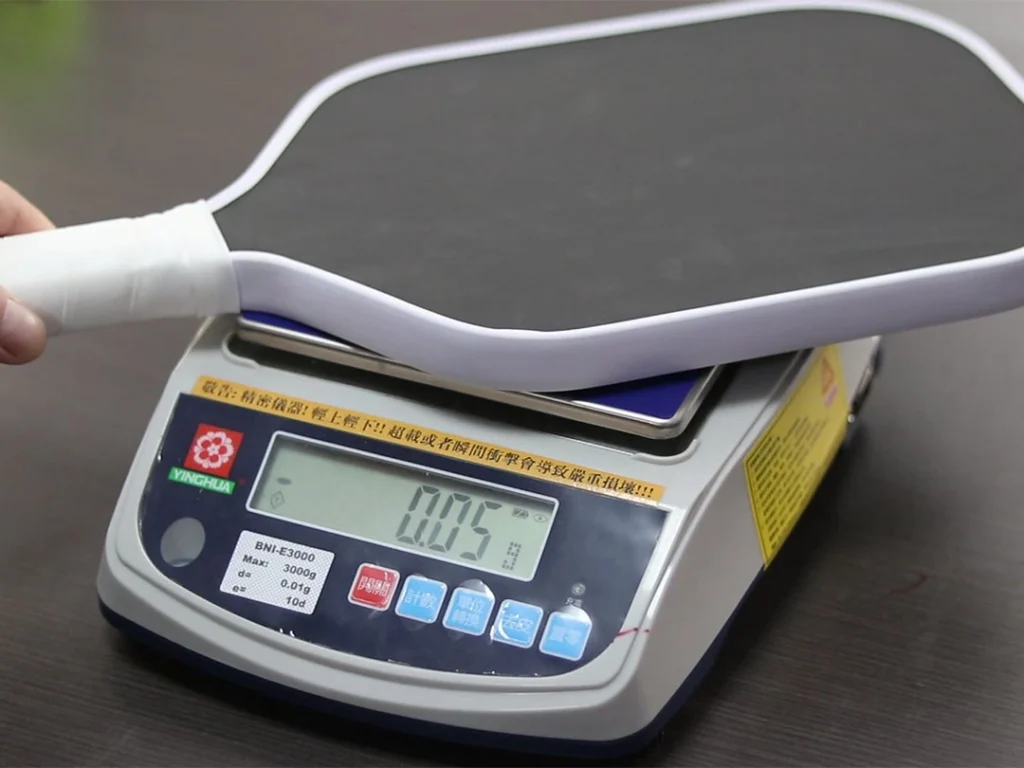
- FQC (Final Quality Control): Every finished paddle is individually weighed before packaging. No sampling. No spot checks. 100% measurement, with results logged to a batch record.
- OQC (Outgoing Quality Control): Pre-shipment verification of batch records, carton-level weight sampling, and final comparison against the Golden Sample.
100% Individual Weighing + Batch Logging
Most factories weigh a sample. We weigh every paddle.
Each unit is placed on a calibrated digital scale and its weight recorded in the batch log. The log captures production date, batch number, mold, and individual weights. This creates a traceable record that brand owners can request for any shipment — useful for warranty claims, compliance documentation, and long-term quality trending.
Golden Sample A/B Comparison System
When a new product is developed or a production run begins, we establish a Golden Sample — a reference paddle that represents the approved spec for weight, balance point, and hardness. Every batch is compared against the Golden Sample at FQC.
If a unit falls outside tolerance relative to the Golden Sample, it’s pulled, logged, and either reworked or scrapped. It does not ship.
Step 05 Quality Department: What We Actually Measure
Our Step 05 Quality Department measures three key parameters on every paddle:
- Balance point — where the paddle’s center of mass sits relative to the handle/face junction
- Weight — total mass in grams
- Hardness — face surface hardness measured with a Shore D gauge
These three together define the playing feel of a paddle far more accurately than weight alone. A paddle can hit its weight spec while being face-heavy or handle-heavy — which creates completely different swing feel. We track all three.
12-Item QC Test Table
Our full production QC checklist runs 12 items. Weight consistency is Item #1. The remaining items cover face texture, edge seal integrity, handle bond strength, grip wrap quality, print registration, and packaging.
Weight leads the list because it’s the first thing a player notices and the hardest defect to catch after the fact.
Recommended Tolerances
For standard orders, we recommend starting at ±7g tolerance on weight specifications. This is tight enough to deliver consistent player feel while remaining achievable across high-volume production.
For premium lines — higher price points, professional-level claims, or programs targeting competitive players — we recommend tightening to ±5g, which is our internal capability target. Our carbon fiber pickleball paddles in thermoformed configurations consistently achieve this range.
| Mold / Configuration | Typical Weight Range | Recommended Tolerance |
|---|---|---|
| Cold Press Fiberglass | 220–245g | ±7g |
| Cold Press Carbon Fiber | 210–235g | ±7g |
| Thermoformed Mold#3 (Power) | ~220g | ±5g |
| Extended Handle Mold#5 | 215–230g | ±7g |
| Hot Press Forged Mold#7 | 220–235g | ±5g |
6. How to Evaluate a Factory’s Weight Control
If you’re vetting a new supplier — or auditing your current one — here are the questions that separate serious manufacturers from spec-sheet factories:
Ask for Batch Weight Reports
Request actual batch weight data from a recent production run. A real QC system generates real records. If the factory can’t produce individual-unit weight logs within a few minutes, they don’t have 100% weighing — they have sampling, and they’re calling it QC.
Ask How They Handle Out-of-Spec Paddles
A factory with real weight control has a clear answer: out-of-spec units are pulled, logged, and either reworked or scrapped. They do not ship. If the answer is vague — “we adjust the production” or “rarely happens” — push harder. What’s the threshold? What happens to the unit? Is it documented?
Request the Golden Sample Protocol
Ask whether the factory uses a Golden Sample or reference standard. Ask where it’s stored, how it’s maintained, and whether it’s compared against production at FQC or only at initial setup. A Golden Sample that’s only used once — during sampling — provides no batch-level protection.
Check Whether Weight Is Measured 100% or Sampled
This is the most important question. Sampling catches systematic issues but misses individual unit variance. If a factory is sampling 5% or even 10% of units, paddles at ±15g can still ship legally within their own QC system. Only 100% weighing catches the outliers that cause the review complaints.
Ask About IQC on Incoming Materials
Raw material variance is the upstream cause of finished weight variance. A factory that doesn’t measure incoming material weights is operating blind. Ask specifically: do you weigh carbon fiber sheets by batch? Do you measure core density on incoming rolls? The answer tells you a lot about where their control system actually starts.
7. Choosing the Right Pickleball Paddle Weight for Your Product Line
For brand owners building a product line, weight selection is a market positioning decision as much as a technical one.
Match Weight to Player Segment
| Player Type | Recommended Weight | Notes |
|---|---|---|
| Women, seniors, beginners | Light (<7.5 oz / <213g) | Prioritize fatigue reduction and quick hands |
| All-around recreational | Mid (7.5–8.4 oz / 213–238g) | Widest appeal, most popular segment |
| Power players, men’s doubles | Heavy (>8.4 oz / >238g) | Drive power, stable block game |
If you’re building a single hero SKU, the 230–235g range is the safest mass-market position. It covers most recreational players without alienating anyone.
Think Beyond Weight: Swing Weight and Balance Point
Total weight is one number. Swing weight is how the paddle feels when you actually swing it — and it’s determined by where the mass is distributed, not just how much there is. A head-heavy paddle feels heavier than its static weight. A handle-heavy paddle feels lighter.
Balance point — the distance from the handle butt to the paddle’s center of gravity — is the metric that captures this. We measure balance point as part of our standard QC process and can provide target balance point specs for brand owners who want to define the full swing feel of their paddle, not just the static weight.
If your premium line competes on “feel,” balance point is the spec you should be controlling. Weight alone isn’t enough.
The Lead Tape Market as Evidence
One underappreciated signal: there’s an entire aftermarket category of lead tape sold specifically for pickleball paddles. Players buy it to adjust swing weight and balance point — adding grams to the head for more power, or to the handle for more control. This market exists precisely because players can feel small weight differences, and because factory production doesn’t always deliver what they want.
For brand owners, this is a quality signal worth noting. If your paddles are consistent, players adjust with lead tape because they want to customize. If your paddles are inconsistent, players adjust with lead tape because they have to — and they blame your brand, not the factory.
Frequently Asked Questions
u003cstrongu003eWhat is the standard weight range for pickleball paddles?u003c/strongu003e
The industry generally recognizes three categories: light (under 7.5 oz / under 213g), mid-weight (7.5–8.4 oz / 213–238g), and heavy (over 8.4 oz / over 238g). The mid-weight range is the most popular for recreational and all-around play. There is no official weight limit imposed by USA Pickleball — the 2025 Equipment Standards Manual, Revision 3.0 does not specify a maximum or minimum paddle weight.
u003cstrongu003eHow much weight variation is normal in manufacturing?u003c/strongu003e
In well-controlled manufacturing environments, a tolerance of ±0.2 oz (±5.7g) is considered standard and achievable. Budget factories with limited QC infrastructure routinely see ±10–15g variance within a single production batch. NexaPaddle’s internal capability target is ±5g, achieved through 100% individual weighing and material-level incoming QC.
u003cstrongu003eCan players actually feel a few grams of difference in pickleball paddle weight?u003c/strongu003e
Yes — experienced players can detect differences of 5–10 grams, particularly when comparing two paddles of the same model side by side. The lead tape aftermarket exists specifically because players are sensitive to weight and balance point adjustments at this scale. In customer returns, “feels heavier/lighter than expected” is a consistently cited complaint even when the variance is within published tolerances.
u003cstrongu003eDoes USA Pickleball have a weight limit for paddles?u003c/strongu003e
No. As of the 2025 Equipment Standards Manual, Revision 3.0, USA Pickleball does not enforce any weight limit on approved paddles. Approval criteria focus on overall dimensions (combined length + width ≤ 24 inches), surface texture, material type restrictions, and deflection testing — not weight. Brand owners building a USAPA-approved line have complete freedom on weight specification.
u003cstrongu003eHow does NexaPaddle ensure weight consistency across large orders?u003c/strongu003e
NexaPaddle uses a 4-layer QC system (IQC → IPQC → FQC → OQC) with 100% individual weighing at final quality control — not sampling. Every paddle’s weight is logged to a batch record. Production is compared against a Golden Sample at FQC. Incoming materials are batch-logged at IQC before entering production. For standard orders, we recommend ±7g tolerance; for premium lines, our internal capability of ±5g is available.
Partner With a Factory That Takes Weight Seriously
Weight consistency isn’t a detail. For brand owners competing on Amazon or in the specialty retail channel, it’s one of the core factors that separates a sustainable brand from a race-to-the-bottom SKU.
At NexaPaddle, we’ve spent over a decade building systems — not just making paddles. Our 4-layer QC, 100% weighing protocol, and Golden Sample standard exist because we’ve seen what happens when these controls aren’t in place. We’ve helped brands recover from supplier failures, and we’ve helped brands build for scale from the beginning.
If you’re serious about weight consistency in your next production run, reach out to the NexaPaddle team. We’ll walk you through our QC documentation, share batch reports from comparable production runs, and help you define the tolerances that make sense for your product line and target audience.
Footnotes
USA Pickleball 2025 Equipment Standards Manual, Revision 3.0. No official weight limit is specified for approved paddles. Approval criteria focus on dimensions, surface texture, material restrictions, and deflection testing.
NexaPaddle internal QC documentation. 4-layer QC system: IQC (Incoming), IPQC (In-Process), FQC (Final), OQC (Outgoing). Step 05 Quality Department measures weight, balance point, and hardness on 100% of finished paddles.
Industry standard tolerance data from OEM manufacturing experience across multiple Chinese production facilities. Budget production environments without systematic QC routinely produce ±10–15g variance within single batches.
NexaPaddle PO template recommended tolerances: ±7g for standard production lines; ±5g for premium configurations including thermoformed and hot press forged constructions.
Lead tape market data as evidence of player weight sensitivity. Pickleball-specific lead tape products are sold by major equipment retailers specifically for swing weight and balance point customization, confirming that players can detect and respond to sub-10g weight differences.
Amazon seller case study from NexaPaddle client records. US brand experienced return rate increase and listing rank decline attributed to inter-unit weight inconsistency from previous supplier. Issue resolved following transition to NexaPaddle’s 100% weighing protocol.