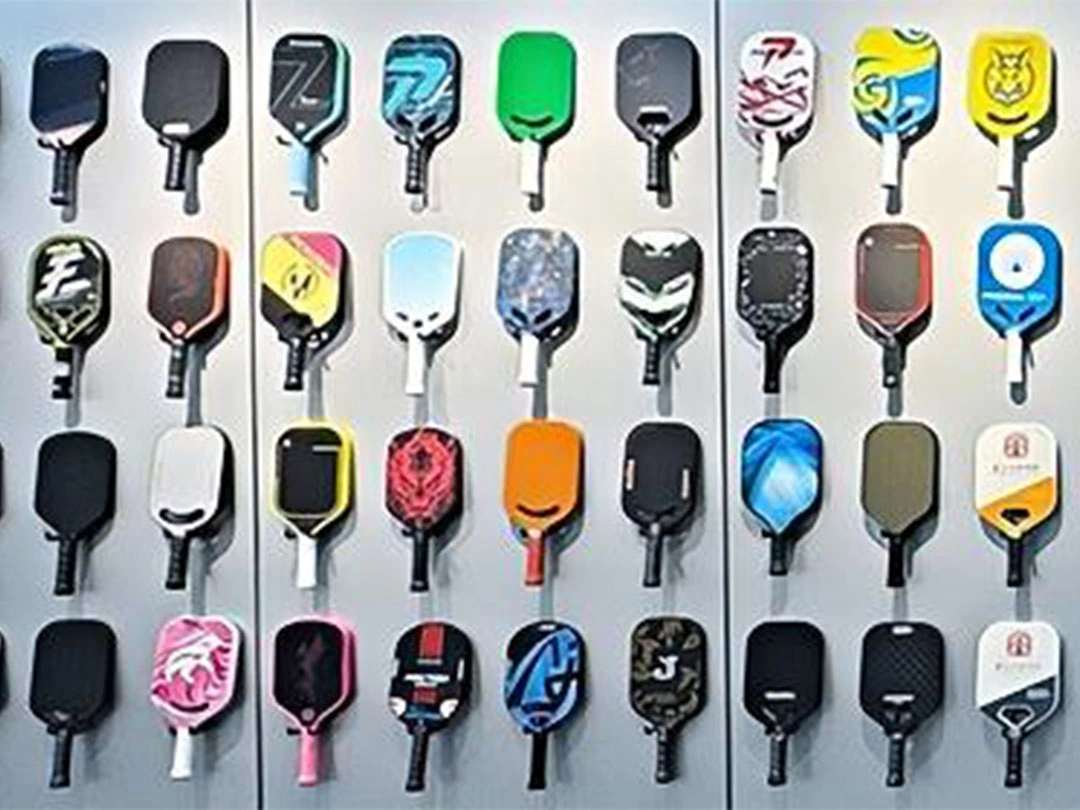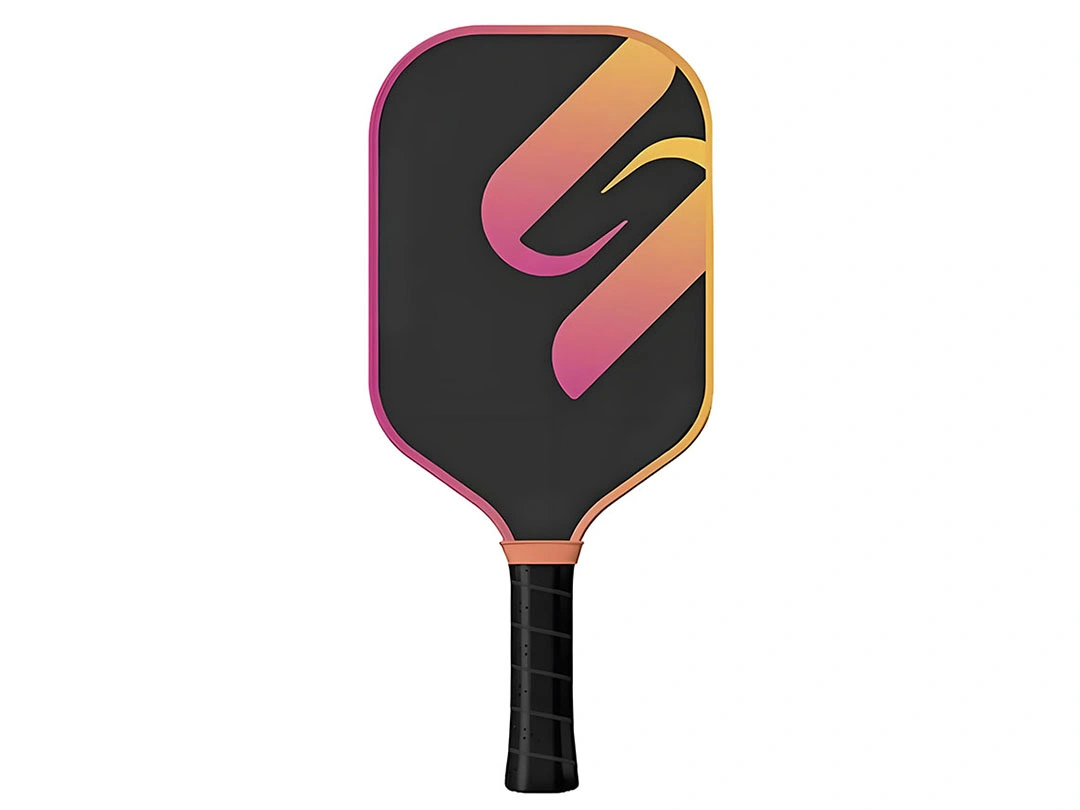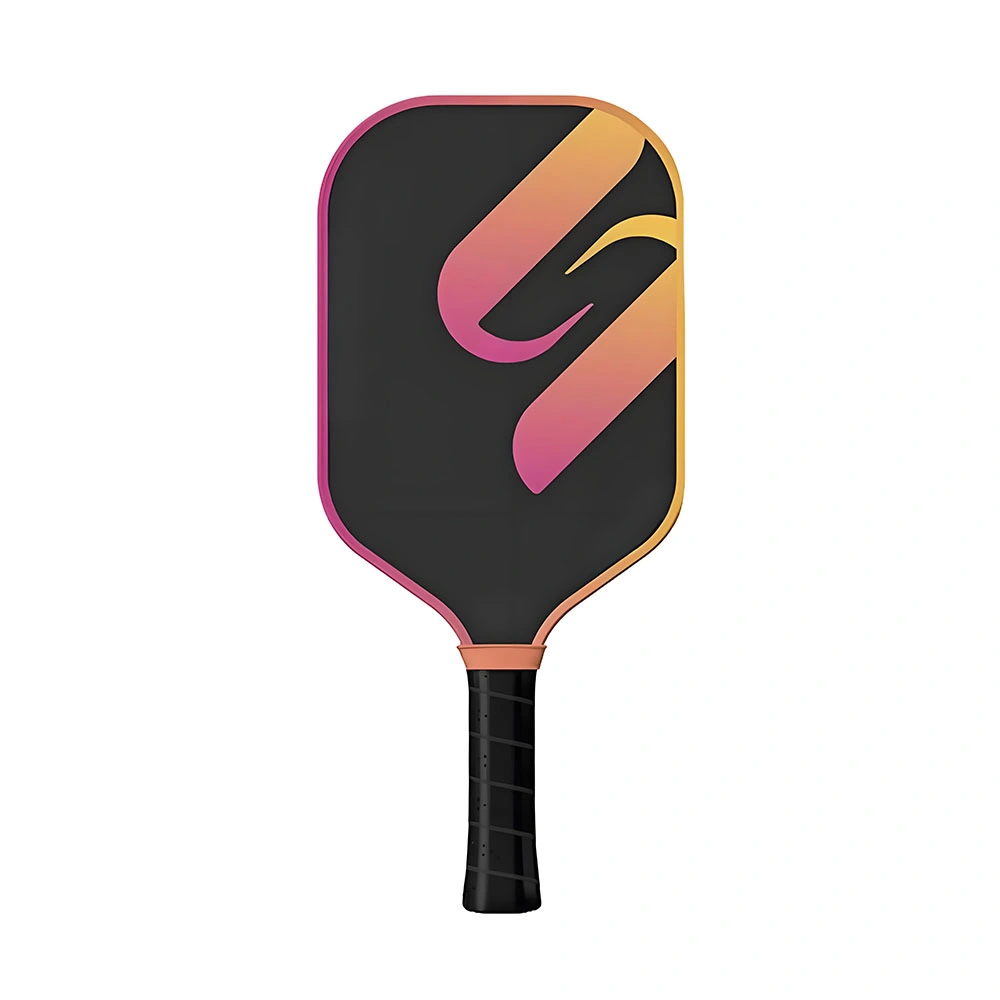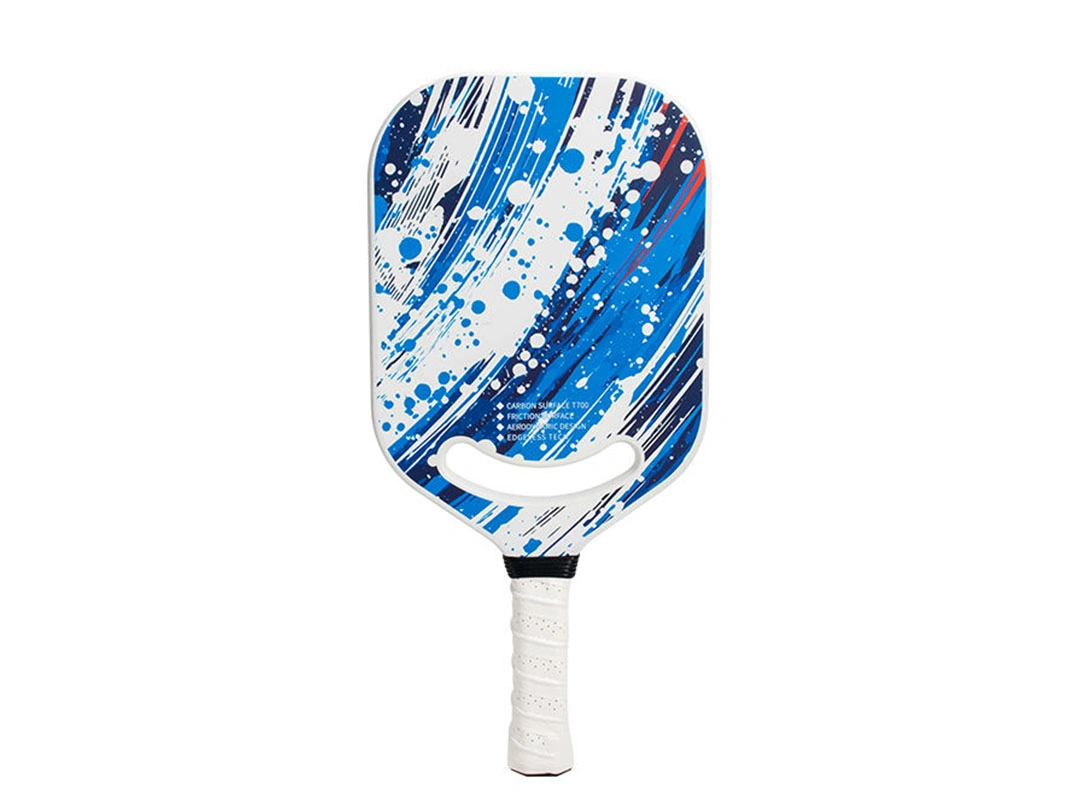
Most B2B buyers spend hours comparing surface materials and core technologies — and spend almost no time evaluating paddle shape. That is a strategic error.
Shape determines sweet spot geometry, swing mechanics, power generation, and player forgiveness tolerances. It is the single specification that most directly maps to a target player segment. Yet in many sourcing conversations, it gets reduced to a passing note: “we want the standard one” or “can you make it longer?” without any understanding of the dimensional physics behind that choice.
This guide corrects that. It covers the USAPA regulatory envelope, the mechanics of aspect ratio, how each of the three primary shape categories (standard, wide-body, and elongated) performs differently at ball-strike, and how to match NexaPaddle mold specifications to your specific product line strategy.
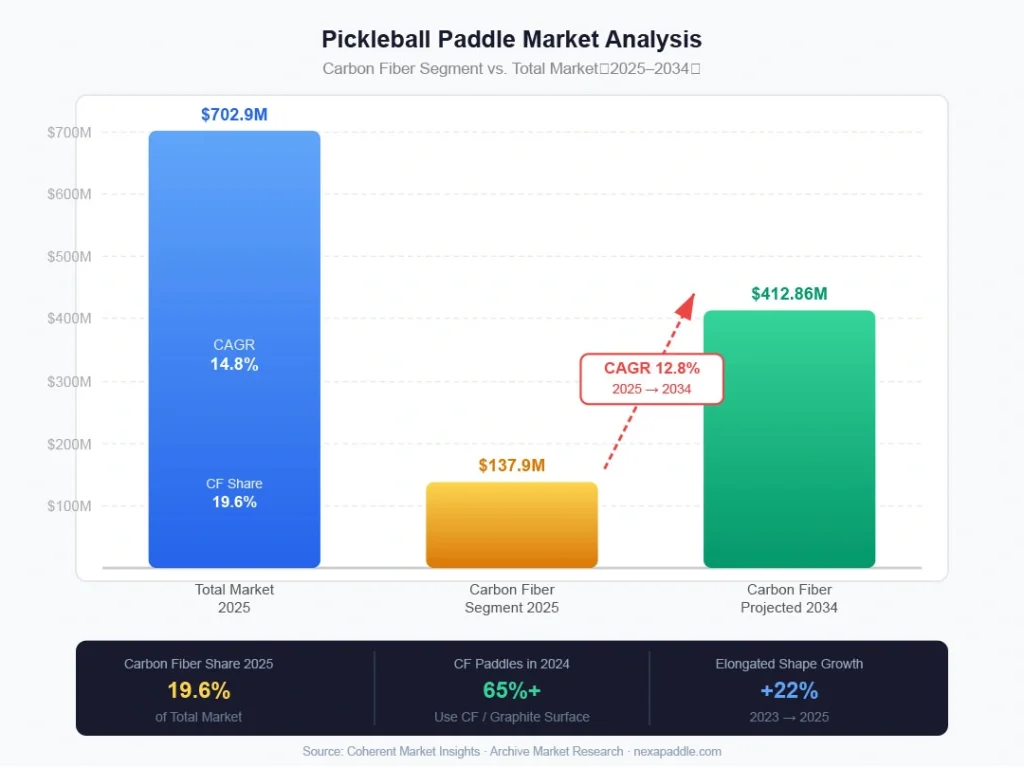
The US pickleball market is projected to reach $702.9M in 2025. The sport now has 36.5 million players in the United States. That market is not monolithic. Beginners, competitive doubles players, aggressive singles players, and tennis crossovers each have distinct biomechanical preferences. Paddle shape is your primary tool for targeting them.
The USAPA Regulatory Envelope: What the Rules Actually Say
Before discussing shape categories, it is worth establishing exactly what USA Pickleball permits. The Equipment Standards Manual, Revision 3.0 (January 2025) defines the following dimensional constraints for approved paddles:
| Parameter | Limit |
|---|---|
| Maximum combined length + width | 24 inches (609.6 mm) |
| Maximum length (including handle) | 17 inches (431.8 mm) |
| Minimum length | Not specified |
| Thickness | Not specified |
| Weight | Not specified |
| Handle length | Not specified |
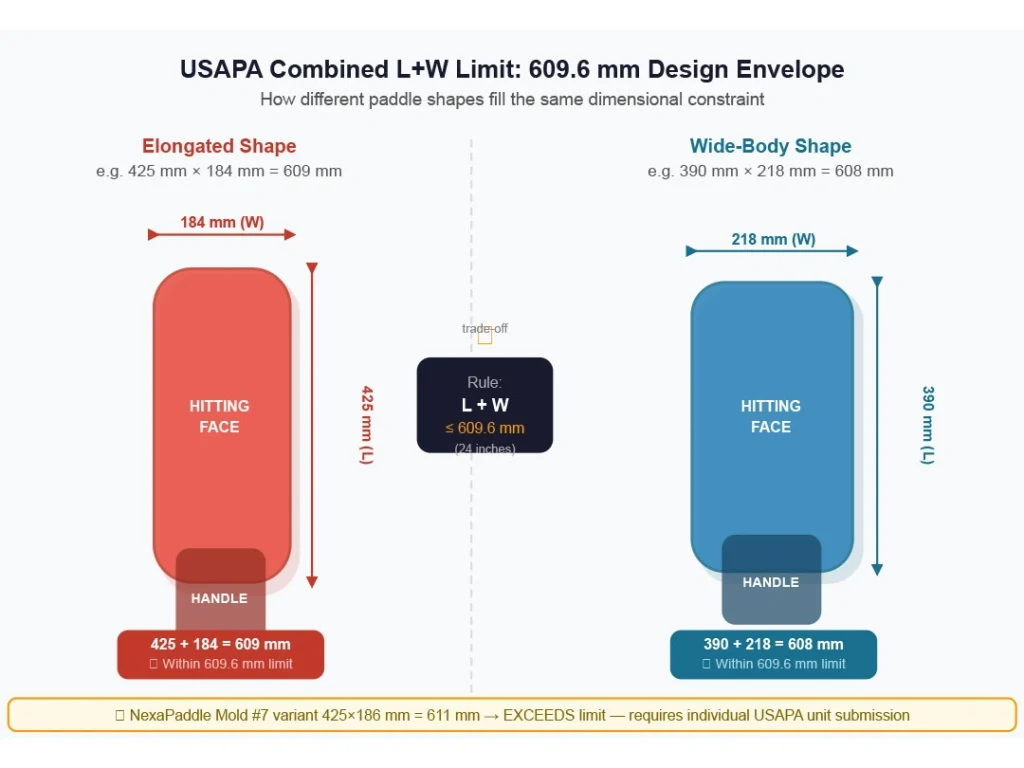
The key constraint is the combined L+W maximum of 609.6 mm. This is a ceiling, not a target. It creates a design envelope inside which manufacturers can trade length against width and vice versa.
There is no thickness limit. There is no weight requirement. These omissions are significant — they allow manufacturers to differentiate on core thickness and weight distribution without regulatory constraint.
One compliance note for B2B buyers: Some NexaPaddle molds intentionally leave margin below the 609.6 mm ceiling. Mold #7 at its 425×186 mm variant sums to 611 mm and therefore operates at or slightly beyond the standard limit — this configuration requires individual unit submission for USAPA approval before use in sanctioned play. The 420×185 mm variant of the same mold (605 mm total) is comfortably within limits. Always confirm the specific dimensional variant with your sourcing contact before adding “USAPA Approved” claims to marketing materials.
The Three Shape Categories: Full Specifications
Category 1: Standard / Control Shape
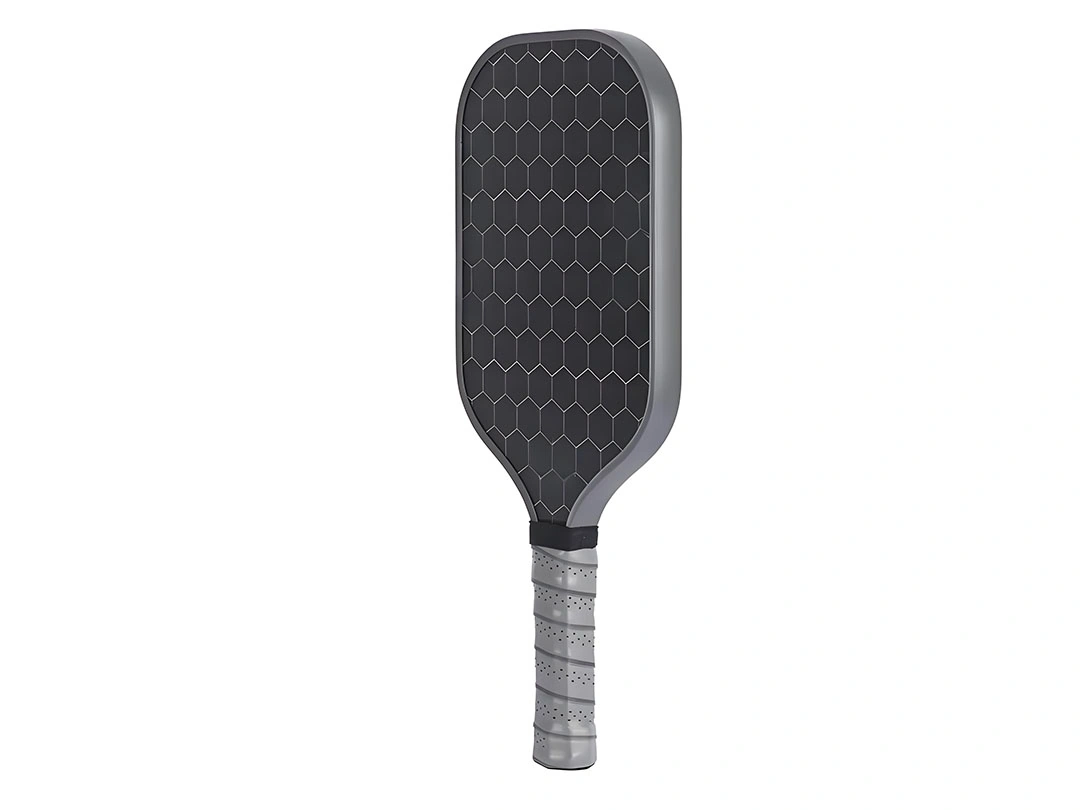
The standard control shape is the industry baseline — the shape most recreational players and beginners encounter first. It prioritizes face width, which directly enlarges the sweet spot and increases forgiveness on off-center contact.
NexaPaddle Mold #1 (Wide-Body, Thermoformed + Edgeless Option)
| Spec | Value |
|---|---|
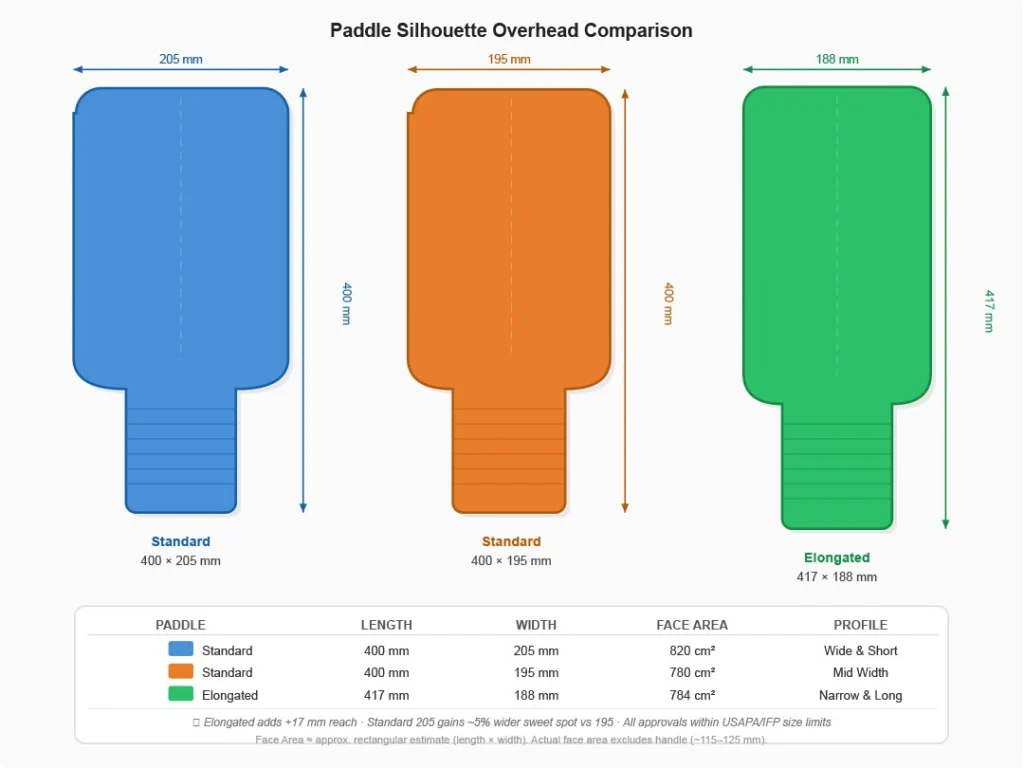
| Body dimensions | 400 × 205 mm |
| Combined L+W | 605 mm (within 609.6 mm limit ✓) |
| Thickness | 20 mm |
| Handle length | 130 mm |
| Approx. weight | ~245 g |
| Width/Length ratio | 0.51 |
| Construction | Thermoformed unibody; edgeless option available |
At 205 mm wide, Mold #1 carries the largest face width in the NexaPaddle lineup. This is the widest face available and produces the largest effective sweet spot — meaning the lateral tolerance zone for off-center hits is maximized. The 20 mm core thickness further softens impact feel, making this the most forgiving configuration on mishits.
NexaPaddle Mold #2 (All-Around, Thermoformed)
| Spec | Value |
|---|---|
| Body dimensions | 400 × 195 mm |
| Combined L+W | 595 mm (within limit ✓) |
| Thickness | 14–16 mm |
| Handle length | 130 mm |
| Width/Length ratio | 0.49 |
At 195 mm width, Mold #2 steps back slightly from maximum forgiveness to gain a bit more paddle head maneuverability. The 14–16 mm thickness range offers a firmer response than Mold #1, improving touch and dink precision at the kitchen line.
Cold Press Control Shape matches the Mold #2 footprint (400 × 195 mm, 130 mm handle) at a lower price point, with MOQ of 300 pcs versus 100 pcs for thermoformed.
Category 2: Elongated / Power Shape
Elongated paddles redistribute the same dimensional budget — the 609.6 mm combined limit — toward length rather than width. This geometry shifts the sweet spot higher on the face, increases reach, and raises rotational velocity at the paddle tip during a swing arc.
NexaPaddle Mold #3 (Primary Elongated, Thermoformed + Edgeless Option)
| Spec | Value |
|---|---|
| Body dimensions | 417 × 188 mm |
| Combined L+W | 605 mm (within limit ✓) |
| Thickness | 13–16 mm |
| Handle length | 139 mm |
| Approx. weight | ~220 g |
| Width/Length ratio | 0.45 |
| Construction | Thermoformed unibody; edgeless option available |
Mold #3 is the elongated workhorse. The 417 mm length pushes the sweet spot to a higher contact point — aligning with the natural strike zone for players driving from the baseline. The handle extends to 139 mm, providing +9 mm over the standard 130 mm, which accommodates partial two-handed backhand grips. At approximately 220 g, it is 25 g lighter than Mold #1, which improves swing speed and reduces arm fatigue during extended play.
NexaPaddle Mold #5 (Extended Handle, Thermoformed)
| Spec | Value |
|---|---|
| Body dimensions | 415 × 185 mm |
| Combined L+W | 600 mm (within limit ✓) |
| Thickness | 16 mm |
| Handle length | 145 mm |
| Approx. weight | 215–230 g |
| Width/Length ratio | 0.45 |
Mold #5 is optimized for tennis-to-pickleball crossover players. The 145 mm handle provides sufficient real estate for a full two-handed backhand grip. This is 15 mm longer than the standard 130 mm — enough to change hand positioning fundamentally, not just marginally.
NexaPaddle Mold #7 (Hot Press Forged)
| Spec | Value |
|---|---|
| Body dimensions | 420 × 185 mm (or 425 × 186 mm — see compliance note above) |
| Combined L+W | 605 mm or 611 mm |
| Handle length | 145 mm |
| Approx. weight | 220–235 g |
| Construction | Hot press forged |
NexaPaddle Mold #8 (Silent Series)
| Spec | Value |
|---|---|
| Body dimensions | 420 × 185 mm |
| Combined L+W | 605 mm (within limit ✓) |
| Thickness | 14 mm |
| Handle length | 145 mm |
| Notes | Noise-dampened construction; ideal for noise-restricted courts |
Cold Press Power Shape mirrors Mold #3 (417 × 188 mm, 139 mm handle) at the cold press price point.
Category 3: Specialty / Hybrid Shapes
Two NexaPaddle molds fall between the standard and elongated categories — they are neither maximum-width nor maximum-length, but deliberately balanced hybrid configurations. Hybrid shapes are the fastest-growing retail paddle segment (2023–2025), as players at 3.5+ skill levels increasingly seek the best-of-both-worlds geometry.
GEN3 Core 2.0 — Maximum Handle Extension
| Spec | Value |
|---|---|
| Body dimensions | 417 × 188 mm |
| Handle length | 149 mm (maximum in lineup) |
| Notes | Longest handle available; designed for advanced leverage mechanics |
T800 + Titanium Thread — Hybrid Geometry
| Spec | Value |
|---|---|
| Body dimensions | 413 × 195 mm |
| Handle length | 145 mm |
| Notes | Intermediate between standard and elongated; wider than power shape, longer than control shape |
The 413 × 195 mm footprint is unique in the lineup. At 195 mm wide it retains meaningful face area; at 413 mm it gains some reach without going to full elongated dimensions. This makes it a legitimate crossover shape for players who want forgiveness but aren’t willing to sacrifice all reach.
GEN5 Gatling Flagship
| Spec | Value |
|---|---|
| Body dimensions | 419.5 × 188 mm |
| Thickness | 16 mm |
| Notes | Near-maximum elongated geometry in flagship specification |
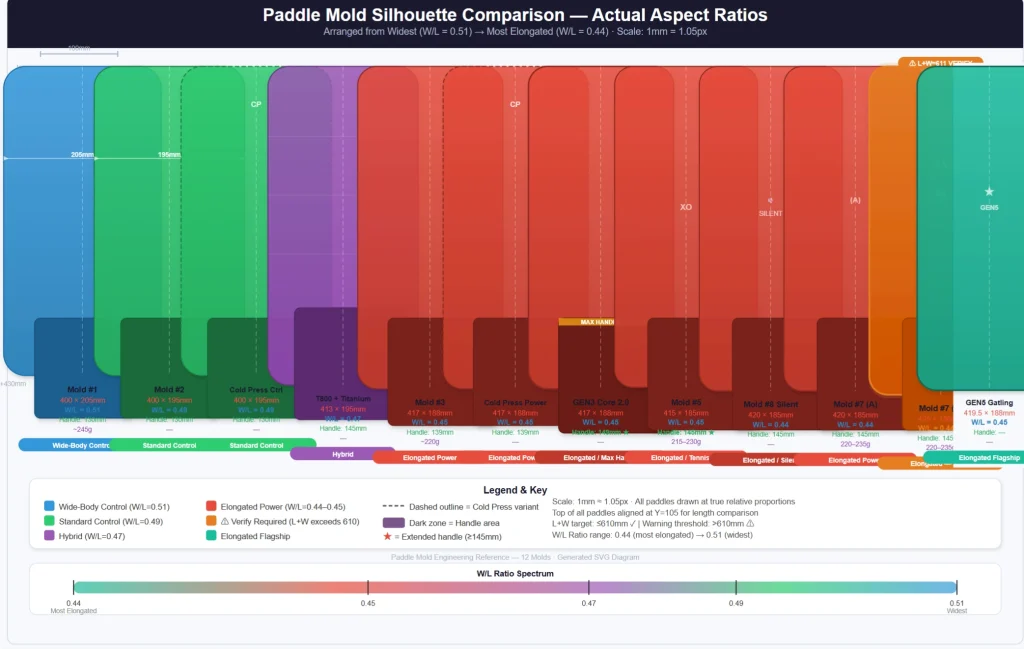
Complete Mold Comparison Table
| Mold | Dimensions (mm) | L+W Total | W/L Ratio | Handle (mm) | Category | Weight |
|---|---|---|---|---|---|---|
| Mold #1 | 400 × 205 | 605 ✓ | 0.51 | 130 | Wide-Body Control | ~245g |
| Mold #2 | 400 × 195 | 595 ✓ | 0.49 | 130 | Standard Control | — |
| Cold Press Control | 400 × 195 | 595 ✓ | 0.49 | 130 | Standard Control | — |
| T800 + Titanium | 413 × 195 | 608 ✓ | 0.47 | 145 | Hybrid | — |
| Mold #3 | 417 × 188 | 605 ✓ | 0.45 | 139 | Elongated Power | ~220g |
| Cold Press Power | 417 × 188 | 605 ✓ | 0.45 | 139 | Elongated Power | — |
| GEN3 Core 2.0 | 417 × 188 | 605 ✓ | 0.45 | 149 | Elongated / Max Handle | — |
| Mold #5 | 415 × 185 | 600 ✓ | 0.45 | 145 | Elongated / Tennis XO | 215–230g |
| Mold #8 Silent | 420 × 185 | 605 ✓ | 0.44 | 145 | Elongated / Silent | — |
| Mold #7 (A) | 420 × 185 | 605 ✓ | 0.44 | 145 | Elongated Power | 220–235g |
| Mold #7 (B) | 425 × 186 | 611 ⚠️ | 0.44 | 145 | Elongated — verify | 220–235g |
| GEN5 Gatling | 419.5 × 188 | 607.5 ✓ | 0.45 | — | Elongated Flagship | — |
The Physics of Aspect Ratio: How Dimensions Affect Ball-Striking
Understanding why these shapes perform differently requires examining four mechanical variables: sweet spot geometry, swing velocity, leverage mechanics, and moment of inertia.
1. Face Width and Sweet Spot Forgiveness
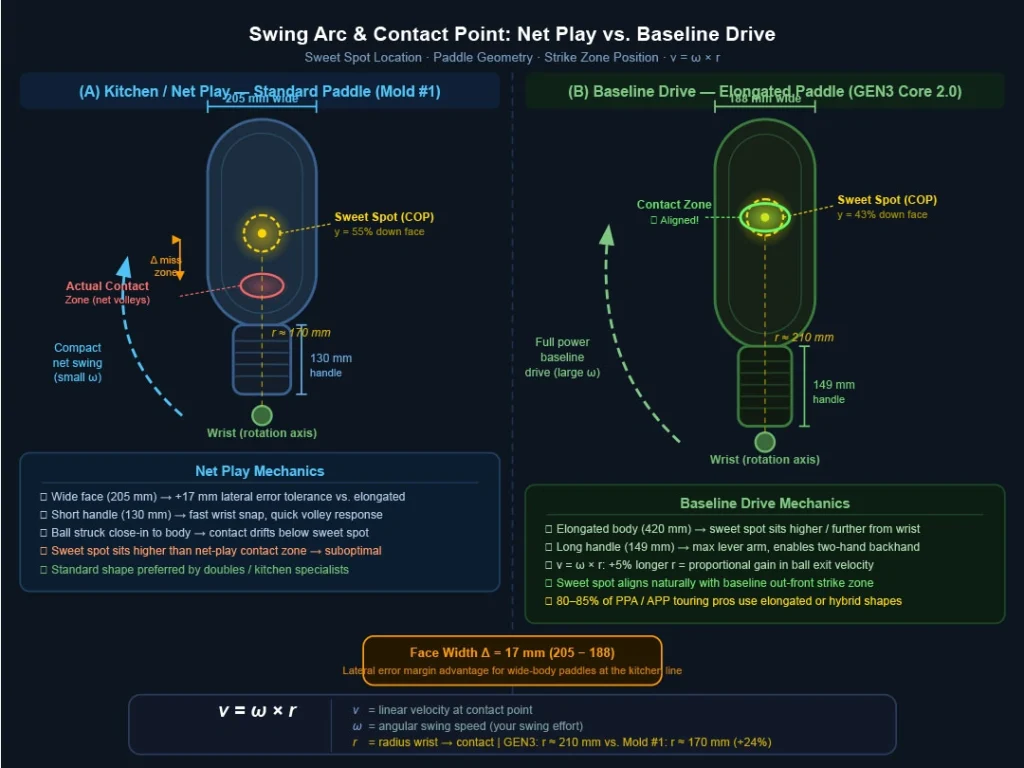
A wider face does not automatically create a larger sweet spot in the strict physics definition — the center of percussion (COP) is determined by mass distribution, not face shape alone. However, face width does directly determine lateral error tolerance: the distance from the center of percussion to the paddle edge in the horizontal plane.
On Mold #1 (205 mm wide), a player can miss the ideal horizontal contact point by more millimeters before reaching the frame. On Mold #3 (188 mm wide), that lateral margin shrinks by 17 mm. For players hitting under pressure at the kitchen line, this difference is operationally significant.
The practical effect: wide-body paddles are more forgiving on lateral mishits. Elongated paddles are more forgiving on vertical mishits — they offer more face length above and below the geometric center.
2. Body Length and Rotational Velocity
Physics defines rotational (angular) velocity as:
v = ω × r
Where v is the linear velocity at the contact point, ω is angular velocity (how fast you rotate the paddle through the swing arc), and r is the distance from the rotation axis (the wrist) to the contact point.
A longer paddle places the sweet spot further from the wrist. With identical swing effort — same ω — a longer paddle generates measurably higher linear velocity at contact. This directly translates to more ball speed off the face.
The difference between a 400 mm body and a 420 mm body is 20 mm of extra radius. At competitive swing speeds, this 5% increase in r produces a proportionally higher exit velocity at the sweet spot. For power-oriented SKUs targeting competitive singles players, this is real, measurable differentiation.
3. Handle Length and Lever Mechanics
The handle functions as the lever arm between the player’s grip and the paddle head. Longer lever = more mechanical advantage = higher paddle head velocity per unit of grip effort.
NexaPaddle handles span a 19 mm range: from 130 mm (Molds #1 and #2, control shapes) to 149 mm (GEN3 Core 2.0, maximum extension). Each step in handle length shifts the power-control balance:
| Handle Length | Molds | Primary Benefit | Trade-off |
|---|---|---|---|
| 130 mm | #1, #2, Cold Press Control | Quick wrist response, maneuverability | Less leverage for drives |
| 139 mm | #3, Cold Press Power | Moderate leverage + two-hand option | Slightly slower at net |
| 145 mm | #5, #7, #8, T800+Ti | Full two-hand grip, high leverage | Reduced compact-play feel |
| 149 mm | GEN3 Core 2.0 | Maximum lever arm, maximum power | Advanced mechanics required |
The 130 mm standard handle is optimized for the kitchen line — where soft resets, dinks, and quick volleys dominate. The 145–149 mm handles are optimized for baseline exchanges and full-swing drives. Neither is universally superior; each serves a distinct playing context.
4. Body Length and Sweet Spot Location (Vertical Axis)
Longer paddles position the sweet spot higher on the face — further from the handle. For a baseline player striking the ball out in front of their body, this higher vertical contact point aligns naturally with their swing path.
For a net player reacting quickly to volleys close to the body, the higher sweet spot actually works against them: the ball is typically contacted closer to the handle-end of the face, away from the sweet spot.
This is why doubles specialists often prefer standard/control shapes and singles players tend toward elongated geometries — not purely about power, but about matching sweet spot location to strike zone position.
At the professional level, an estimated 80–85% of touring PPA/APP professionals now use elongated or hybrid paddle shapes, driven primarily by the modern two-handed backhand meta and the power advantage of longer lever arms. This professional adoption validates the directional shift in the broader market and provides B2B buyers with a clear signal about where premium product demand is heading.
Handle Length: The Hidden Dimension
Handle length receives less attention than paddle dimensions but functions as an independent performance variable. It directly affects:
- Two-handed backhand viability: 130 mm handles force hand overlap; 145 mm handles provide clean two-hand separation
- Serve power: Longer handles allow a tennis-style pronation swing that generates more serve velocity
- Kitchen line speed: 130 mm handles enable faster wrist articulation for reflex volleys
- Arm ergonomics: Extended handles shift the center of gravity toward the handle end, reducing perceived tip-heaviness
For B2B buyers, handle length is a segmentation variable. A 130 mm handle positions a paddle for the recreational and dinking-focused player. A 149 mm handle positions it for the aggressive singles competitor comfortable with advanced mechanics. Most retail assortments should cover at least two handle length categories.
Dimension-to-Player Profile Mapping
The table below maps dimensional configurations to player characteristics — useful for retail assortment planning and product line positioning.
| Player Profile | Preferred Shape | Key Dimensions | NexaPaddle Mold(s) |
|---|---|---|---|
| Beginner recreational | Wide-body control | 400 × 205 mm, 130 mm handle | Mold #1 |
| Intermediate recreational | Standard control | 400 × 195 mm, 130 mm handle | Mold #2, Cold Press Control |
| Competitive doubles player | Standard/control | 400 × 195 mm, 130–139 mm handle | Mold #2, Mold #3 |
| Competitive singles player | Elongated power | 417–420 × 185–188 mm, 145 mm handle | Mold #3, Mold #7, Mold #8 |
| Tennis/racquet crossover | Extended handle elongated | 415 × 185 mm, 145 mm handle | Mold #5, GEN3 Core 2.0 |
| Noise-restricted courts | Silent series elongated | 420 × 185 mm, 145 mm handle | Mold #8 |
| Premium flagship buyer | Hybrid geometry | 413 × 195 mm, 145 mm handle | T800 + Titanium |
| High-performance flagship | Max elongated | 419.5 × 188 mm | GEN5 Gatling |
Mold Selection Guide for B2B Buyers
“I want to launch a beginner-to-recreational line at accessible price points.”
→ Cold Press Control Shape (400 × 195 mm, 130 mm handle, MOQ 300 pcs)
Cold press construction significantly reduces unit cost while delivering the standard forgiving geometry most beginners need. Wide face, comfortable handle length, manageable weight. Good baseline SKU for entry-level retail assortments.
“I want a premium control/doubles-focused paddle with a wide sweet spot.”
→ Mold #1 (400 × 205 mm, 20 mm thick, 130 mm handle, thermoformed, MOQ 100 pcs)
The widest face in the lineup with the thickest core — maximum forgiveness configuration. Pair with edgeless construction for a premium aesthetic and marginally increased face area. This configuration suits retail buyers targeting recreational doubles players who value consistency over raw power.
For the full control paddle category see NexaPaddle’s lineup.
“I want to capture the growing competitive and power-play segment.”
→ Mold #3 (417 × 188 mm, 139 mm handle, thermoformed, MOQ 100 pcs)
This is the most versatile elongated mold — long enough for competitive power, handle long enough for partial two-hand play, light enough (~220g) for swing speed. Suitable for intermediate-to-competitive singles players. Available in thermoformed construction for premium positioning or cold press for value tiers.
For the full power paddle category see NexaPaddle’s lineup.
“I want to target tennis-to-pickleball crossover players specifically.”
→ Mold #5 (415 × 185 mm, 145 mm handle, thermoformed) or GEN3 Core 2.0 (417 × 188 mm, 149 mm handle)
Both molds prioritize handle length for two-handed backhand compatibility. Mold #5 is the proven standard; GEN3 Core 2.0 offers the maximum handle extension available. Both are discussed in depth in the elongated paddle B2B guide.
“I need a multi-shape product line — how should I structure it?”
A balanced B2B assortment typically covers three configurations:
- Wide-body control (Mold #1 or Mold #2) for beginners and recreational doubles players
- Standard elongated (Mold #3) for intermediate competitive players
- Extended handle elongated (Mold #5 or Mold #7) for competitive singles and crossover athletes
This three-mold structure covers 80%+ of the addressable market. Adding Mold #8 for noise-restricted court segments and T800+Titanium for premium flagship positioning completes a five-SKU line that covers every major player segment.
All custom OEM configurations are available with private label, custom graphics, and certification support for USAPA-approved paddles.
What the Carbon Fiber Market Data Tells Buyers About Shape Priority
The carbon fiber paddle segment — which overlaps heavily with elongated and premium shapes — is valued at $137.9M in 2025 and expanding at 12.8% CAGR, projected to reach $412.86M by 2034. This growth rate significantly outpaces the broader market.
The implication for shape strategy: premium buyers are moving toward elongated geometries combined with advanced materials. The addressable market for a thermoformed elongated carbon fiber paddle is growing faster than the market for standard recreational shapes.
For Amazon FBA sellers and specialty retailers: assortments weighted toward elongated thermoformed carbon shapes are better positioned for the premium growth curve than assortments centered on standard cold-press configurations.
Frequently Asked Questions
What is the maximum pickleball paddle size allowed by USAPA rules?
Under the USA Pickleball Equipment Standards Manual Revision 3.0 (January 2025), the maximum combined length plus width is 24 inches (609.6 mm), and the maximum total length is 17 inches (431.8 mm). There is no specified minimum length, no thickness restriction, and no weight limit. All NexaPaddle molds are within these limits, with the exception of the Mold #7 variant at 425 × 186 mm (611 mm combined), which requires individual unit submission for sanctioned play approval.
What is the actual performance difference between a 205mm wide paddle and a 188mm wide paddle?
The 17mm width difference translates primarily to lateral sweet spot margin — the horizontal distance between the center of percussion and the paddle edge. On the wider 205mm paddle (Mold #1), off-center hits toward the lateral edge travel further before leaving the effective strike zone. On the narrower 188mm elongated shape, that margin is reduced, requiring more precise horizontal contact. However, the elongated paddle gains vertical sweet spot margin: more face length above and below the geometric center. Neither is objectively “better” — each suits a different player context and skill level.
Does handle length actually affect performance, or is it just an ergonomic preference?
Handle length has documented mechanical effects beyond ergonomics. A longer handle increases the lever arm distance between grip and paddle head, amplifying paddle head velocity per unit of player effort — the same principle as a longer tennis racket. Longer handles also enable two-handed backhand grips by providing physical real estate for both hands without overlap. For singles players generating power from baseline exchanges, the difference between a 130mm and a 145mm handle is measurable in exit ball velocity. For kitchen-line doubles play, the shorter handle allows faster wrist articulation and quicker reflex volleys.
As a B2B buyer, which paddle shape should I source first if I’m launching a new brand?
Start with a standard control shape (400 × 195 mm) for breadth of market coverage, then add an elongated shape (417 × 188 mm) for competitive differentiation. The standard control shape covers recreational players, beginners, and casual doubles — the largest volume segment. The elongated shape captures the faster-growing premium performance segment. Running both from MOQ 100 (thermoformed) allows a minimal two-SKU launch that covers both ends of the market. Custom paddle design support is available for branding and surface customization on both configurations.
What is a “hybrid” paddle shape and when does it make sense in a product line?
Hybrid paddles — such as the NexaPaddle T800+Titanium at 413 × 195 mm — occupy the dimensional space between standard and elongated. They retain more face width than a full elongated shape (195mm vs. 185–188mm) while gaining more length than a standard shape (413mm vs. 400mm). The result is a paddle that does not maximize either sweet spot forgiveness or power leverage, but delivers competent performance across both axes. This makes hybrid shapes ideal for product lines targeting intermediate all-court players who play both singles and doubles, or for premium flagship SKUs where wide player appeal is more important than category-specific optimization.
Summary
Paddle shape is a decision that locks in your product’s target player segment before a single unit is manufactured. The physics are fixed: wider face = more lateral forgiveness, longer body = more power leverage, longer handle = more lever mechanical advantage.
NexaPaddle’s mold lineup covers the full spectrum from maximum-width control (Mold #1 at 205mm) to maximum-extension power (GEN5 Gatling at 419.5mm body). The correct sourcing strategy is not to pick a single “best” shape — it is to match each shape to a defined segment in your product architecture.
For B2B buyers ready to spec out a shape-differentiated paddle line, contact NexaPaddle for full mold documentation, custom surface options, and certification support.
References
Grand View Research / Coherent Market Insights. US Pickleball Equipment Market Report, 2025. Carbon fiber segment CAGR and market size projections cited from industry research. US total market estimate: $702.9M (2025).
Sports & Fitness Industry Association (SFIA) / USA Pickleball. 2024 Pickleball Fact Sheet. 36.5 million players in the United States.
USA Pickleball. Equipment Standards Manual, Revision 3.0. January 2025. Section 2.D: Paddle Specifications. Maximum combined length + width: 24 in (609.6 mm); maximum length: 17 in (431.8 mm). Available at usapickleball.org.
Pickleball Science. “Where is the Sweet Spot?” PickleballScience.org, July 2022. Analysis of center of percussion (COP) mechanics demonstrating that sweet spot location is primarily a function of mass distribution, not paddle face geometry. The face shape affects the effective sweet spot zone (lateral margin) but not the center of percussion calculation directly.
Hudef Sport / Pickleball Nation. Professional Elongated Pickleball Rackets Win 85 Percent. 2025. Industry analysis of PPA/APP touring professional paddle shape preferences.