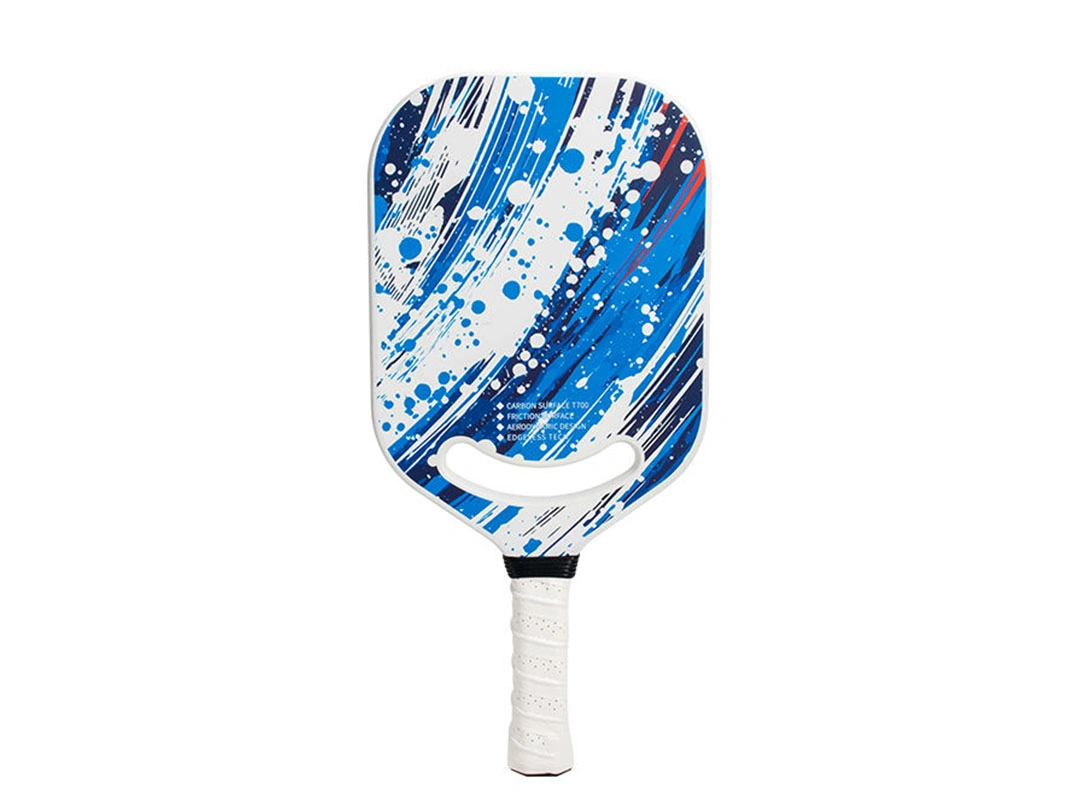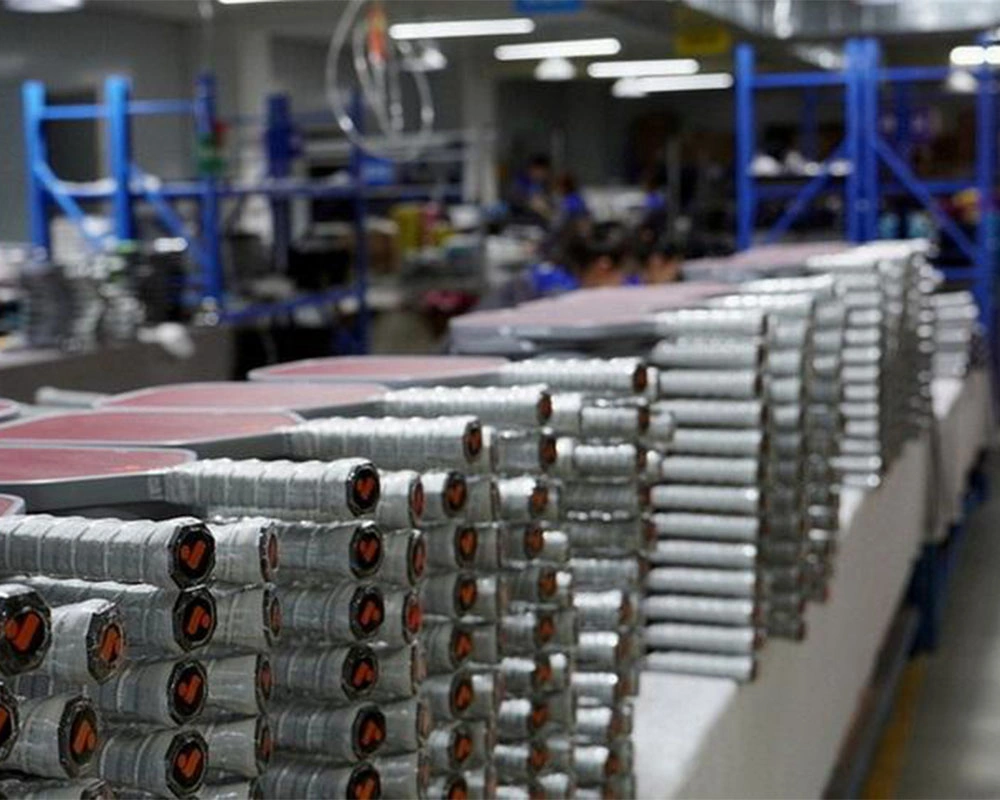
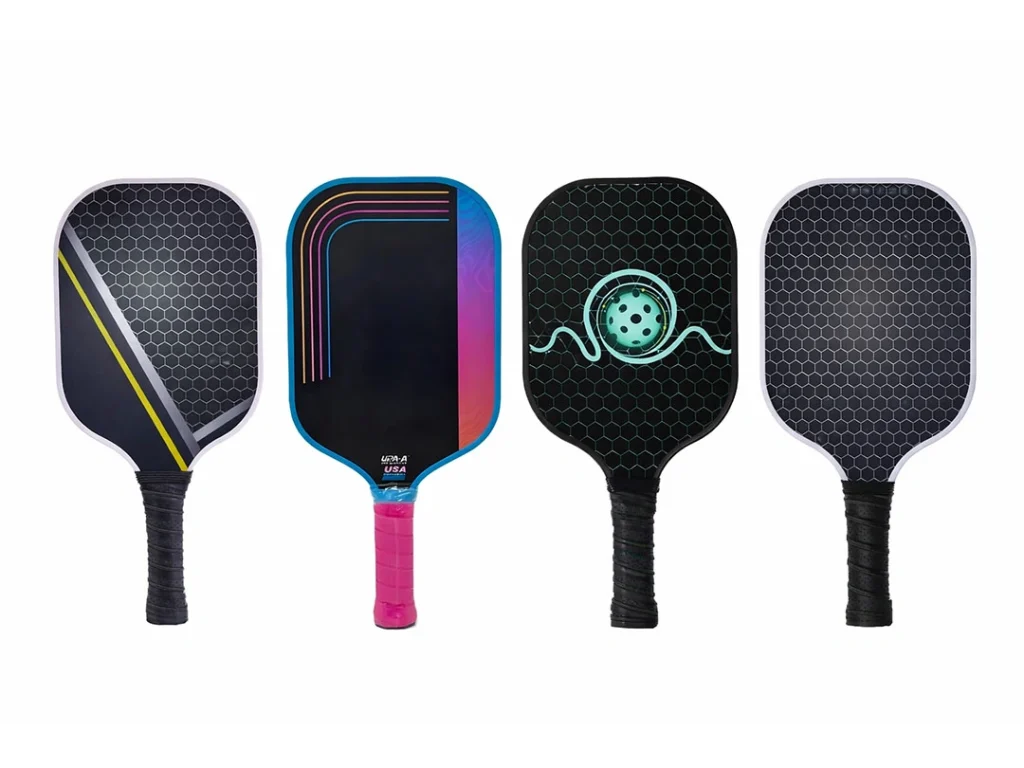
The global pickleball equipment market is valued at approximately $702.9 million — and it continues to expand at a pace that is creating real, sustained sourcing demand. For B2B buyers, understanding the types of pickleball paddles is not an exercise in product trivia. It is sourcing strategy.
Every construction category — cold press, thermoformed, foam core, edgeless, and hot press forged — carries a different cost structure, retail price ceiling, margin profile, and target player segment. Selecting the wrong construction for the wrong tier is not a minor mistake; it is a misallocation of capital, inventory, and brand positioning.
NexaPaddle operates all four production lines under one roof with extensive manufacturing experience, serving B2B brands across multiple international markets across the USA, Canada, Japan, Australia, UK, Germany, Spain, France, and beyond. This article is the definitive wholesale paddle sourcing guide to NexaPaddle’s full product catalog — technical specs, pricing, MOQs, and strategic positioning across every paddle construction type.
Cold Press Pickleball Paddles
The Manufacturing Process
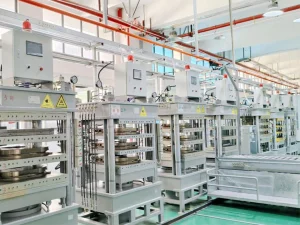
Cold press is the foundational construction method in pickleball paddle manufacturing. The process bonds a face sheet to a PP (polypropylene) honeycomb core using an adhesive film, then compresses the assembly under a hydraulic press at ambient temperature. Cycle time runs 30–45 minutes per batch — the fastest production cycle of any construction type.
The name says everything: no heat is applied during compression. The structural integrity of the paddle depends on the adhesive bond between the face and core.
NexaPaddle Cold Press Variants
NexaPaddle produces three distinct cold press paddle configurations:
1.1 — Fiberglass UV
The entry-level workhorse. High-elasticity fiberglass face bonded to PP honeycomb core. Available in 10mm, 13mm, and 16mm thicknesses. Weight range: 220–245g. Shape options: standard (400×195mm) or elongated (417×188mm).
1.2 — Carbon Fiber UD/3K
Carbon fiber face (either unidirectional weave or 3K woven) over PP honeycomb. Available in 13mm and 16mm. Weight range: 210–235g. Entry point to the carbon fiber pickleball paddles tier without premium construction costs.
1.3 — Carbon + Teflon Spin
Carbon UD face with Teflon coating for maximum surface grip and spin generation. Fixed at 16mm thickness, elongated shape (417×188mm). Targets spin-focused players in the mid-tier.
Cold Press: Business Case
| Metric | Cold Press |
|---|---|
| OEM Cost | $15–$28/unit |
| Target Retail | $25–$130 |
| Gross Margin | 40–55% |
| MOQ | 300 pieces |
| Mold Fee | None (standard shapes) |
| Graphics | UV printing (full-color, durable) |
Cold press is the volume engine for most brand catalogs. The $15–$28 OEM cost opens up retail price points between $25 and $130 — ideal for beginners, recreational players, bundled sets, club purchases, and retail chains that need accessible price points at scale. No mold fee for standard shapes reduces upfront capital risk to near zero at launch.
Key limitation: The adhesive bond is the structural weak point. Under repeated high-impact play, delamination risk is real — particularly in high-humidity environments or with aggressive play styles. Sweet spot is standard-sized. PBCoR drops measurably as the adhesive joint ages — which is actually a compliance advantage for brands concerned about USAPA equipment standards.
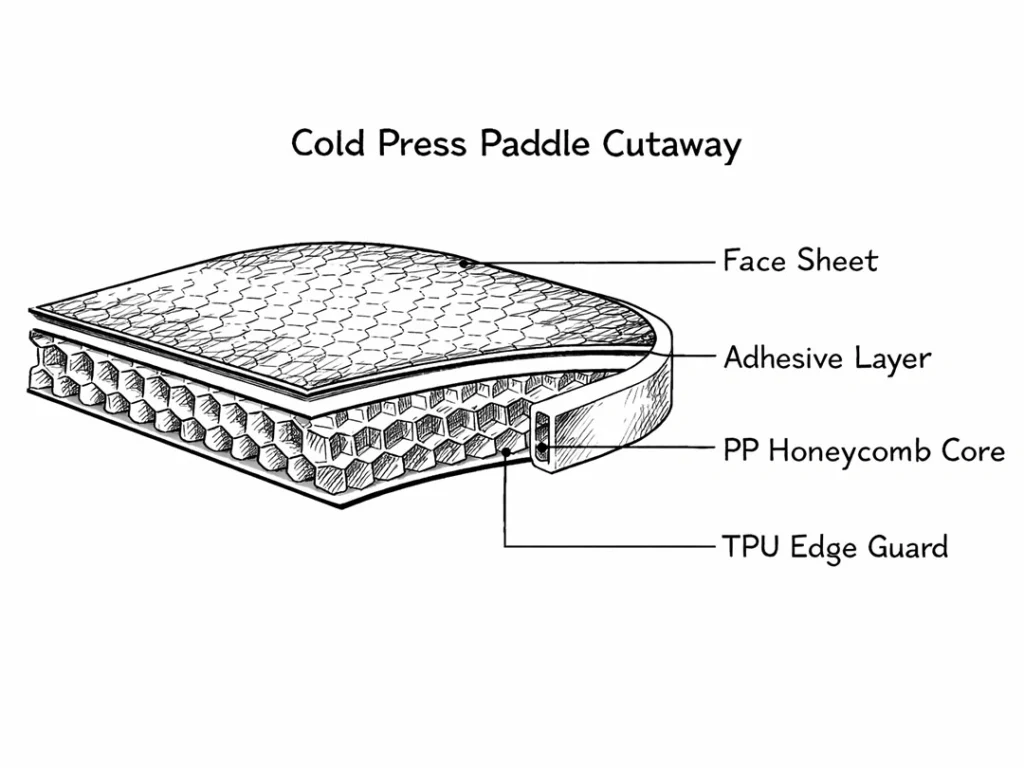
Commercial Implication: Cold press is where you build volume, accumulate reviews, and fund your premium line. The 300-piece MOQ and zero mold fees make it the lowest-risk entry point for new brands testing the market.
Thermoformed Pickleball Paddles
The Manufacturing Process
Thermoformed construction is the technology that reshaped the premium paddle market. Instead of bonding face to core with adhesive at room temperature, thermoforming fuses all components — face, core, and edge — simultaneously under heat (>150°C) and pressure. The result is a unibody structure where carbon fiber runs uninterrupted from the face through the edge into the handle.
Cycle time: 60–90 minutes per batch. Longer than cold press, but the structural output is fundamentally different. There is no adhesive joint to fail. The entire paddle is one continuous structure.
Thermoformed paddles have captured 43% of the premium market as of 2024 — the fastest adoption curve of any paddle construction technology in the sport’s history.
NexaPaddle Thermoformed Mold Configurations
NexaPaddle maintains multiple dedicated thermoformed mold configurations, giving brands genuine shape and performance differentiation at the premium tier:
| Mold | Description | Dimensions | Thickness | Weight | Notes |
|---|---|---|---|---|---|
| Mold #1 | Edgeless Control | 400×205mm | 20mm | ~245g | Edgeless profile |
| Mold #2 | Lightweight | 400×195mm | 14mm / 16mm | — | Balanced play |
| Mold #3 | Edgeless Power | 417×188mm | 13mm / 16mm | ~220g | Edgeless, elongated |
| Mold #4 | Hybrid (Kevlar/Aramid) | Various | Various | — | Specialty weave options |
| Mold #5 | Extended Handle | 415×185mm | 16mm | — | 145mm handle |
| Mold #8 | Silent/Quiet | 420×185mm | 14mm | — | NCT-BV Core |
Explore the full thermoformed pickleball paddles lineup for detailed mold-level specifications.
Thermoformed: Business Case
| Metric | Thermoformed |
|---|---|
| OEM Cost | $32–$52/unit |
| Target Retail | $129–$249 |
| Gross Margin | 55–68% |
| MOQ | 100 pieces |
| Sweet Spot | 15–20% larger than cold press |
| Delamination Risk | Near zero |
| Graphics | Water decal, laser engraving, UV printing |
The MOQ of 100 pieces — lower than cold press — allows brands to test premium SKUs without significant inventory commitment. The 55–68% gross margin, combined with retail price points between $129 and $249, makes thermoformed the backbone of any serious premium brand strategy.
The 15–20% sweet spot expansion over cold press is structural — not cosmetic. It is the direct result of the unibody construction distributing impact load across a larger face area, compared to the localized compression point of an adhesive-bonded cold press paddle.
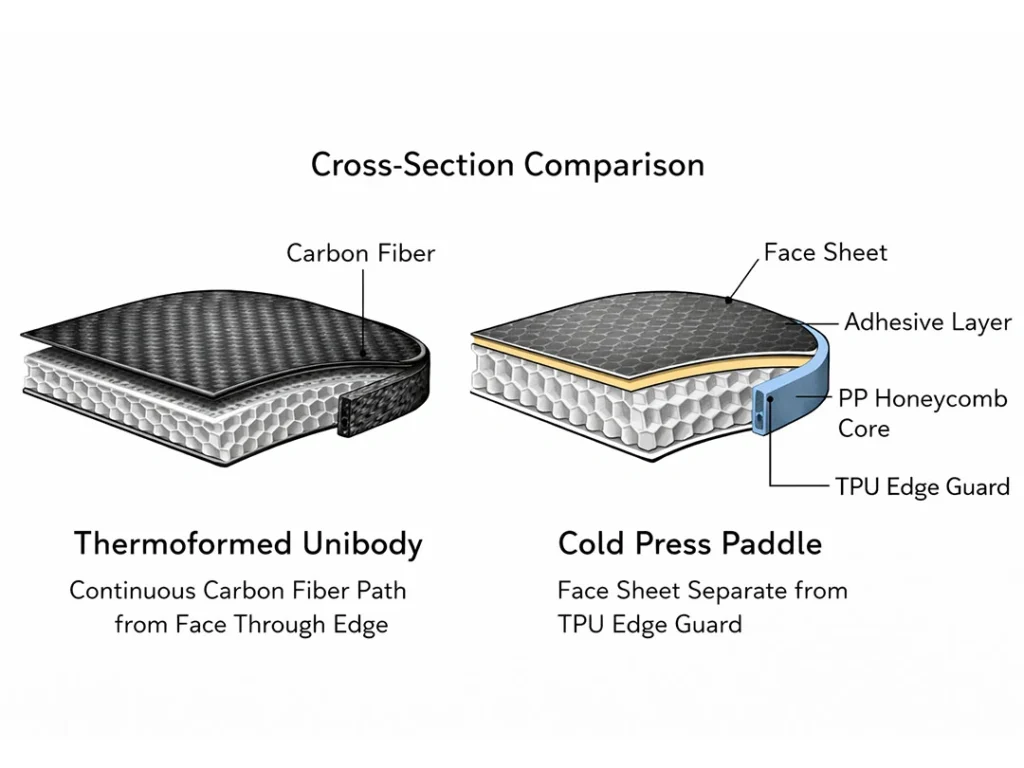
Commercial Implication: Thermoformed is the backbone SKU for any premium brand. The 100-piece MOQ lets brands enter the $129–$249 tier with minimal inventory risk, while the unibody structure delivers a performance story your marketing team can actually verify — 15–20% larger sweet spot is measurable, photographable, and marketable.
Foam Core Pickleball Paddles (Gen 4)
The Technology Shift
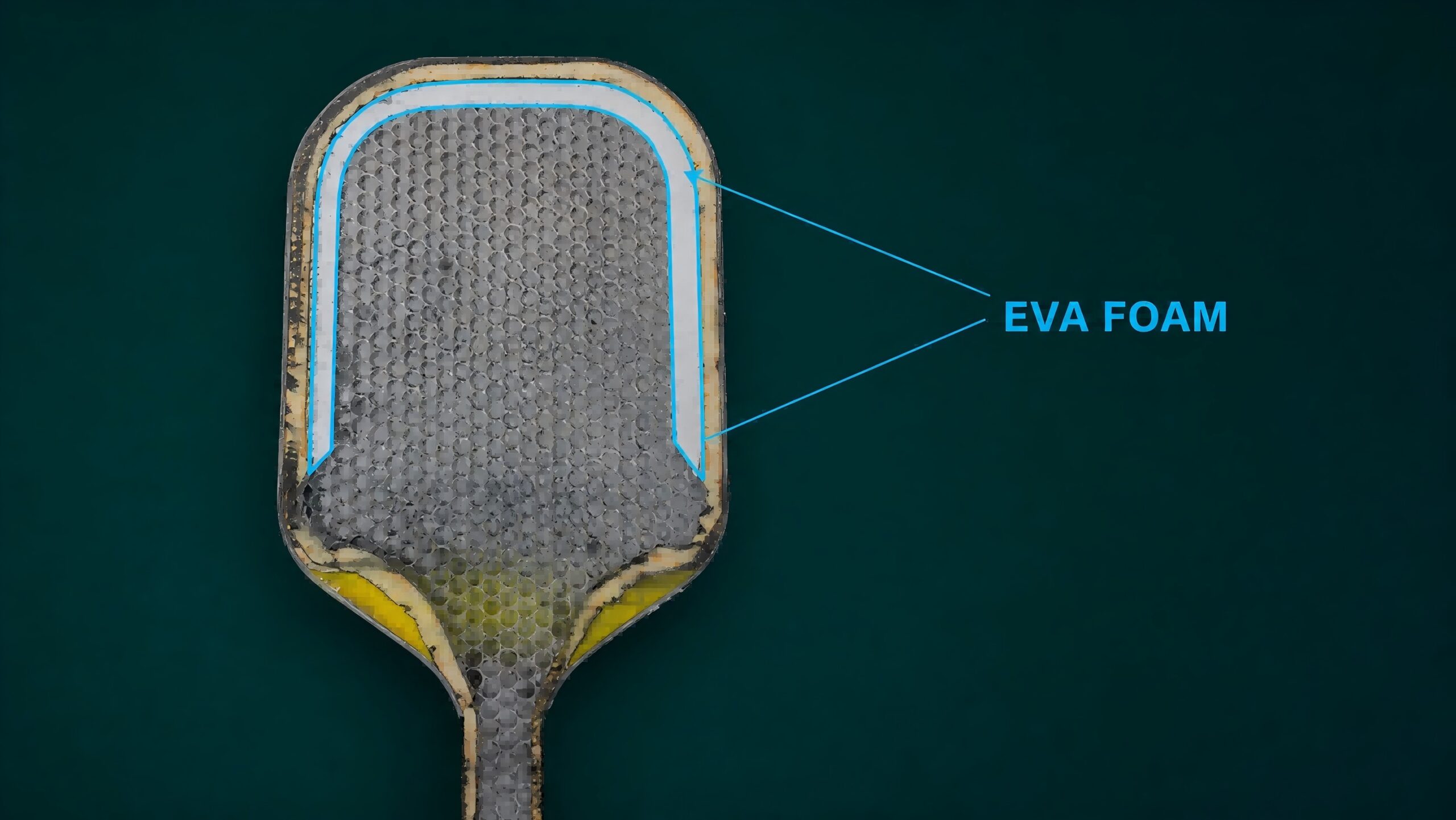
Gen 4 foam core construction replaces the traditional PP honeycomb core entirely with EPP (Expanded Polypropylene) foam. This is not a minor material substitution — it changes the fundamental vibration profile, rebound characteristics, and joint-stress behavior of the paddle.
PP honeycomb cores transmit impact vibrations directly through the paddle structure. EPP foam absorbs and redirects vibration in the 200–500 Hz frequency range — precisely the range associated with repetitive stress injuries including lateral epicondylitis (tennis elbow). Both variants use T700 Carbon Fiber face, 417×188mm shape, and 139mm handle.
Explore the full foam core pickleball paddles product range for variant-level specs and customization options.
Two EPP Foam Variants
Filled EPP Foam (High Density — 8x–10x expansion ratio)
Aggressive rebound, explosive power, vibration dampening. Targets players who want the arm-care properties of foam without sacrificing power.
Non-Filled EPP Foam (Softer Density)
“Absorb-then-release” feel. Maximum shock absorption. Joint-friendly for the 40+ demographic, players recovering from injury, and anyone prioritizing long-session playability over raw power.
Both variants eliminate the “core crush” failure mode endemic to PP honeycomb cores — where repeated off-center impacts compress honeycomb cells permanently, degrading the sweet spot over time.
Foam Core: Business Case
| Metric | Foam Core Gen 4 |
|---|---|
| OEM Cost | $42–$60/unit |
| Target Retail | $169–$249 |
| Gross Margin | 58–68% |
| MOQ | 100 pieces |
| Compliance | PBCoR ≤0.43 comfortable |
| Delamination Risk | Near zero |
Gen 4 foam core sits comfortably within the USAPA PBCoR ≤0.43 envelope — a meaningful compliance advantage over Gen 5 technology. For brands building USAPA-approved product lines, this is a lower-risk compliance position.
Competitive context: foam core construction is the technology behind Selkirk BoomCore, CRBN TruFoam, and JOOLA 4S — all priced at $169–$299 retail. NexaPaddle’s Gen 4 enables OEM buyers to compete in this tier from $42–$60 OEM cost.
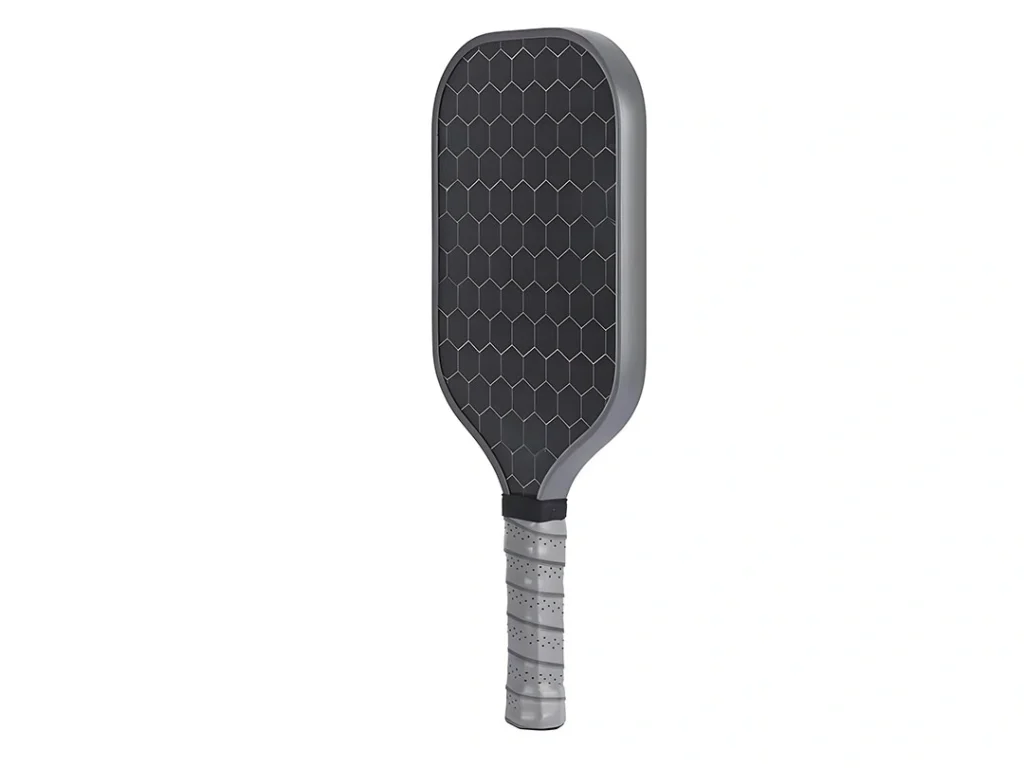
Commercial Implication: Foam core is a segment-capture play, not just a product upgrade. The arm-care narrative — backed by the 200–500 Hz vibration absorption data — gives your brand a clinically defensible marketing angle for the 40+ demographic and returning-injury players. At $42–$60 OEM against $169–$249 retail, the margin profile is among the strongest in the catalog.
Edgeless Pickleball Paddles — Aesthetics Meets Performance
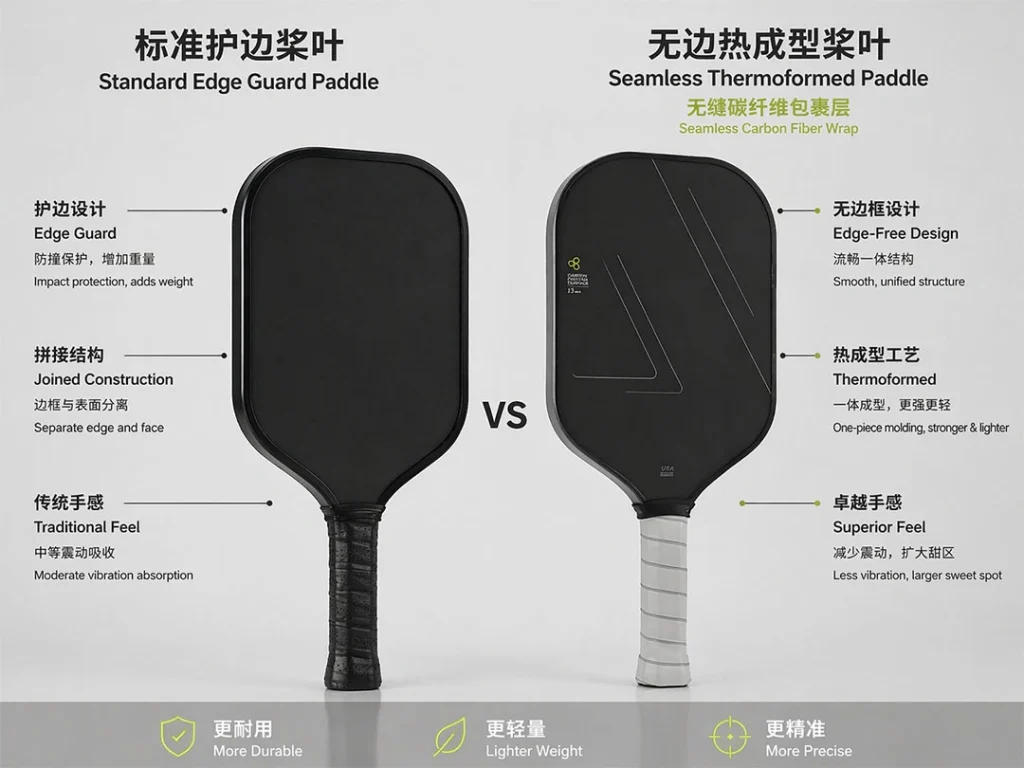
Edgeless construction eliminates the traditional TPU edge guard that wraps the perimeter of conventional paddles. The carbon fiber face wraps continuously around the edge in a seamless unibody — no interruption, no raised plastic border, no adhesive edge seam.
The performance implications are measurable. Removing the edge guard recovers 8–10% of face real estate (NexaPaddle Structural Analysis 2024–2025) — returning that surface area to the active hitting zone. The smoother aerodynamic profile reduces drag through the swing arc, producing faster swing speeds and quicker hand exchanges at the kitchen line. For doubles players trading fast hands in the transition zone, this is a quantifiable advantage.
NexaPaddle Edgeless Models
NexaPaddle offers two dedicated edgeless thermoformed models, each targeting a distinct performance profile within the edgeless pickleball paddles lineup:
Mold #1 Edgeless Control
- Dimensions: 400×205mm, 20mm thick
- Weight: ~245g
- Face: Carbon UD/3K + grit spray surface
- Handle: 130mm
- Profile: The widest paddle in the NexaPaddle lineup. Maximum dwell time at contact. Built for control-first players who want to dictate pace from the kitchen. The wide body distributes impact load across the broadest face area of any mold configuration.
Mold #3 Edgeless Power
- Dimensions: 417×188mm, 13mm/16mm thick
- Weight: ~220g
- Face: Carbon UD/3K or T700
- Handle: 139mm
- Profile: Elongated shape optimized for offensive play and aggressive baseliners. The narrower, longer format generates faster head speed and transfers more energy on drives and overhead shots. Available in two thickness options to split between power-pop (13mm) and vibration absorption (16mm).
Both models are thermoformed unibody construction with MOQ 100 pieces. Full OEM customization available: face material, surface grit density, handle wrap, graphics, and packaging.
Who Buys Edgeless
Edgeless paddles index toward younger competitive players (18–40) who prioritize performance specs and aesthetics equally. The seamless carbon fiber wrap is a premium visual signal — it reads as “premium” in a way that edge-guarded paddles cannot replicate. This makes edgeless an ideal SKU for:
- DTC brands building Instagram and TikTok-friendly product imagery
- Amazon sellers where the seamless aesthetic differentiates product listings
- Design-forward boutique brands targeting the performance-lifestyle overlap
- Tournament-focused lines where players research equipment specifications
Commercial Implication: Edgeless is a brand-positioning tool as much as a performance spec. The seamless unibody look photographs better for DTC and Amazon listings, and the recovered 8–10% face area gives your marketing team a measurable performance claim. At 100-piece MOQ, it’s an accessible premium add to any existing catalog — a product that visually justifies a $149–$199 price point before the buyer even plays a ball.
Hot Press Forged Pickleball Paddles
NexaPaddle’s Flagship Construction
Hot press forged construction is NexaPaddle’s highest-performance production process. The flagship is Mold #7 — a proprietary production protocol that applies localized pressure differentials during the baking cycle to achieve maximum carbon fiber compaction. Where standard thermoforming applies uniform heat and pressure, forging applies variable pressure across different zones of the paddle face and structure.
The result: highest structural density, maximum durability, and peak power transfer of any construction type in the catalog.
Learn more about the forged T700 carbon pickleball paddle production line.
Hot Press Forged Specifications
| Spec | Detail |
|---|---|
| Face | Premium T700 Carbon Fiber (UD or 3K weave) |
| Dimensions | 420×185mm or 425×186mm |
| Thickness | 13.5–14mm (power pop) / 16mm (vibration absorption) |
| Handle | 145mm extended (two-handed backhand compatible) |
| Weight | 220–235g |
| Core | High-density PP Honeycomb (GEN3–GEN5 foam compatible) |
| Surface | Factory-adjustable grit spray (metered to USAPA roughness limits) |
| Graphics | Premium water decals under clear coats |
| Delamination Risk | Zero |
The 145mm extended handle is specifically designed for two-handed backhand technique. Thickness options split the performance profile cleanly: 13.5–14mm maximizes pop and power transfer; 16mm shifts toward vibration absorption.
Forged: Business Case
| Metric | Hot Press Forged |
|---|---|
| OEM Cost | $55–$75/unit |
| Target Retail | $130–$280+ |
| Gross Margin | 55–72% |
| MOQ | 100 pieces |
| Sweet Spot | 15–20% larger (unibody) |
| Delamination Risk | Zero |
The 55–72% gross margin — the widest range in the catalog — reflects the forged paddle’s ability to anchor retail prices at $200–$280+ for flagship SKUs.
Commercial Implication: Forged construction is the catalog anchor. Every premium brand needs a hero SKU — the product that defines what the brand stands for and commands the highest price point. At $55–$75 OEM and $200–$280+ retail, a single forged flagship generates more gross profit per unit than three cold press paddles combined. Source it for prestige; let the cold press line fund the volume.
Specialty & Flagship Models
Beyond the four core construction types, NexaPaddle produces a tier of specialty models that push material science to its current ceiling. Each model addresses a distinct player need — power, arm-care, spin, quiet play, and maximum performance — allowing brands to build a true tiered catalog within the premium segment.
Specialty Model Specifications
| Model | Core | Face | Dimensions | Handle | Key Feature | OEM Cost | Retail |
|---|---|---|---|---|---|---|---|
| GEN3 Core 2.0 | GEN3 Core 2.0 | T700 Carbon | 417×188mm | 149mm | Enhanced elasticity, high energy return | $32–42 | $129–169 |
| T800 + Titanium Thread | GEN3 Core | T800+Ti | 413×195mm | 145mm | Maximum spin, gritty matte texture | $45–55 | $180–220 |
| GEN4 EPP Foam (Filled) | EPP Foam | T700 Carbon | 417×188mm | 139mm | Explosive power + vibration dampening | $45–55 | $199–249 |
| GEN4 EPP Foam (Non-Filled) | EPP Foam | T700 Carbon | 417×188mm | 139mm | Soft touch, joint-friendly | $42–52 | $169–219 |
| PP + Elastic Block | PP+Elastic | T700 Carbon | 417×188mm | 139mm | Ultra-crisp feedback, rapid rebound | $40–50 | $149–199 |
| GEN5 “Gatling” | GEN5 Polymeric Mesh | T800+Teflon-weave | 419.5×188mm | Foam grip + 3D leather | Massive sweet spot, flagship | $65+ | $249–319 |
| Silent Series (Mold #8) | NCT-BV | T700+Teflon | 420×185mm | 145mm | Dual-zone dampening, quiet play | $45–55 | $169–229 |
Specialty Model Profiles
GEN3 Core 2.0 — T700 Carbon face, 417×188mm, 149mm extended handle, enhanced core elasticity for maximum dwell time.
T800 + Titanium Thread — GEN3 Core construction with T800 carbon + titanium thread composite face, 413×195mm. Maximum spin generation, aggressive gritty matte surface texture.
GEN5 “Gatling” Flagship — Polymeric mesh core. T800+Teflon weave face (419.5×188mm). Foam-enhanced grip, 3D leather handle wrap, massive sweet spot. NexaPaddle’s apex product.
PP + Elastic Block — Ultra-crisp feedback, rapid rebound, T700 face. For players and brands that prioritize immediate ball response.
Silent Series (Mold #8) — NCT-BV dual-zone dampening core. 420×185mm, 14mm. Engineered for noise-sensitive venues — indoor courts, recreation centers, residential communities.
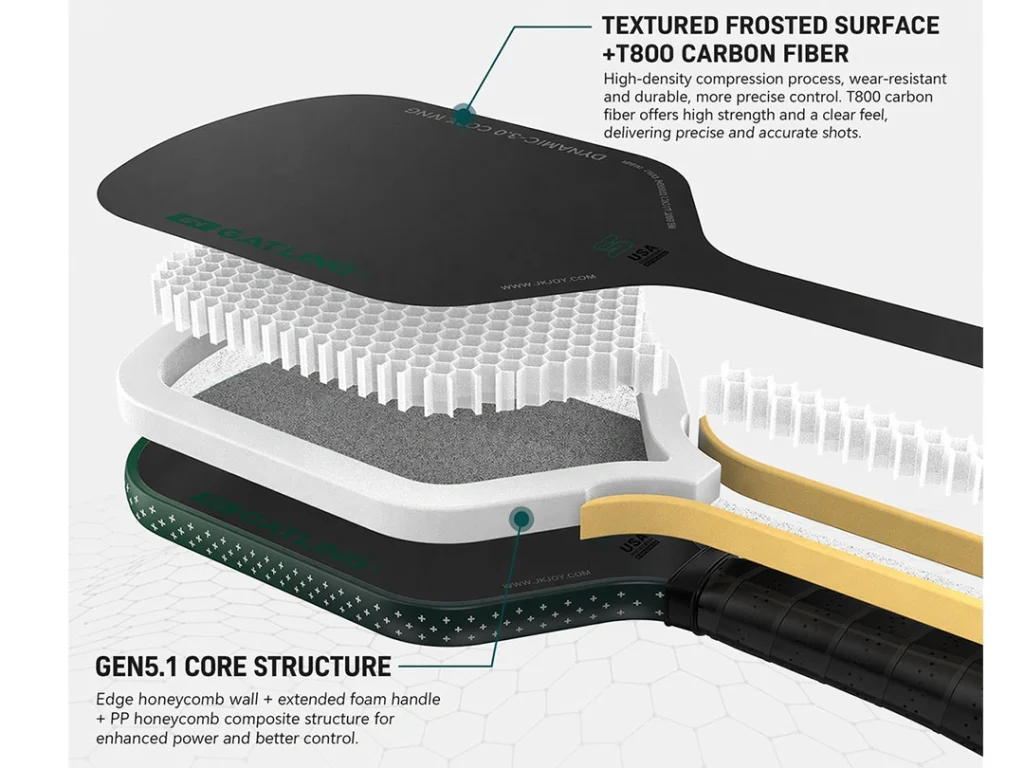
Commercial Implication: Specialty cores let you tier your catalog from “Better” to “Best” to “Flagship.” Each targets a distinct player segment — power (GEN3), arm-care (GEN4), spin (T800+Ti), quiet play (Silent), and maximum performance (GEN5 Gatling). A three-SKU specialty lineup captures the full $129–$319 premium segment.
Complete Comparison — All Types of Pickleball Paddles
The following table consolidates all five primary types of pickleball paddles across every commercially relevant dimension for B2B sourcing decisions:
| Feature | Cold Press | Thermoformed | Foam Core (Gen 4) | Edgeless | Hot Press Forged |
|---|---|---|---|---|---|
| Bonding Method | Adhesive film | Heat + pressure fusion | Heat + pressure + foam injection | Heat + pressure fusion (no edge guard) | Localized pressure differential forging |
| Structure | Two-piece | Unibody | Unibody + foam core | Seamless unibody | Unibody (max compaction) |
| Face Materials | Fiberglass, Carbon UD/3K, Carbon+Teflon | T700/T800, Kevlar | T700 Carbon | Carbon UD/3K, T700 | T700 Carbon (UD/3K) |
| Core | PP Honeycomb | PP Honeycomb, GEN3–5 | EPP Foam (Filled/Non-Filled) | PP Honeycomb, GEN3–5 | High-density PP Honeycomb |
| Weight | 210–245g | 215–245g | ~220–235g | ~220–245g | 220–235g |
| Thickness | 10–16mm | 13–20mm | 16mm standard | 13–20mm | 13.5–16mm |
| Sweet Spot | Standard | 15–20% larger | Large, forgiving | 8–10% face area gain | 15–20% larger |
| Delamination Risk | Moderate | Near zero | Near zero | Near zero | Zero |
| OEM Cost | $15–$28 | $32–$52 | $42–$60 | $32–$52 | $55–$75 |
| Target Retail | $25–$130 | $129–$249 | $169–$249 | $129–$219 | $130–$280+ |
| Gross Margin | 40–55% | 55–68% | 58–68% | 55–68% | 55–72% |
| MOQ | 300 pcs | 100 pcs | 100 pcs | 100 pcs | 100 pcs |
| Cycle Time | 30–45 min/batch | 60–90 min/batch | 60–90 min/batch | 60–90 min/batch | 60–90 min/batch |
| USAPA Compliance | Comfortable | Comfortable | Comfortable | Comfortable | Max performance within limits |
| Best For | Entry/mid brands, bundles, starters | Premium brands, pro lines | Arm-care, comfort, 40+ demo | DTC brands, design-forward, competitive | Flagship, tournament, max durability |
Building Your Product Line — The Good–Better–Best Framework
Sourcing a single type of pickleball paddle is a niche play. Building a tiered catalog is a brand play. The distinction matters: niche buyers optimize one SKU; brand builders capture the full market.
Good — Entry Tier ($25–$60 Retail)
Construction: Cold Press Fiberglass
Cold press fiberglass is the highest-volume, lowest-barrier entry point in pickleball. At $25–$60 retail, this tier captures beginners, casual players, club buyers, gift purchasers, and bundle deals. With OEM costs at $15–$22 for fiberglass variants, margins remain viable even at aggressive retail pricing.
This tier is also the acquisition engine. Players who start on your entry paddle and have a good experience upgrade within your catalog — not to a competitor’s.
Better — Mid Tier ($60–$169 Retail)
Construction: Cold Press Carbon OR Thermoformed (Gen 3 core)
The mid tier is the brand-building inflection point. Cold press carbon UD/3K paddles bridge the fiberglass-to-premium gap at $60–$130 retail. Entry thermoformed paddles (Mold #2 or Mold #3) push toward $129–$169. This tier serves intermediate players, club competitors, and online buyers who have done research and are willing to spend more for performance.
Best — Premium Tier ($169–$280+ Retail)
Construction: Hot Press Forged OR Foam Core Gen 4 OR Edgeless
The premium tier is where brand equity is built and defended. Forged construction ($130–$280+), foam core Gen 4 ($169–$249), and edgeless thermoformed models ($129–$219) anchor the top of the catalog. With gross margins of 55–72%, premium SKUs carry the financial weight of the brand — even at lower unit volumes relative to the entry tier. Edgeless models add a design-differentiation play within this tier, particularly for DTC and direct-to-consumer brands where aesthetics drive purchase decisions online.
The Single-Source Advantage
Sourcing all construction types of pickleball paddles from a single manufacturer produces compounding operational advantages:
- One supplier relationship — one contact, one payment terms, one compliance process
- Consistent QC standards — same inspection criteria across all tiers
- Simplified logistics — consolidated shipments, predictable lead times, single customs documentation
- Scalability — pricing and relationship scale as volume grows
NexaPaddle serves B2B brands across multiple international markets. All construction types. All under one roof. For brands ready to build a multi-tier catalog, custom OEM pickleball paddles from NexaPaddle cover every construction type with full customization across shape, core, face material, graphics, handle length, and packaging.
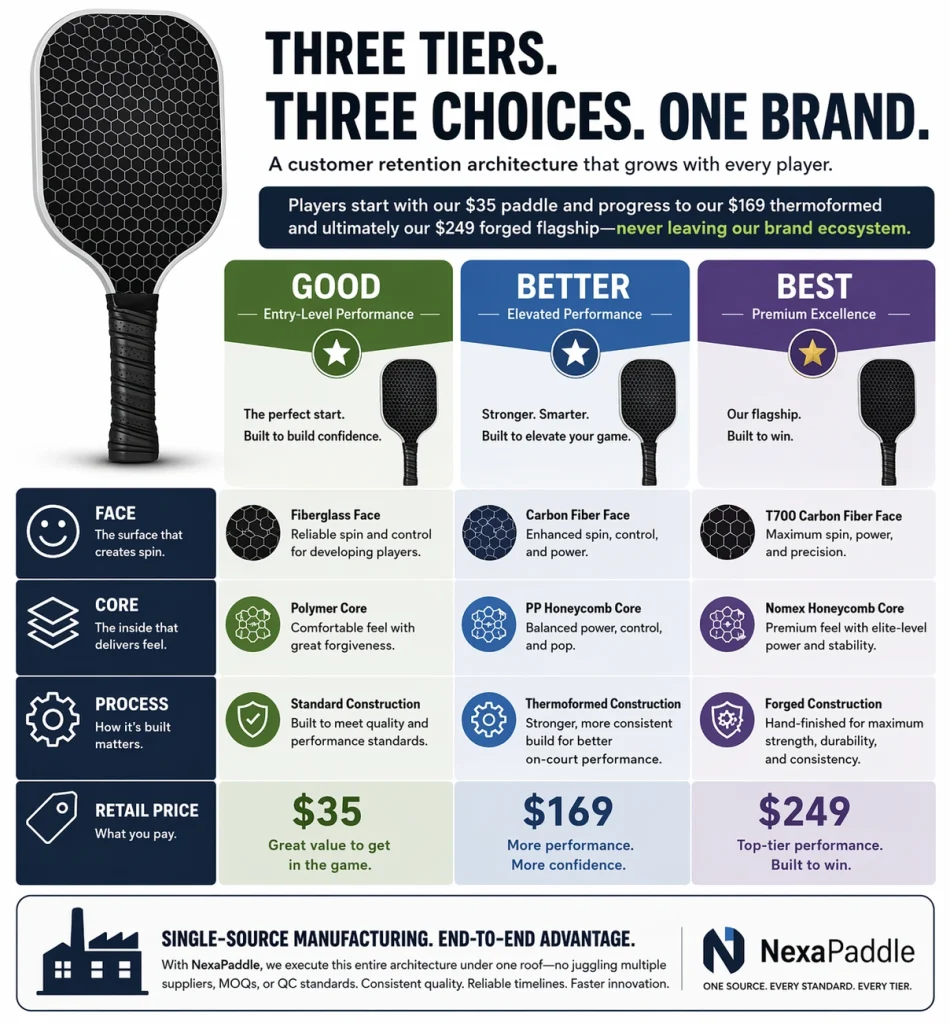
Commercial Implication: The Good–Better–Best framework is not just a catalog strategy — it is a customer retention architecture. Entry players who buy your $35 paddle and progress to your $169 thermoformed and ultimately your $249 forged flagship never leave your brand ecosystem. Single-source manufacturing from NexaPaddle means you can execute this architecture without juggling multiple supplier relationships, MOQ schedules, or inconsistent QC standards.
Frequently Asked Questions
What are the main types of pickleball paddles available for wholesale?
There are five main construction types: u003cstrongu003ecold pressu003c/strongu003e, u003cstrongu003ethermoformedu003c/strongu003e, u003cstrongu003efoam core (Gen 4)u003c/strongu003e, u003cstrongu003eedgelessu003c/strongu003e, and u003cstrongu003ehot press forgedu003c/strongu003e. Each serves a different price tier and player segment. Cold press serves entry and mid-tier retail ($25–$130), thermoformed serves premium retail ($129–$249), foam core Gen 4 targets arm-care and comfort-focused players ($169–$249), edgeless thermoformed targets design-forward premium buyers ($129–$219), and hot press forged anchors flagship and tournament lines ($130–$280+). Understanding these types of pickleball paddles is the foundation of B2B catalog strategy.
Which type of pickleball paddle offers the best profit margins for retailers?
Hot press forged paddles deliver the widest gross margin range — 55–72% — followed by foam core Gen 4 at 58–68%. However, the highest-profit strategy is not a single SKU. Brands that deploy a tiered catalog using all construction types optimize for both volume (cold press) and per-unit profit (forged/foam core). Margin-per-unit is highest in the premium tier; total margin contribution depends on catalog architecture.
What is the difference between thermoformed and hot press forged paddles?
Both use heat and pressure to create unibody paddle structures without adhesive bonding. The distinction is in the pressure application method. Thermoformed paddles use heated platens to fuse carbon fiber uniformly around the core at u003e150°C. Hot press forged construction (NexaPaddle Mold #7) applies u003cstrongu003elocalized pressure differentials during the baking cycleu003c/strongu003e, achieving maximum carbon fiber compaction not possible with uniform thermoforming — resulting in higher structural density, maximum durability, and peak power transfer.
What are the minimum order quantities for different types of pickleball paddles?
Cold press: u003cstrongu003e300 piecesu003c/strongu003e (no mold fee for standard shapes). Thermoformed, edgeless, foam core Gen 4, and hot press forged: u003cstrongu003e100 pieces per designu003c/strongu003e. The lower MOQ on premium construction types allows brands to market-test high-margin SKUs at 100 units before committing to full production runs — minimizing capital risk during product line development.
What are edgeless pickleball paddles and who are they best for?
Edgeless paddles eliminate the traditional TPU edge guard, replacing it with a continuous carbon fiber wrap around the paddle perimeter. This recovers 8–10% of face real estate and produces a faster, cleaner swing profile. They are best suited for younger competitive players (18–40) who play aggressively at the kitchen line, and for DTC or design-forward brands where the seamless aesthetic adds significant perceived value in online product imagery.
Can I source all types of pickleball paddles from one manufacturer?
Yes. NexaPaddle operates cold press, thermoformed, edgeless, foam core (Gen 4), and hot press forged production lines under one roof. This enables brands to build Good–Better–Best catalogs from a single sourcing relationship — with consistent quality standards, simplified logistics, and a single scalable supplier as the brand grows.
References
- NexaPaddle Product Knowledge Base (2026). Cold Press, Thermoformed, Specialty Core Series Specifications. Internal technical documentation.
- NexaPaddle Manufacturing Process Documentation (2026). 5-Step Custom Production Workflow.
- NexaPaddle Structural Analysis (2024–2025). Thermoformed vs. Cold Press Sweet Spot Expansion Study. 15–20% expansion verified across Mold #1–#5.
- NexaPaddle Structural Analysis (2024–2025). Edgeless Construction Face Area Recovery Study. 8–10% face real estate recovery documented across Mold #1 and Mold #3 configurations.
- Coherent Market Insights (2025). Pickleball Equipment Market Size Report. Market valued at ~$702.9M.
- USA Pickleball Association (2025). Equipment Standards — PBCoR threshold ≤0.43 (tightened November 2025).
- Sports & Fitness Industry Association (2024). Participation Report: 36.5 million+ active US pickleball players.
NexaPaddle — established OEM manufacturing experience. B2B brands served across multiple international markets. Five construction types. One factory.
Ready to build your catalog? Contact NexaPaddle for wholesale pricing, samples, and production timelines.