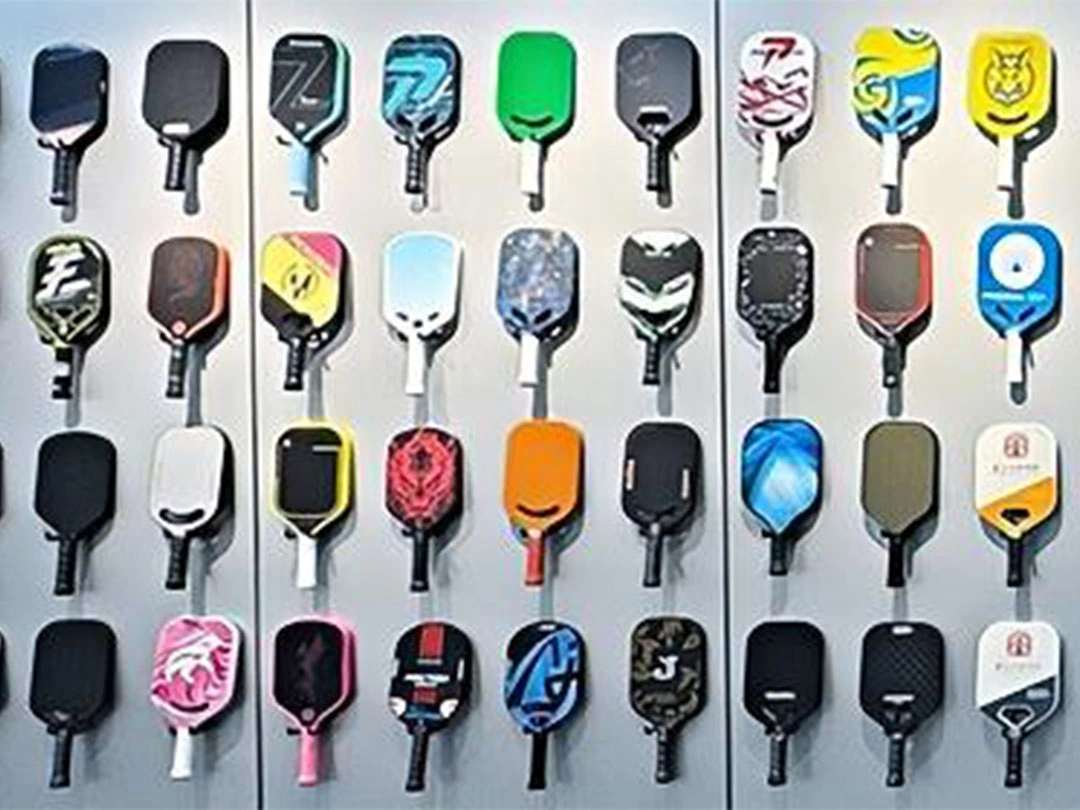
For brand owners, Amazon FBA sellers, and wholesalers building a business around pickleball, three words carry more financial risk than any other: delisted by USA Pickleball. They mean unsellable inventory, mandatory consumer refunds, and brand equity that took years to build — erased before the next trade show. In January 2026 alone, on-site testing at Golden Ticket tournaments revealed that 6% of all paddles tested — roughly 1 in 17 — were non-compliant.
This is not a theoretical risk. The $200 million countersuit that followed one major brand’s 2024 delisting is proof that manufacturing compliance has graduated from technical footnote to the foundation of your entire business model. One failed test, one non-compliant production batch, one sampling inconsistency: any of these can trigger the cascade.
In this guide, we break down the timeline of major paddle bans, the exact technical parameters your products must meet, the true costs of certification failures, and how choosing the right manufacturing partner for your benutzerdefinierte OEM-Pickleball-Paddles is your most effective defense against catastrophic losses.
A Timeline of Major Delistings (2022–2026)
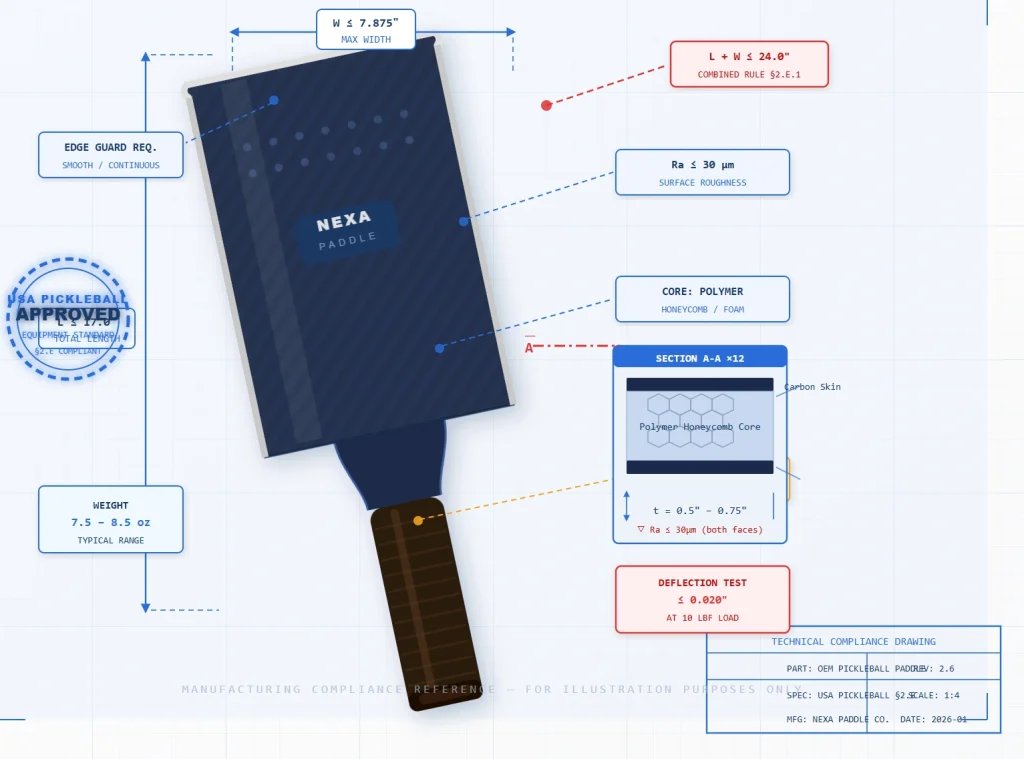
Understanding today’s compliance landscape starts with its history. Enforcement mechanisms have evolved rapidly — from basic surface roughness checks to complex energy-return metrics and live, on-site tournament testing. Each enforcement action has raised the stakes for every brand in the market.
- 2022: The CRBN Surface Roughness Ban
One of the first major industry shake-ups occurred when CRBN models were temporarily delisted. The governing body found that their surface roughness exceeded USAP limits. CRBN was forced to halt sales, recall inventory, and rapidly re-engineer their paddles before eventually regaining market trust. - May 2024: The JOOLA Gen 3 Delisting
USA Pickleball abruptly pulled 17 JOOLA Gen 3 models from its approved list. The core issue was a “Certification by Similarity” failure — the retail paddles sold to consumers did not match the physical samples originally submitted for testing. The result: a massive class action settlement providing $300 refunds per purchase, a lawsuit between JOOLA and USA Pickleball, and a staggering $200M countersuit filed by JOOLA. - Q4 2024 – July 2025: The PBCoR “Power Paddle Ban”
The introduction of the Paddle Ball Coefficient of Restitution (PBCoR) targeted the dangerous “trampoline effect” in modern paddles. With a threshold set at ≤0.47 in Q4 2024, high-profile paddles including the JOOLA Perseus MOD-TA 15, Gearbox Pro Power Elongated, and multiple ProKennex Black Ace models were slated for sunset effective July 2025. - January 2026: The RFID Field-Testing Era
USA Pickleball, alongside Pickleball Instruments, launched mandatory paddle field-testing at Golden Ticket tournaments, beginning in Glendale, Arizona.
Each of these failures shares a common thread: brands that did not fully understand — or fully control — the technical parameters governing their products. The five compliance parameters below define the current testing battlefield.
Why Paddles Get Banned: The 5 Compliance Parameters Explained
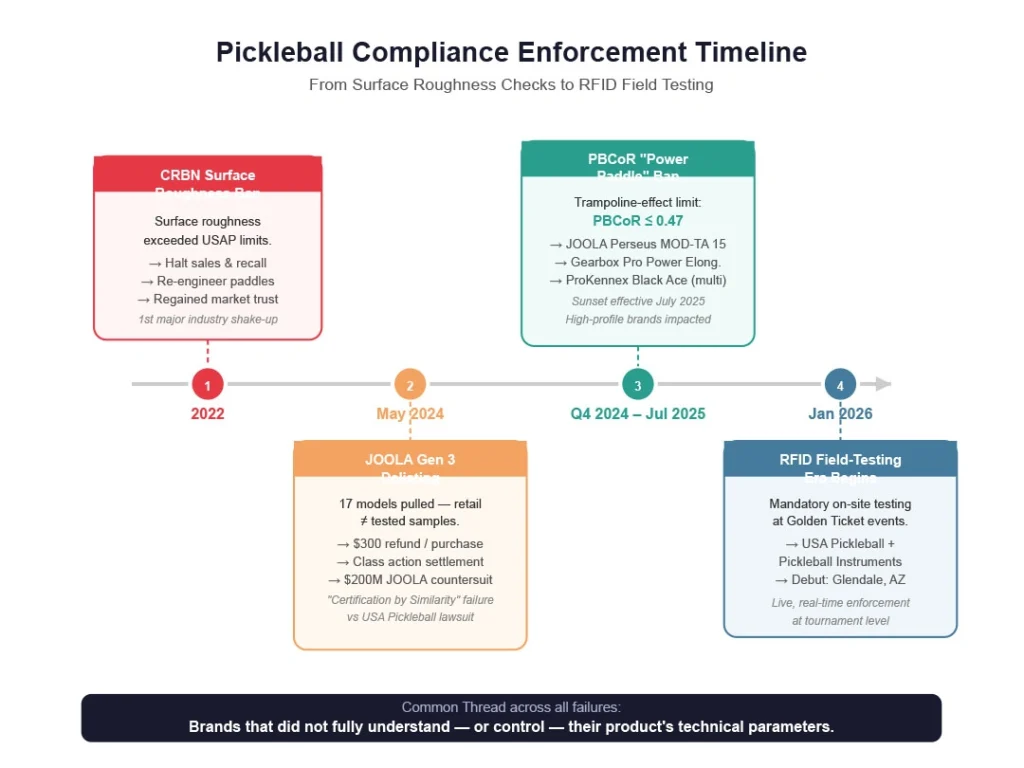
For B2B buyers, understanding exactly why paddles fail is the first step to preventing it. USA Pickleball enforces five primary tests for von USAPA genehmigten Paddeln.
1. Surface Roughness
USA Pickleball controls surface roughness through Rt and Rz limits. Its current Equipment Standards Manual specifies Starrett SR160 or SR300, or equivalent, for official roughness measurement. Factory-side checks can support process control, but they should not be presented as official certification testing.
2. PBCoR (Paddle Ball Coefficient of Restitution)
This metric measures energy return. USA Pickleball’s published PBCoR not-to-exceed limit is 0.43, gültig ab 1. November 2025.. Buyers should verify the current Equipment Standards Manual and the exact certification status of the brand/model rather than relying on an older 0.47 threshold.
3. Dimensions
The combined length and width of a paddle cannot exceed 24 inches (609.6 mm), and maximum length is strictly capped at 17 inches (431.8 mm).
4. Kernablenkung
Core deflection measures the stiffness of the paddle face. The paddle face must not depress beyond specific USAPA ranges when a standardized weight is applied. Excessive deflection results in illegal power generation.
5. COF (Coefficient of Friction)
Closely related to surface roughness, the Coefficient of Friction must remain within USAPA limits to ensure the paddle does not grip the ball excessively during slicing or topspin shots.
Of these five parameters, PBCoR has proven the most technically treacherous — and the hardest to control across a product’s full lifespan.
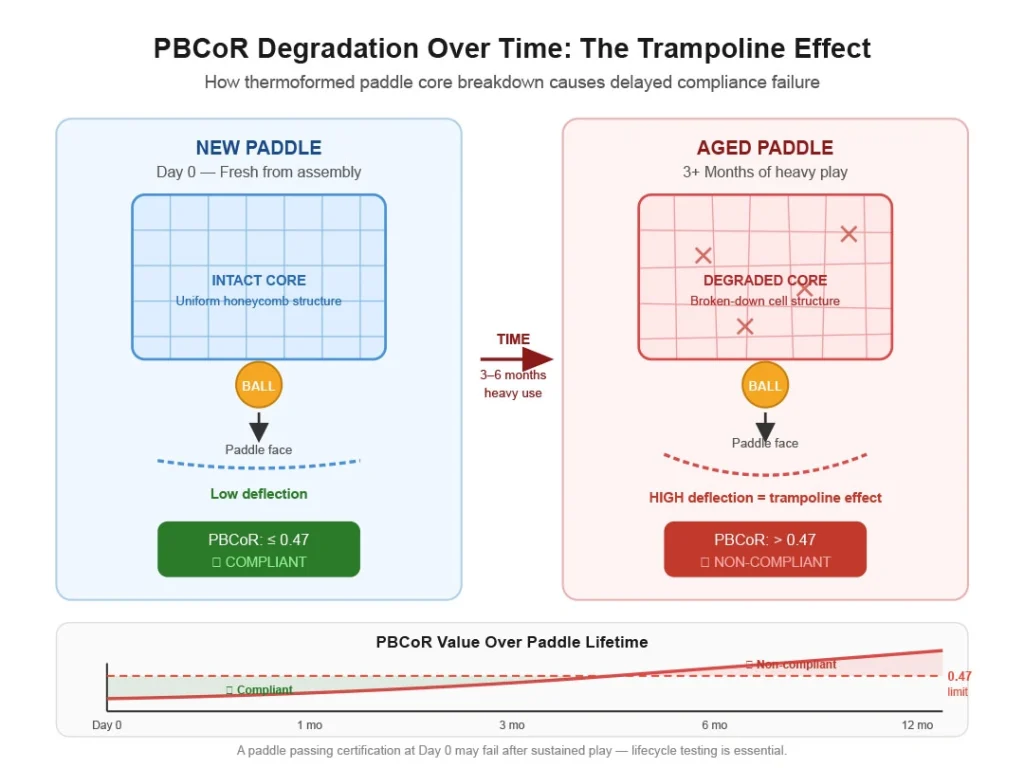
The PBCoR Power Problem: Why Thermoformed Paddles Fail Over Time
The PBCoR problem is particularly acute for thermoformte Pickleball-Schläger, and it is more insidious than a simple manufacturing defect.
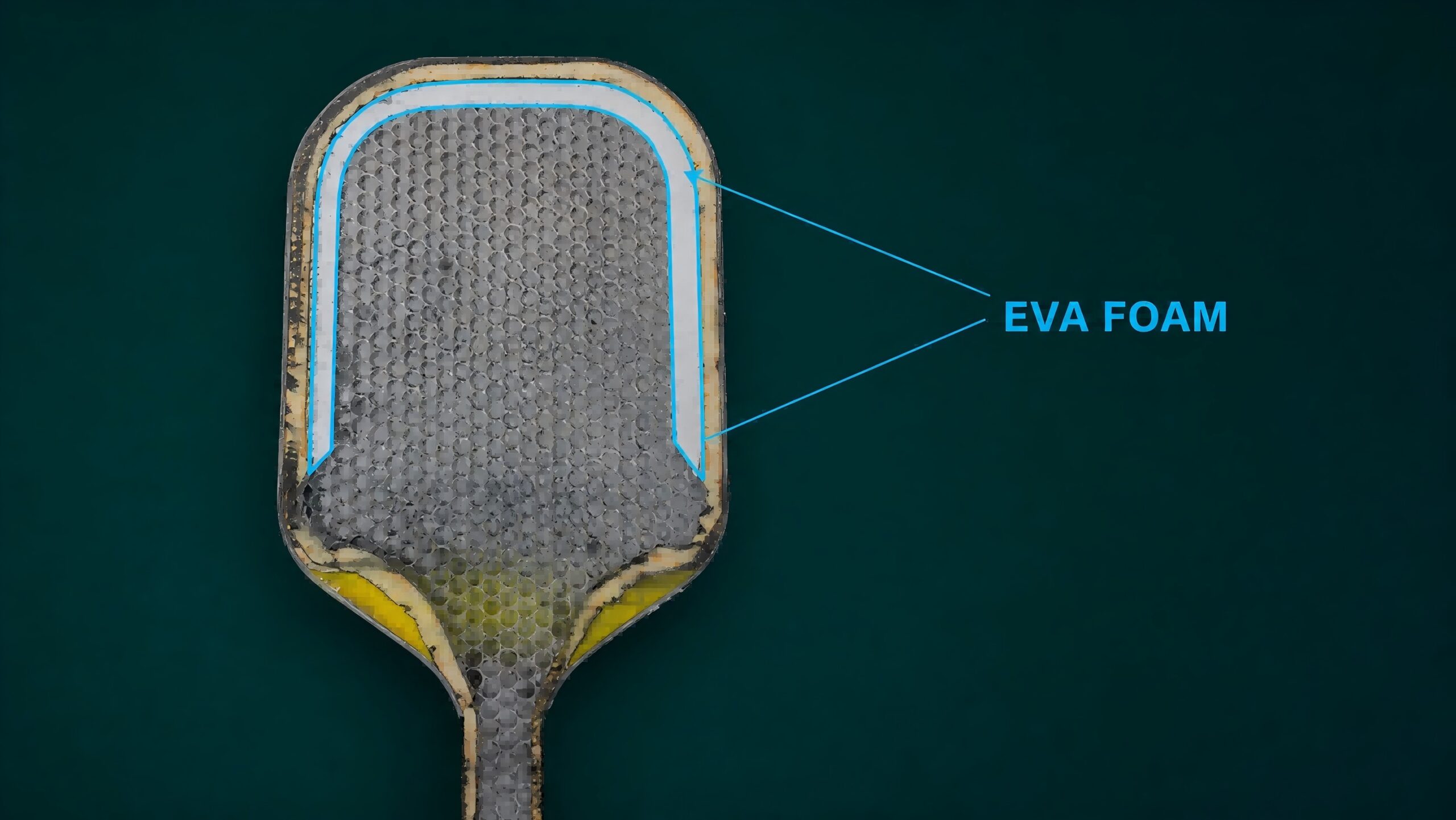
Thermoforming seals the paddle edges with carbon fiber under high heat and pressure, creating a unibody construction that is durable and powerful. But it introduces a dangerous variable: aging. Over time, the internal core of a thermoformed paddle can break down slightly, increasing the trampoline effect.
A paddle that passes the ≤0.47 PBCoR threshold fresh off the assembly line may exceed that threshold after three months of heavy play. This delayed failure mode is exactly what trapped brands in the Q4 2024 power paddle ban. Buyers must ensure their manufacturers are accounting for the full lifecycle degradation of advanced tech thermoformed paddles — not just day-one performance.
Die finanziellen Konsequenzen, wenn eines dieser Parameter — im großen Stil — falsch ist, sind schwerwiegend genug, um eine Marke zu beenden.
Die Kosten des Falschseins
Der gefährlichste Verstoß gegen die Einhaltung ist nicht eine Ablehnung des Labors für 4.500 USD — es ist ein konformer Testergebnis gefolgt von einem nicht konformen Produktionslauf. Betrachten Sie das JOOLA Gen 3-Szenario: Einzelhandels-Schläger, die nicht mit den genehmigten Mustern übereinstimmten, eine obligatorische Rückerstattung von 300 USD pro Kauf über Tausende von Einheiten und eine Gegenklage von 200 Millionen USD. So sieht ein Verstoß gegen die Compliance in der Massenproduktion aus. Wenn Sie 10.000 Einheiten eines Schlägers produzieren, die anschließend aus dem Sortiment genommen werden, blicken Sie nicht auf einen Rückschlag — Sie sehen einem geschäftsbeendenden Ereignis entgegen.
Probleme in der Testphase zu erkennen, ist vergleichsweise günstig. Die Grundgebühr für die Zertifizierung beträgt 4.500 USD pro Modell und erfordert 8 eingereichte Schlägermuster. Eine einzige Ablehnung bringt Ihre Gesamtkosten auf etwa 9.400 USD — steil, aber überlebensfähig. Jede Einreichung dauert auch 4 bis 6 Wochen, was bedeutet, dass eine Ablehnung Ihre Markteinführungszeit um ein volles finanzielles Quartal verzögern kann.
Über die Testgebühren hinaus zerfällt die regulatorische Landschaft in ein Dual-Zertifizierungssystem. Während USAPA die Basis für das allgemeine Spiel bleibt, wird seit September 2025 eine UPA-A-Zertifizierung für PPA- und MLP-Pro-Events benötigt. Marken sollten derzeit etwa 6.000 USD pro Modell einplanen, um den gesamten Dual-Approval-Weg zu navigieren.
RFID-Feldtests: Die neue Durchsetzungsrealität
Die Ära, in der ein perfekt abgestimmtes „goldenes Muster“ an ein Labor eingereicht und leicht nicht konforme Schläger massenproduziert wurden, ist vorbei. Ab Januar 2026 haben USA Pickleball und Pickleball Instruments aggressive Vor-Ort-Durchsetzungsmaßnahmen eingeführt.
Bei den Golden Ticket-Turnieren in Glendale und Las Vegas wurden über 2.000 Schläger, die von Wettkämpfern mitgebracht wurden, im Feld getestet. Die Ergebnisse waren ein Weckruf für die Branche: Riley Burgess, VP für Geräte-Compliance, berichtete von einer Non-Compliance-Rate von 6 % unter den zur Konkurrenz mitgebrachten Schlägern.
Dieses Feldtesten wird in zwei Phasen eingeführt:
- Phase 1: Testen des Reibungskoeffizienten, der Abweichung, der Delaminierungserkennung und des Gewichts/Balances.
- Phase 2 (Wird kommen): Vor-Ort-PBCoR- und Spinmessungen.
Schläger, die bestehen, erhalten einen digitalen RFID-Aufkleber, der mit einem dauerhaften Compliance-Protokoll verlinkt ist. Wie Carl Schmits, CTO von USA Pickleball, feststellte: „Die Integrität der Ausrüstung ist entscheidend für einen fairen Wettbewerb. Diese Plattform für Feldtests ermöglicht es uns, die Leistungsstandards zu überprüfen, die Transparenz zu erhöhen und die Grundlage zur Identifizierung gefälschter Geräte zu schaffen.“
Für B2B-Käufer ist die Implikation klar: Wenn Ihre Produktionscharge aus der Toleranz driftet, werden Turnierbeamte es in den Händen Ihrer Kunden feststellt — nicht in Ihrem QC-Labor. Die Frage ist nicht, ob Ihre Schläger getestet werden. Es ist, ob Ihr Produktionsprozess konstant bestehen kann.
Wie Sie Ihre Marke schützen: Einen konformen Hersteller auswählen
Sich auf eine Fabrik zu verlassen, die Abkürzungen nimmt, wird zwangsläufig zu einem gescheiterten Feldtest führen. Um Ihre Marke zu verteidigen, müssen Sie aktiv gegen die fünf häufigsten Fertigungsfehlerarten wachen:
- Spray-on-Grit, der die Grenzwerte überschreitet: Schlecht kalibrierte Anwendungen können Rt leicht über 40 µm drücken, sobald die Beschichtung trocknet.
- Thermoformalter PBCoR-Aging: Es wird versäumt, zu simulieren, wie sich der Schlägerkern über 6 Monate der Nutzung verschlechtert.
- Maßtoleranzdrift: Inkonsistentes Schneiden und Formen während der Massenproduktion drängt die Maße über das kombinierte Limit von 24 Zoll.
- Oberflächenbehandlungsinkonsistenz: Ein Mangel an standardisiertem QC über verschiedene Produktionschargen hinweg.
- Ungültige Beschichtungschemie: Verwendung experimenteller Farben oder Harze, die den Reibungskoeffizienten unerwartet verändern.
Bevor Sie die Massenproduktion autorisieren, fordern Sie dokumentierte, chargenbezogene Qualitätskontrolldaten an — und gehen Sie von jedem Hersteller weg, der dies nicht bereitstellen kann.
Die folgende Fallstudie veranschaulicht, wie dieser Standard in der Praxis aussieht.
NexaPaddle’s Compliance-First-Ansatz
After a decade and B2B brands across multiple markets served, one pattern holds across every brand that has never faced a compliance crisis: they treat certification limits as a floor, not a ceiling. That principle drives NexaPaddle’s 5-stage manufacturing protocol — not to meet USAPA standards, but to build a measurable safety buffer into every Carbonfaser-Pickleball-Schläger die wir produzieren.
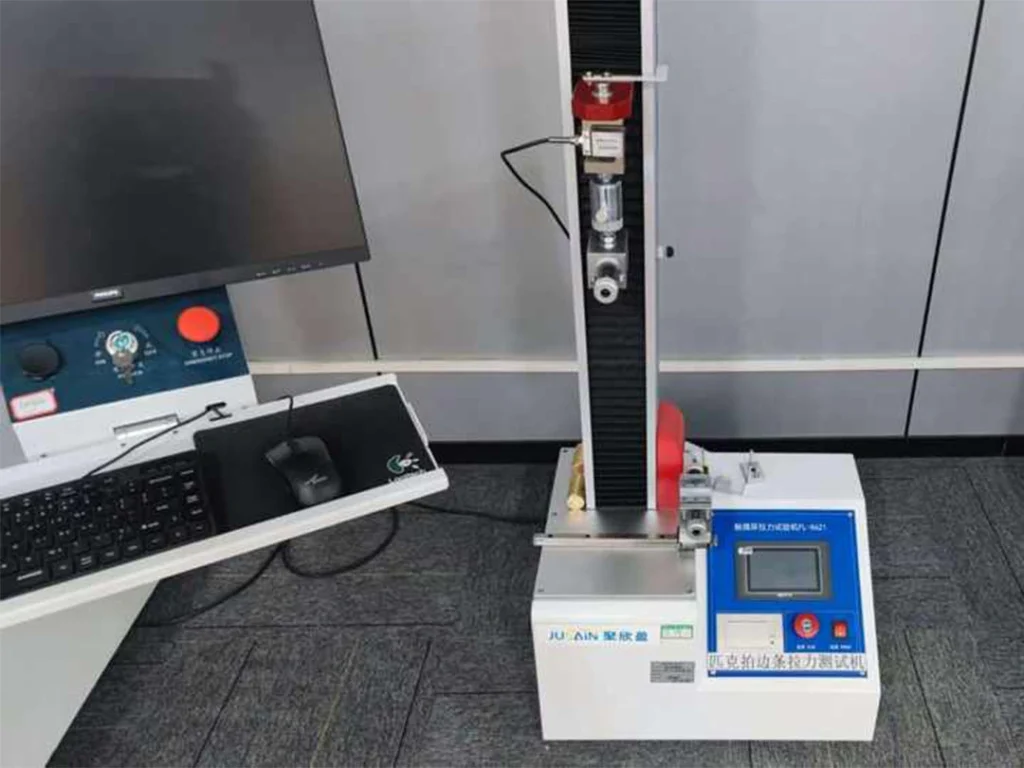
NexaPaddle publishes first-party QA imagery and describes a factory-side inspection workflow. That public evidence does not currently verify a company-wide Rt/Rz or PBCoR guard band, a specific calibrated profilometer, testing after every coating stage, accelerated-aging predictions, or guaranteed field compliance months after shipment.
For a compliance-sensitive OEM project, define the approved specification, sampling plan, measurement method, change-control rules and any required third-party or governing-body testing before production. Treat internal factory checks as process controls, not certification.
Häufig gestellte Fragen
u003cstrongu003eHow much does it cost to get a pickleball paddle USAPA certified?u003c/strongu003e
Certification fees, sample quantities and re-submission charges change by program and year. Verify the current fee and submission schedules directly with USA Pickleball and UPA-A before budgeting; do not use an older fixed per-model figure as a current quote.
u003cstrongu003eWhat is PBCoR and why are paddles being banned for it?u003c/strongu003e
PBCoR stands for Paddle Ball Coefficient of Restitution. It measures the energy return or “trampoline effect” of a paddle. The current threshold is ≤0.47, with expectations it will tighten to ≤0.43. Paddles that exceed this limit generate dangerous ball speeds, leading to bans affecting models from JOOLA and ProKennex scheduled for July 2025.
u003cstrongu003eCan a paddle pass certification but fail later?u003c/strongu003e
Yes. This is a common issue with thermoformed paddles, where internal core breakdown over time increases PBCoR beyond the legal threshold. Additionally, USA Pickleball’s RFID field-testing program at tournaments is specifically designed to catch mass-production paddles that deviate from the original approved prototypes — whether due to aging or manufacturing inconsistency.
u003cstrongu003eHow does the new tournament field testing work?u003c/strongu003e
Starting in January 2026, USA Pickleball began using on-site field testing at tournaments. Phase 1 tests for friction, deflection, delamination, and weight. Passing paddles receive a digital RFID sticker. In early testing of over 2,000 paddles, officials found a 6% non-compliance rate among players’ equipment.
u003cstrongu003eWhat should I require from my OEM manufacturer before committing to a mass production run?u003c/strongu003e
Before authorizing production, demand documented evidence of the following: batch-level surface roughness measurements (Rt and Rz) showing results below — not merely at — the official USAPA limits; internal PBCoR targets with a compliance buffer below ≤0.47; and, for thermoformed models, project-specific validation data for any durability or break-in claim that matters to the buyer. You should also clarify the contractual liability if a finished batch fails USAPA certification or RFID field testing — specifically who absorbs the cost of the $4,500 resubmission fee, retooling, and any launch delay. NexaPaddle’s u003ca href=u0022https://nexapaddle.com/custom-paddles/u0022 target=u0022_blanku0022 rel=u0022noreferrer noopeneru0022u003ecustom paddle programu003c/au003e can scope the documentation required for the specific project; availability should be confirmed before production.
Referenzen
- USA Pickleball Ausrüstungsstandards & Zertifizierungsupdates — usapickleball.org/equipment/paddle-certification-updates/
- USA Pickleball Erklärung zu entziehen JOOLA Paddeln (Mai 2024) — usapickleball.org
- JOOLA Gen 3 Sammelklagevergleich — Sammelklage, die Rückerstattungen von 300 USD pro Kauf bietet; JOOLA reichte eine Gegenklage von 200 Millionen USD gegen USA Pickleball ein.
- USAP NPRM 24-002: PBCoR-Testanforderungsdokument — equipment.usapickleball.org/docs/pbcor-testing.pdf
- Pickleheads: USA Pickleball entfernt 7 Paddel von der Genehmigten Liste (9. Januar 2025) — pickleheads.com
- USA Pickleball und Programm zur Feldprüfung von Pickleball-Geräten Ankündigung (16. Januar 2026) — usapickleball.org
- Ergebnisse der USA Pickleball Paddle Feldprüfung — Riley Burgess, VP für Ausrüstungskonformität: über 2.000 getestete Paddel, 6 % Nichteinhaltungsquote (2026)
- Carl Schmits, CTO von USA Pickleball — Erklärung zur Integrität der Ausrüstung und zur Erkennung von Fälschungen mittels RFID-Feldtesting-Infrastruktur
- USA Pickleball Equipment Standards Manual — current official paddle testing requirements and surface-roughness procedure
- NexaPaddle Supplier Proof & Factory Evidence — first-party factory, QA-process and evidence-boundary record