De Tennis Migratie Inkoopkans
Zesendertig en een half miljoen Amerikanen spelen nu pickleball — en een onevenredig deel van hen is rechtstreeks van het tennisveld gekomen. Deze demografische verschuiving is geen trend. Het is een structurele marktransitie en vertegenwoordigt een zeer lucratieve inkoopkans voor detailhandelsmerken, groothandelaren en uitrusting distributeurs. Deze crossover-atleten brengen geavanceerde biomechanische gewoonten, hoge prestatieverwachtingen en gevestigde koopkracht mee naar het veld.
Het begrijpen van de financiële schaal van deze markt is essentieel voor strategische voorraadplanning. De totale Amerikaanse pickleballmarkt wordt voorspeld om $702,9M in 2025 te bereiken. Het premium koolstofvezelsegment — dat rechtstreeks dient voor geavanceerde overgangsatleten — is gewaardeerd op $137,9M in 2025 en groeit met 12,8% CAGR, gericht op een geschat $412,86M tegen 2034. Merken die geen uitrusting op voorraad hebben die is ontworpen voor deze demografie laten meetbare inkomsten liggen.
Racket sportconversies willen geen instap-niveau glasvezeluitrusting. Ze vereisen geavanceerde composietmaterialen, specifieke dimensionale geometrieën en handvatconfiguraties die rekening houden met ingesleten swingmechanica. Voor B2B-kopers is het begrijpen van deze technische vereisten de basis van een winstgevende premium productassortiment. Het vinden van de juiste langwerpige modellen positioneert uw merk om deze high-intent, premium-bestedende klantenkring te verwerven.
Het Probleem van de Tweehands Backhand
Standaard paddle-ontwerpen falen fundamenteel om tegemoet te komen aan de biomechanische realiteiten van de swing van een tennisser. Het standaard 130mm handvat is oorspronkelijk ontworpen voor éénhandige tafeltennis- of badmintongrepen. Wanneer een tennisser probeert een tweehands backhand uit te voeren op een standaard grip, glijdt de niet-dominante hand onvermijdelijk van de basis van het handvat of overlapt awkwardly op de paddle-throat.
Dit gebrek aan fysieke ruimte dwingt tot een kritische mechanische compromis. Spelers moeten het handvat dichterbij de grip houden, waardoor het lagesysteem dat kracht en rotatietorque genereert, instort. Het resultaat is een voorspelbaar verlies van controle, snelheid en topspin — precies de slagen die geavanceerde racketsportspelen definiëren.
Een goede tweehands backhand hangt af van een duidelijke handspanning om een functionele push-pull hefboom te creëren. De onderhand stabiliseert de paddlehoek; de bovenhand drijft de paddle kop door de contactzone. Zonder adequate handvatlengte valt dit systeem volledig uit elkaar. De speler kan de heup- en schouderrotatie niet volledig benutten, en kinetische energie wordt niet efficiënt in de bal overgebracht.
Deze biomechanische kloof vertegenwoordigt een duidelijke commerciële kans. Crossover-atleten zijn actief op zoek naar paddles die hen niet dwingen om tientallen jaren aan spiergeheugen op te geven. Merken die deze specifieke fysieke vereiste herkennen — en dienovereenkomstig op voorraad hebben — zijn het beste gepositioneerd om dit waardevolle segment te veroveren en te behouden.
Mok #5 Diepgaande Analyse: Ontworpen voor de Crossover Atleet
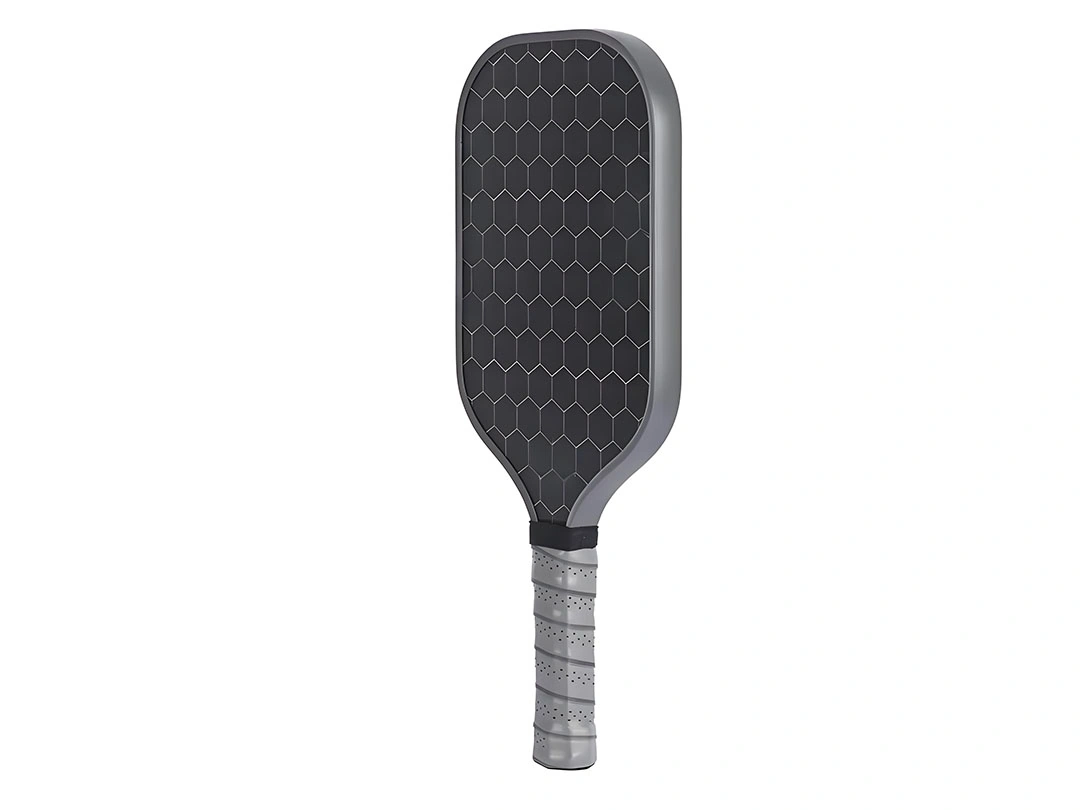
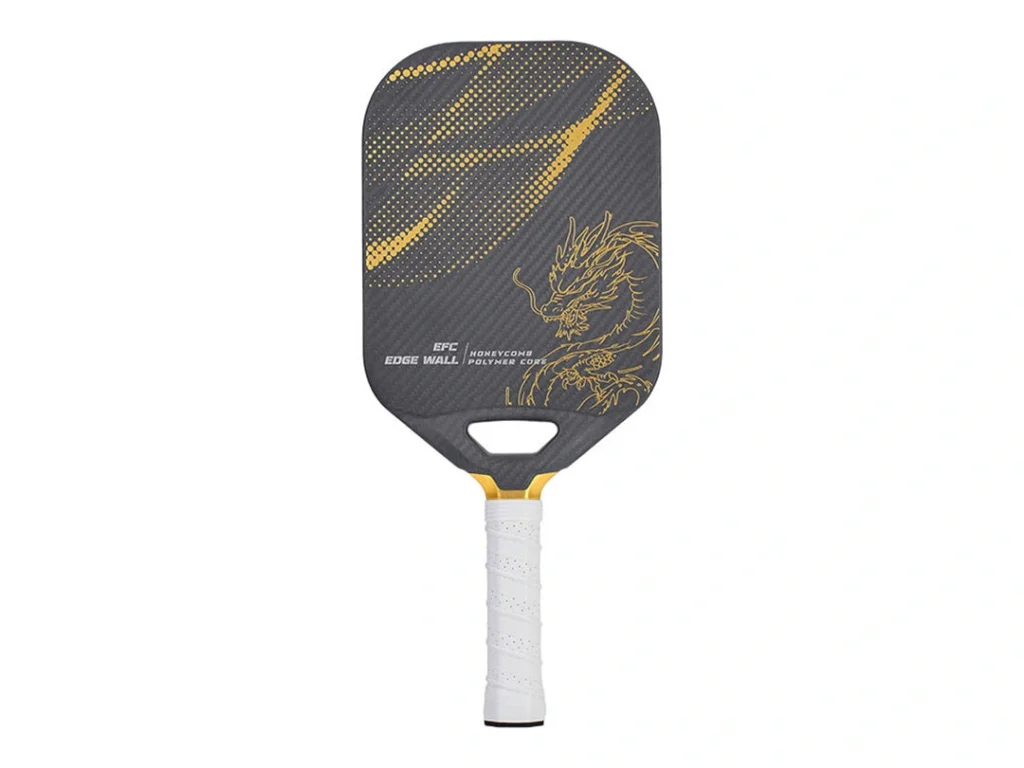
Geavanceerde productiebedrijven hebben gespecialiseerde paddle-geometrieën ontwikkeld die specifiek zijn ontworpen om aan deze biomechanische vereisten te voldoen. De specificatie van Mok #5 is de gouden standaard voor deze demografie, en combineert een uitgebreide reikwijdte met premium composietconstructie. Hieronder volgt de volledige technische breakdown.
| Spec | Waarde |
|---|---|
| 5 × 5 × 2,5 cm | 415 × 185 mm |
| Handgreeplengte | 145 mm (verlengd — +15mm boven standaard) |
| Gezichtsmateriaal | T700 Koolstofvezel (UD + 3K weefopties) |
| Kern | PP Honingraat |
| Kern Dikte | 16 mm |
| Gewicht | 215–230 g |
| Constructie | Thermogevormde unibody (geïntegreerd gezicht-tot-handvat) |
| MOQ | Foam Kern Pickleball Peddels B2B Fabriek |
De 415 × 185 mm de algehele afmeting benadert de maximale toegestane grootte van het bestuursorgaan terwijl het aerodynamisch profiel maximaal benut wordt. Het verschuiven van het oppervlak omhoog verlegt de sweet spot om precies uit te lijnen met het natuurlijke strike point van een tennisser — verder verwijderd van de hand dan een traditionele pickleball slag. De smalle 185 mm breedte vermindert de luchtweerstand, waardoor snellere swingsnelheden tijdens baseline-uitwisselingen mogelijk zijn.
De 145 mm handvat is het bepalende technische kenmerk van de mal. Het biedt voldoende oppervlak voor twee volwassen handen zonder overlapping op de paddle-throat, waardoor de mechanische beperkingen die crossover-atleten op standaarduitrusting plagen, direct worden geëlimineerd. Met beide handen goed gepositioneerd, kan de speler de kern- en schouderrotatie volledig benutten, waardoor maximale kracht door de T700 Koolstofvezel gezicht.
The internal architecture uses a Polypropylene (PP) Honeycomb core at 16 mm thickness. This calibration absorbs high-frequency vibrations from heavy baseline drives, reducing impact stress on the arm while providing essential energy return. At 215–230 g, the paddle carries enough mass to plow through incoming shots without sacrificing maneuverability at the kitchen line. Thermoformed unibody construction ensures the paddle acts as a single structural unit, eliminating the fragile bond points inherent in cold-pressed alternatives.
Extended Handle Leverage Mechanics
The physics of an elongated handle are directly relevant to your product positioning. A 145mm handle fundamentally alters the paddle’s moment of inertia and the resulting whip effect through the swing arc. In mechanical terms, a longer handle increases the distance between the pivot point (the wrist) and the center of mass (the paddle head). This extended moment arm allows a player to generate substantially more angular momentum from the same physical effort.
During a topspin drive or power groundstroke, a tennis player’s kinetic chain finishes with a sharp wrist snap. The extended handle amplifies this snap, driving paddle head speed in the critical milliseconds before contact. This is the same lever principle that gives a tennis racket its baseline power. By replicating that geometry in a pickleball paddle, manufacturers allow crossover athletes to apply their existing physical mechanics without adjustment.
The extended handle also shifts the balance point slightly toward the head. This head-heavy characteristic increases resistance to torsional twisting at the contact zone. When a player faces a heavy, spin-loaded incoming shot, a neutrally balanced paddle can rotate in the hand; the additional swing weight generated by the elongated geometry stabilizes the response. The mechanical result is measurably improved shot velocity and baseline control — quantifiable performance data that resonates with technically sophisticated buyers.
Strategic Handle Length Sourcing
That physics advantage, however, only captures one segment of the crossover market. A complete product matrix must address the full handle-length continuum to serve distinct player demographics across your catalog. The following comparison illustrates how different handle lengths map to specific buyer profiles.
| Model Series | Handgreeplengte | Beste Voor |
|---|---|---|
| Standard (Mold #1/#2) | 130 mm | Control-focused players, dinking specialists |
| Power Series (Mold #3) | 139 mm | Transition players, mixed game styles |
| Mold #5 Extended | 145 mm | Tennis converts, two-handed backhand players |
| GEN3 Core 2.0 | 149 mm | Power baseline players, maximum leverage |
A brand stocking only the 130mm standard is actively excluding the most commercially valuable segment in the sport. Adding the 145mm Mold #5 to your catalog immediately signals technical authority to high-level athletes who research specifications before purchasing. This targeted SKU expansion increases addressable market without cannibalizing existing standard-shape sales — the two geometries serve entirely different biomechanical needs. The result is higher average order values, improved category conversion rates, and stronger retention among advanced players.
16mm Core Thickness: The Spin and Control Balance
Handle geometry determines biomechanical fit. Core thickness determines what the paddle does at the point of contact. For racket sport converts, a 16mm core represents the optimal balance between power transmission and spin generation. Thinner cores — 13mm or 14mm — produce a trampoline effect with immediate pop, but they severely limit ball dwell time. Players accustomed to the deep pocketing of a tennis stringbed find thin-core paddles to feel erratic and uncontrollable.
The 16mm polymer honeycomb core extends what physicists call “dwell time”: the fraction of a second in which the ball compresses against the paddle face before rebounding. A thicker core absorbs more initial impact energy, allowing the ball to sink deeper into the surface. This extended contact window is critical for spin generation, giving the textured carbon fiber face more time to grip and impart rotational friction.
Tennis players naturally swing with steep, low-to-high attack angles designed for topspin. The 16mm core rewards that aggressive swing path with heavy, diving topspin that keeps shots within the baseline. Beyond power, the thicker geometry delivers exceptional perimeter stability and vibration dampening — essential qualities for resetting fast volleys at the kitchen line. It bridges the gap between the offensive capability of an elongated shape and the precision required for high-level tactical play.
T700 Carbon Fiber: Intrinsic Spin Generation
Surface material is both the most critical performance variable and the most marketable specification in the premium paddle segment. For high-end elongated models, T700 Carbon Fiber is the non-negotiable standard. This aerospace-grade composite delivers a tensile strength of 4.900 MPa and an elongation at break of 2.1%, ensuring the face remains dimensionally stable under impact and prevents energy loss caused by surface deformation.
What differentiates T700 at a structural level is the filament architecture. Each carbon filament measures exactly 7μm in diameter. Woven together, these microscopic filaments create an inherently abrasive texture across the paddle face. This is a fundamental distinction from fiberglass alternatives: cheaper paddles rely on temporary grit sprays or applied chemical coatings to generate friction. T700’s surface texture is a permanent structural property — advanced players using these paddles consistently generate heavy topspin that competitive tennis converts describe as comparable to their racket sport experience.
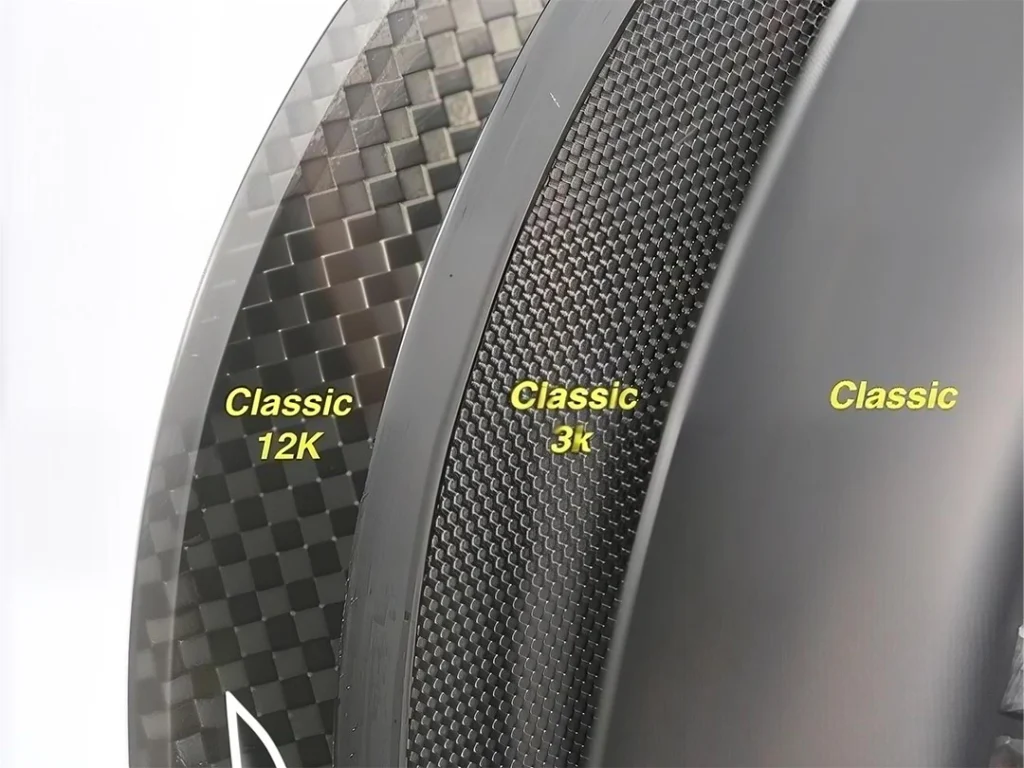
Buyers sourcing carbon fiber pickleball paddles must specify Unidirectional (UD) or 3K weave application. UD carbon aligns all fibers in a single direction, optimizing vertical stiffness and maximizing energy return for raw power. A 3K weave uses an interlocking cross-pattern that expands the horizontal sweet spot and delivers a slightly softer, more communicative feel. Both formats leverage the permanent friction of the 7μm filament structure, ensuring spin performance does not degrade with extended competitive use — a key quality differentiator for brands competing in the premium tier.
Thermoformed Unibody Constructie
Manufacturing process is as commercially significant as material grade. Traditional cold-pressed construction bonds the face material, core, and handle as separate components using adhesive. For the swing speeds generated by crossover athletes using a 145mm handle, this approach creates a structural liability. The torque generated by a loaded two-handed backhand places extreme stress on secondary bond points, leading to delamination or joint failure under sustained competitive use.
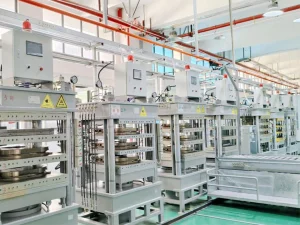
Premium pro en geavanceerde pickleball peddels bouwen solve this through thermoformed unibody construction. In this process, the paddle is formed under extreme heat and pressure inside a precision mold. The carbon fiber face wraps continuously around the edges and down through the throat, integrating the face and handle into a single structural element with no secondary joints.
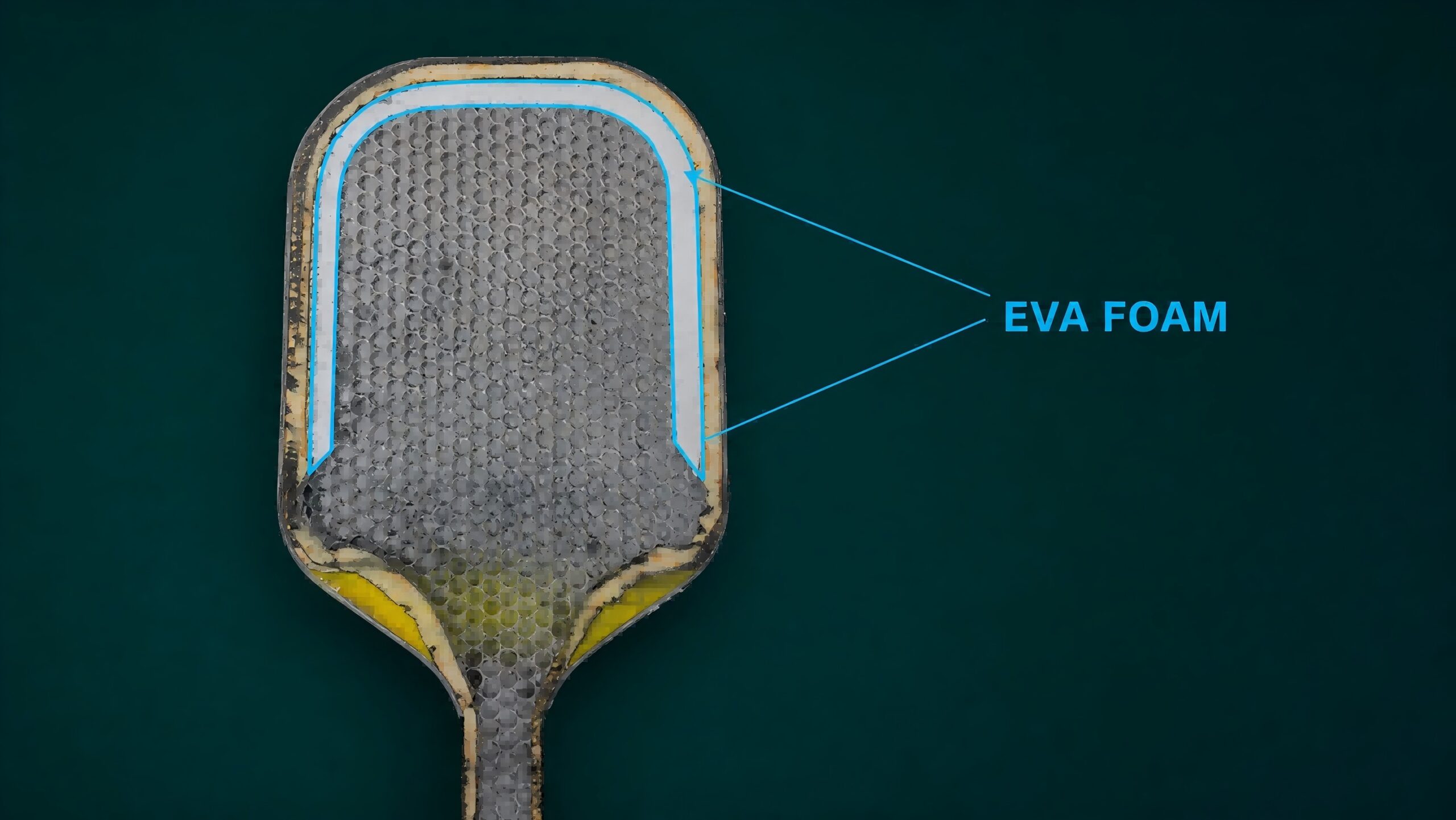
This architecture delivers three concrete performance advantages. First, it eliminates the fragile neck joint entirely, allowing the paddle to withstand maximum-effort swings without structural compromise. Second, it enables injection of high-density perimeter foam around the core edges prior to sealing — foam that expands during thermoforming to increase perimeter density, expand the sweet spot, and create a solid, predictable feel on off-center contact. Third, the continuous carbon wrap from face through handle means energy transfer is uninterrupted and consistent across every hit. Brands building a high-performance product line must prioritize thermovormde pickleball paddles to meet the durability and performance standards this buyer segment demands. For brands evaluating the full range of construction options, T700 koolstofvezel paddles built on this thermoformed architecture represent the current performance benchmark.
The B2B Business Case: Capturing the Crossover Market
The tennis crossover demographic is the highest-margin consumer segment in pickleball today. These are athletes already conditioned to paying premium prices for technical gear — a buyer who spends $250 on a tennis racket will not hesitate to invest $200 in a structurally superior paddle. They are also technically sophisticated: they research core thickness, fiber grade, and handle specs before committing to a purchase. Entry-level product assortments do not capture this revenue. They actively repel it.
Adding an elongated SKU engineered for this segment is a low-risk, high-return portfolio expansion. It extends your addressable market without cannibalizing standard-shape sales, since the two geometries serve distinct biomechanical use cases. Positioning a 145mm handle model as your premium “Pro” or “Tour” tier elevates the perceived technical authority of your entire brand portfolio — a halo effect that builds credibility across your full customer base.
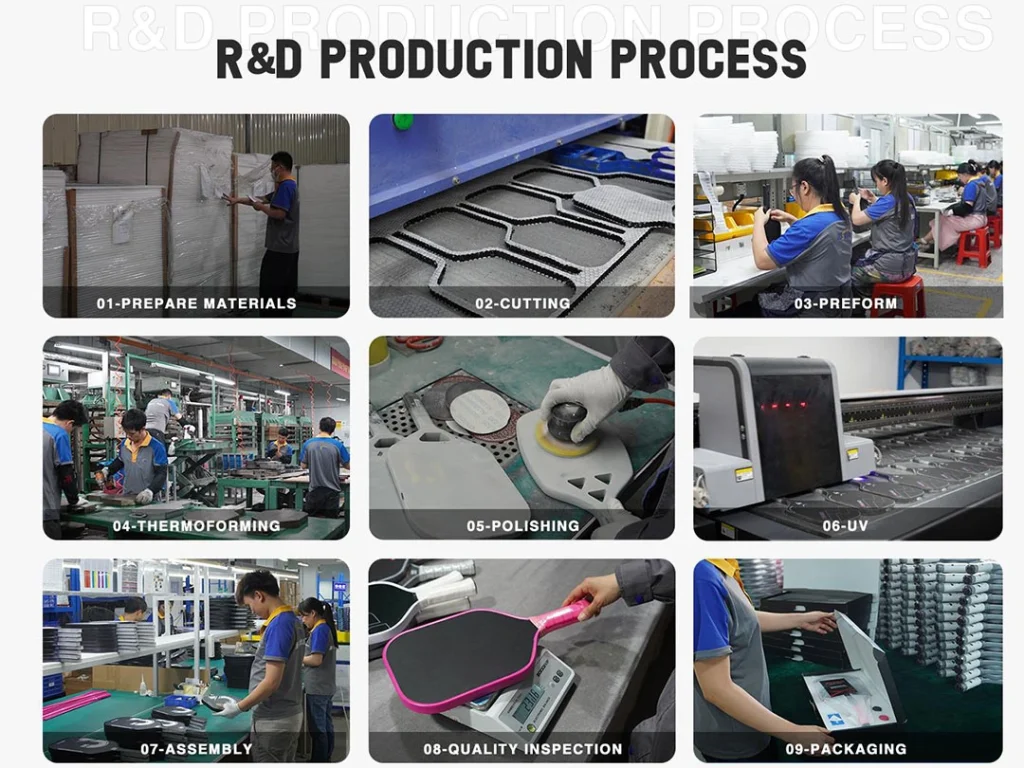
For brands seeking the fastest path to market, partnering with an established elongated pickleball paddles B2B supplier eliminates the costly R&D phase entirely. Proven mold geometries like Mold #5 are ready to deploy. Brands can source aangepaste OEM pickleball paddles with proprietary branding, custom graphics, and specified edge guard colors — launched on an architecture with documented performance credentials. Whether you need a test batch of op maat gemaakte paddles for regional retail validation or a container-scale wholesale order, leveraging existing premium molds delivers tour-level performance to market immediately, without engineering risk.
Veelgestelde vragen
Wat is de beste handvatlengte voor een tweehands backhand in pickleball?
Een 145mm (14,5 cm) handvat is de optimale lengte voor volwassen spelers die een echte tweehands backhand uitvoeren. Deze maat biedt voldoende oppervlak voor beide handen om onafhankelijk op de grip te rusten zonder elkaar te overlappen, waardoor de juiste biomechanische hefboomwerking en paddle-stabilisatie door de volledige slingerboog mogelijk worden. Spelers die maximale hefboomwerking voor agressieve baseline-ritsen verkiezen, kunnen overwegen om de 149 mm handvat beschikbaar in de GEN3 Core 2.0 Serie.
Zijn langwerpige pickleball paddles goedgekeurd door de USAPA?
Ja. Langwerpige paddles zijn volledig compliant mits ze voldoen aan de groottebeperkingen van de regerende instantie. De USAPA beperkt de gecombineerde paddle lengte en breedte tot 24 inch / 609,6 mm. Standaard langwerpige afmetingen van 415 mm lengte en 185 mm breedte totaal 600 mm, ruim binnen de toernooi-legale parameters.
Leidt een zwaardere paddle tot meer kracht?
Kracht is een functie van zowel statisch gewicht als hefboomgeometrie — niet alleen gewicht. Een paddle in de 215–230 g categorie biedt voldoende massa om door de bal te drijven, maar de langwerpige vorm is de belangrijkste krachtversterker. Het langere handvat en de verhoogde sweet spot verhogen het swinggewicht en de rotatiemomentum, wat resulteert in grotere schotdynamiek dan een standaardvormige paddle met identiek statisch gewicht.
Wat is de MOQ voor custom branded langwerpige paddles?
NexaPaddle's thermo-gevormde Mok #5 begint bij 100 stuks per variant. Deze MOQ is ontworpen om merkentests commercieel haalbaar te maken — waardoor opkomende merken, gespecialiseerde detailhandelaren en professionele winkels een volledig aangepaste langwerpige paddle kunnen lanceren (proprietaire graphics, randbeschermkleur, handvatwikkelingen) zonder zich te committeren aan productievolumes. De productietijd loopt 60–90 dagen van bevestigde ontwerpdetail tot afgewerkt voorraad.
Hoe verschilt het T700 koolstofvezeloppervlak van gecoate paddles?
Gecoate paddles vertrouwen op aangebrachte korrelspuiten of wrijvingverven die snel slijten bij competitief gebruik — meestal verslechterend binnen 60–90 dagen van regulier spel. T700 koolstofvezel genereert wrijving door zijn ruwe 7μm filamentstructuur — een intrinsieke, permanente eigenschap van het geweven materiaal zelf. Dit oppervlak degradeert of schilfert niet, wat zorgt voor consistente spinprestaties tijdens de volledige levensduur van de paddle.
Sports & Fitness Industry Association (SFIA) / USA Pickleball. 2024 Pickleball Feitensheet. 36,5 miljoen spelers in de Verenigde Staten.
Grand View Research / Cognitive Market Research. Pickleball Equipment Market Report 2025. Market size $702.9M; carbon fiber segment $137.9M at 12.8% CAGR through 2034.
Toray Industries. Torayca T700S Carbon Fiber Technisch Gegevensblad. Treksterkte 4.900 MPa; trekmodulus 230 GPa; filamentdiameter 7 μm; rek bij breuk 2,1%.
NexaPaddle interne prestaties van paddletests. Ruwe T700 koolstofvezeloppervlakken gemeten bij 2.300+ RPM spindraai onder gestandaardiseerde testomstandigheden.