Die Tennis-Migrationsbeschaffungsmöglichkeit
Sechsunddreißig Millionen fünfhunderttausend Amerikaner spielen jetzt Pickleball – und ein überproportionaler Teil von ihnen stammt direkt vom Tennisplatz. Dieser demographische Wandel ist kein Trend. Es ist ein struktureller Markübergang und stellt eine hochgradig lukrative Beschaffungsmöglichkeit für Einzelhandelsmarken, Großhändler und Ausrüstungsvertriebler dar. Diese Übergangsathleten bringen fortgeschrittene biomechanische Gewohnheiten, hohe Leistungsansprüche und bestehende Kaufkraft auf den Platz.
Das Verständnis des finanziellen Umfangs dieses Marktes ist entscheidend für die strategische Bestandsplanung. Der Gesamtmarkt für Pickleball in den USA wird voraussichtlich erreichen $702,9M im Jahr 2025. Das Segment der Premium-Carbonfaser – das direkt fortgeschrittene Übergangssportler bedient – wird mit $137,9M im Jahr 2025 bewertet und wächst mit 12,8% CAGR, verfolgt eine Schätzung von $412,86M bis 2034. Marken, die keine Ausrüstung auf Lager haben, die für diese demographische Gruppe entwickelt wurde, lassen messbare Einnahmen auf dem Tisch liegen.
Racketsport-Umsteiger wollen keine Einstiegs-Glasfaser-Ausrüstung. Sie benötigen fortgeschrittene Verbundmaterialien, spezifische dimensionale Geometrien und Griffkonfigurationen, die den eingebrannten Schwungmechaniken Rechnung tragen. Für B2B-Käufer ist das Verständnis dieser technischen Anforderungen die Grundlage für ein profitables Sortiment von Premiumprodukten. Die Beschaffung der richtigen verlängerten Modelle positioniert Ihre Marke, um diesen hochintensiven, Premium-verbrauchenden Kundenstamm zu erfassen.
Das Problem der beidhändigen Rückhand
Standard-Paddeldesigns scheitern grundsätzlich daran, die biomechanischen Realitäten des Schwungs eines Tennisspielers zu berücksichtigen. Der Standardgriff der Branche wurde ursprünglich für einhändige Tischtennis- oder Badminton-Griffe entwickelt. Wenn ein Tennisspieler versucht, eine beidhändige Rückhand mit einem Standardgriff auszuführen, rutscht die nicht-dominante Hand zwangsläufig von der Basis des Griffs oder überlappt sich ungeschickt über das Paddelblatt. 130mm handle was originally engineered for single-handed table tennis or badminton-style grips. When a tennis player attempts a two-handed backhand on a standard grip, the non-dominant hand inevitably slides off the handle’s base or overlaps awkwardly onto the paddle throat.
Dieser Mangel an physischem Raum zwingt zu einem kritischen mechanischen Kompromiss. Spieler müssen den Griff enger fassen und das Hebelsystem zusammenbrechen, das Kraft und rotatorisches Moment erzeugt. Das Ergebnis ist ein vorhersehbarer Verlust von Kontrolle, Geschwindigkeit und Topsin – genau die Schläge, die das Spiel im Racketsport definieren.
Eine ordnungsgemäße beidhändige Rückhand hängt von einem bestimmten Handabstand ab, um einen funktionalen Drück-Zieher-Hebel zu schaffen. Die untere Hand stabilisiert den Paddelwinkel; die obere Hand treibt den Paddelkopf durch die Kontaktzone. Ohne eine angemessene Griffgröße funktioniert dieses System überhaupt nicht. Der Spieler kann sich nicht vollständig hip und schulterrotieren, und kinetische Energie wird nicht effizient in den Ball übertragen.
Diese biomechanische Lücke stellt eine klare kommerzielle Chance dar. Überschneidungsathleten suchen aktiv nach Paddeln, die es ihnen nicht erfordern, jahrzehntelange Muskelgedächtnisse aufzugeben. Marken, die dieses spezifische physische Bedürfnis erkennen – und entsprechende Lagerbestände führen – sind am besten positioniert, um dieses wertvolle Segment zu erfassen und zu halten.
Mold #5 Deep-Dive: Entwickelt für den Übergangsathleten
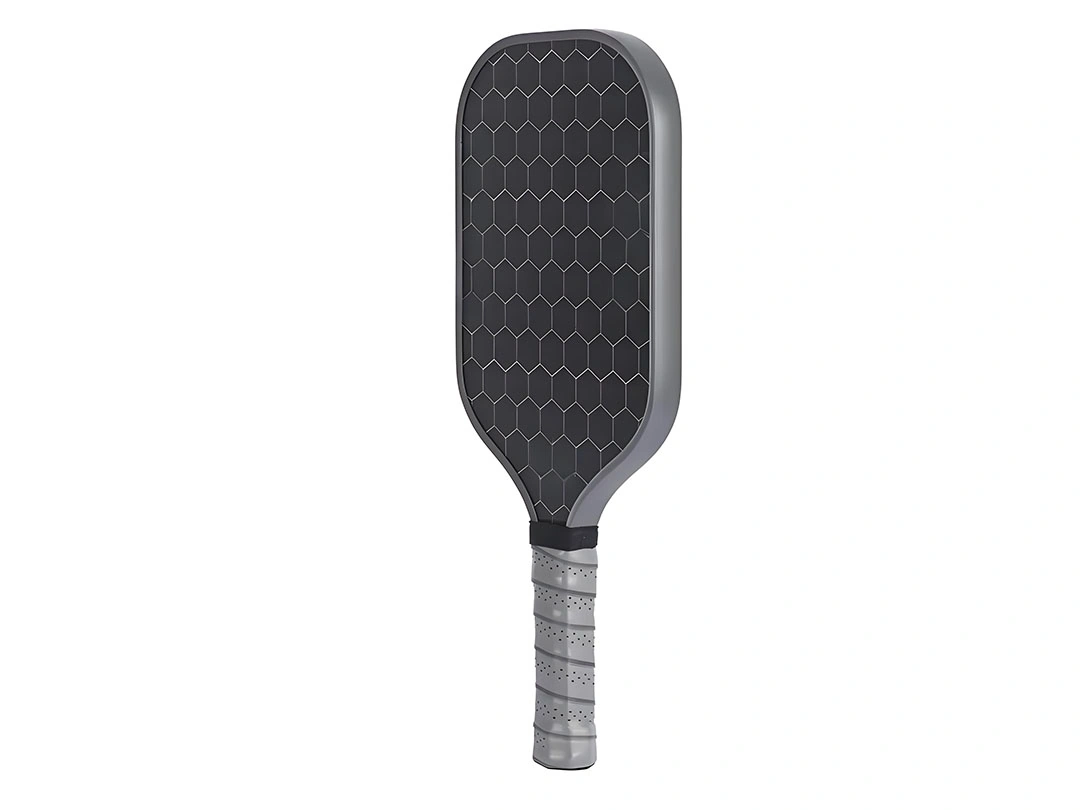
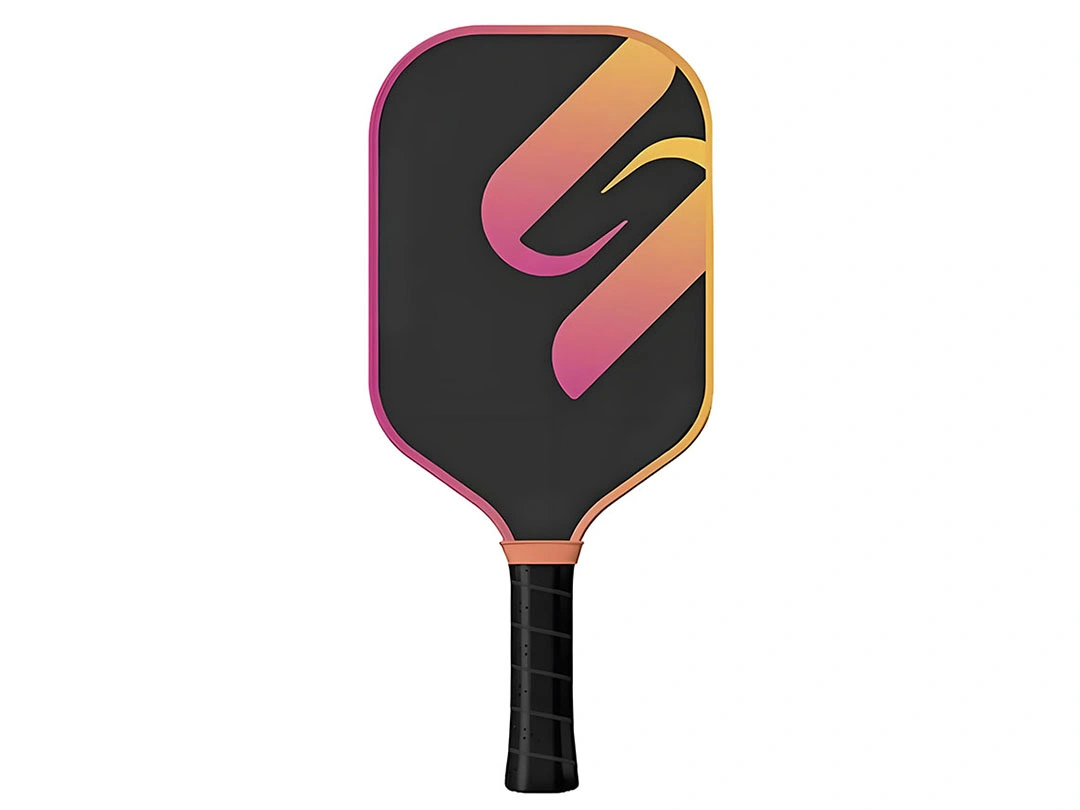
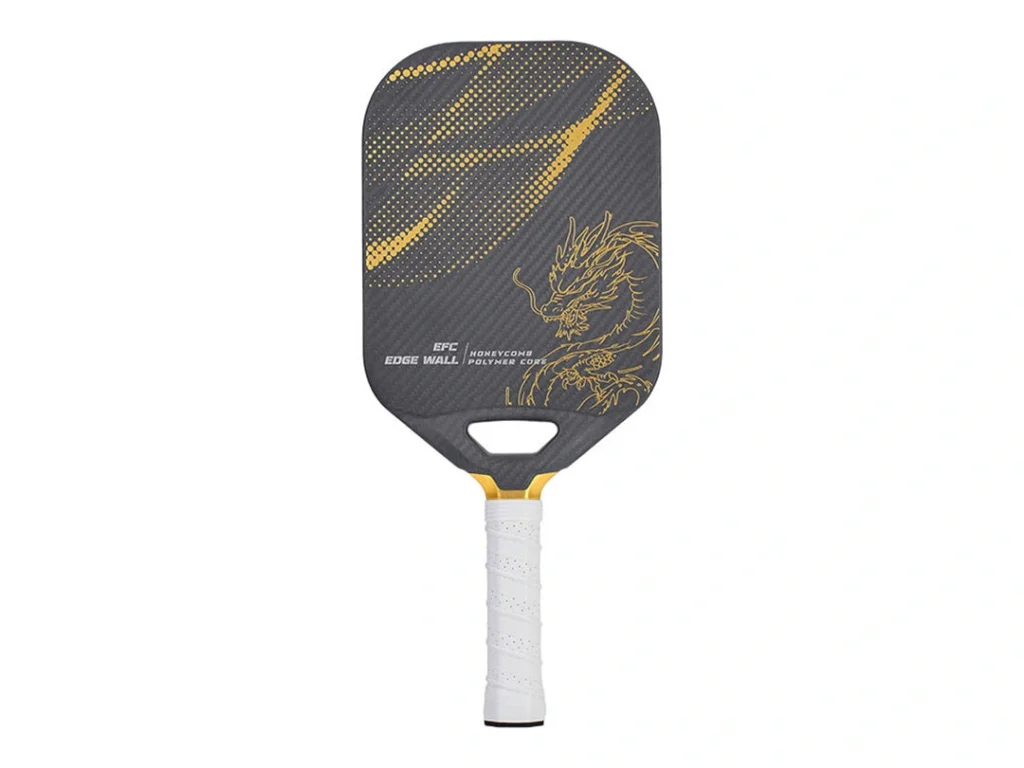
Fortgeschrittene Fertigungsanlagen haben spezielle Paddelgeometrien entwickelt, die speziell auf diese biomechanischen Anforderungen eingehen. Die Spezifikation Mold #5 ist der Goldstandard für diese demografische Gruppe und kombiniert verlängerte Reichweite mit hochwertiger Verbundkonstruktion. Unten finden Sie die vollständige technische Aufschlüsselung.
| Spezifikation | Wert |
|---|---|
| Abmessungen | 415 × 185 mm |
| Grifflänge | 145 mm (verlängert – +15 mm über Standard) |
| Oberflächenmaterial | T700 Carbonfaser (UD + 3K Weboptionen) |
| Kern | PP-Wabenstruktur |
| Kern-Dicke | 16 mm |
| Gewicht | 215–230 g |
| Bauweise | Thermoformbare Unibody (integrierte Fläche zu Griff) |
| MOQ | 100 Stk. |
Der 415 × 185 mm Die Gesamtabmessung nähert sich der maximalen zulässigen Größe des zuständigen Verbands, während das aerodynamische Profil maximiert wird. Eine vertikale Verschiebung der Fläche hebt den Sweet Spot an, um präzise mit dem natürlichen Schlagpunkt eines Tennisspielers übereinzustimmen – weiter von der Hand entfernt als ein traditioneller Pickleball-Schlag. Die schmalere Breite von 185 mm verringert den Luftwiderstand und ermöglicht schnellere Schwunggeschwindigkeiten während der Grundlinienwechsel.
Der 145 mm Der Griff ist das definierende Konstruktionsmerkmal der Form. Er bietet eine ausreichende Fläche für zwei erwachsene Hände ohne Überlappung auf dem Paddelblatt, was direkt das mechanische Problem beseitigt, das Überschneidungsathleten bei Standardausrüstung plagt. Mit beiden Händen richtig positioniert, kann der Spieler die Kern- und Schulterrotation vollständig aktivieren und maximale Kraft durch die T700 Carbonfaser Fläche übertragen.
The internal architecture uses a Polypropylene (PP) Honeycomb core at 16 mm thickness. This calibration absorbs high-frequency vibrations from heavy baseline drives, reducing impact stress on the arm while providing essential energy return. At 215–230 g, the paddle carries enough mass to plow through incoming shots without sacrificing maneuverability at the kitchen line. Thermoformed unibody construction ensures the paddle acts as a single structural unit, eliminating the fragile bond points inherent in cold-pressed alternatives.
Extended Handle Leverage Mechanics
The physics of an elongated handle are directly relevant to your product positioning. A 145 mm handle fundamentally alters the paddle’s moment of inertia and the resulting whip effect through the swing arc. In mechanical terms, a longer handle increases the distance between the pivot point (the wrist) and the center of mass (the paddle head). This extended moment arm allows a player to generate substantially more angular momentum from the same physical effort.
During a topspin drive or power groundstroke, a tennis player’s kinetic chain finishes with a sharp wrist snap. The extended handle amplifies this snap, driving paddle head speed in the critical milliseconds before contact. This is the same lever principle that gives a tennis racket its baseline power. By replicating that geometry in a pickleball paddle, manufacturers allow crossover athletes to apply their existing physical mechanics without adjustment.
The extended handle also shifts the balance point slightly toward the head. This head-heavy characteristic increases resistance to torsional twisting at the contact zone. When a player faces a heavy, spin-loaded incoming shot, a neutrally balanced paddle can rotate in the hand; the additional swing weight generated by the elongated geometry stabilizes the response. The mechanical result is measurably improved shot velocity and baseline control — quantifiable performance data that resonates with technically sophisticated buyers.
Strategic Handle Length Sourcing
That physics advantage, however, only captures one segment of the crossover market. A complete product matrix must address the full handle-length continuum to serve distinct player demographics across your catalog. The following comparison illustrates how different handle lengths map to specific buyer profiles.
| Model Series | Grifflänge | Am besten geeignet für |
|---|---|---|
| Standard (Mold #1/#2) | 130 mm | Control-focused players, dinking specialists |
| Power Series (Mold #3) | 139 mm | Transition players, mixed game styles |
| Mold #5 Extended | 145 mm | Tennis converts, two-handed backhand players |
| GEN3 Core 2.0 | 149 mm | Power baseline players, maximum leverage |
A brand stocking only the 130mm standard is actively excluding the most commercially valuable segment in the sport. Adding the 145mm Mold #5 to your catalog immediately signals technical authority to high-level athletes who research specifications before purchasing. This targeted SKU expansion increases addressable market without cannibalizing existing standard-shape sales — the two geometries serve entirely different biomechanical needs. The result is higher average order values, improved category conversion rates, and stronger retention among advanced players.
16mm Core Thickness: The Spin and Control Balance
Handle geometry determines biomechanical fit. Core thickness determines what the paddle does at the point of contact. For racket sport converts, a 16mm core represents the optimal balance between power transmission and spin generation. Thinner cores — 13mm or 14mm — produce a trampoline effect with immediate pop, but they severely limit ball dwell time. Players accustomed to the deep pocketing of a tennis stringbed find thin-core paddles to feel erratic and uncontrollable.
The 16mm polymer honeycomb core extends what physicists call “dwell time”: the fraction of a second in which the ball compresses against the paddle face before rebounding. A thicker core absorbs more initial impact energy, allowing the ball to sink deeper into the surface. This extended contact window is critical for spin generation, giving the textured carbon fiber face more time to grip and impart rotational friction.
Tennis players naturally swing with steep, low-to-high attack angles designed for topspin. The 16mm core rewards that aggressive swing path with heavy, diving topspin that keeps shots within the baseline. Beyond power, the thicker geometry delivers exceptional perimeter stability and vibration dampening — essential qualities for resetting fast volleys at the kitchen line. It bridges the gap between the offensive capability of an elongated shape and the precision required for high-level tactical play.
T700 Carbon Fiber: Intrinsic Spin Generation
Surface material is both the most critical performance variable and the most marketable specification in the premium paddle segment. For high-end elongated models, T700 Carbon Fiber is the non-negotiable standard. This aerospace-grade composite delivers a tensile strength of 4.900 MPa and an elongation at break of 2.1%, ensuring the face remains dimensionally stable under impact and prevents energy loss caused by surface deformation.
What differentiates T700 at a structural level is the filament architecture. Each carbon filament measures exactly 7μm in diameter. Woven together, these microscopic filaments create an inherently abrasive texture across the paddle face. This is a fundamental distinction from fiberglass alternatives: cheaper paddles rely on temporary grit sprays or applied chemical coatings to generate friction. T700’s surface texture is a permanent structural property — advanced players using these paddles consistently generate heavy topspin that competitive tennis converts describe as comparable to their racket sport experience.
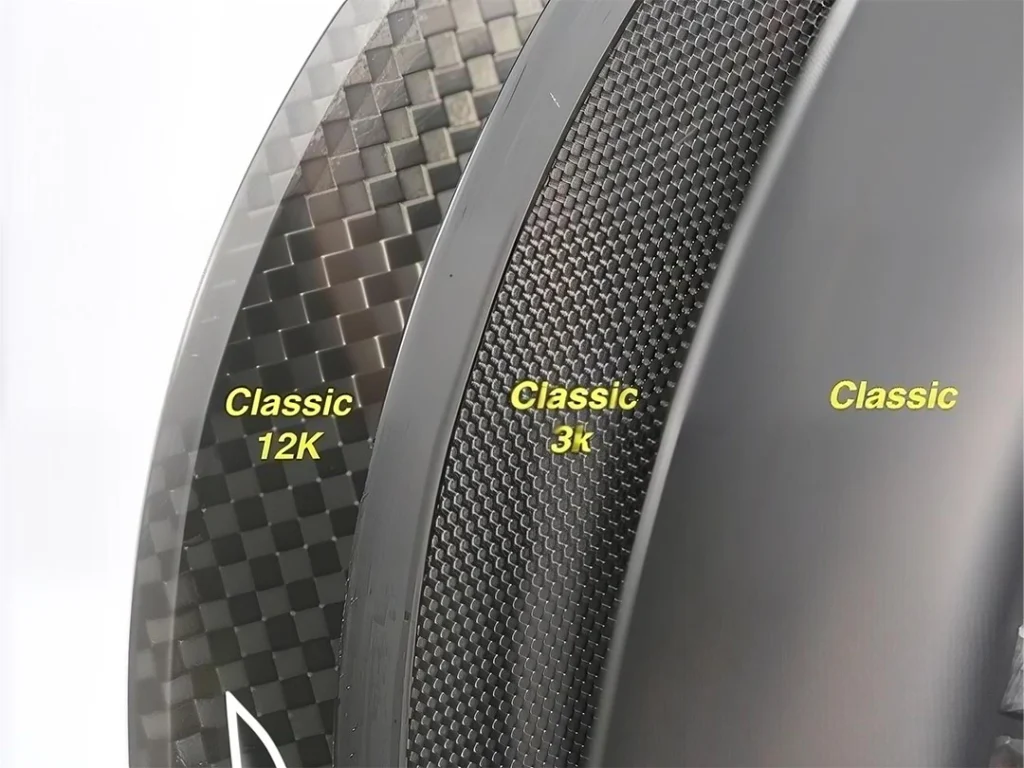
Buyers sourcing Pickleball-Schläger aus Kohlefaser must specify Unidirectional (UD) or 3K weave application. UD carbon aligns all fibers in a single direction, optimizing vertical stiffness and maximizing energy return for raw power. A 3K weave uses an interlocking cross-pattern that expands the horizontal sweet spot and delivers a slightly softer, more communicative feel. Both formats leverage the permanent friction of the 7μm filament structure, ensuring spin performance does not degrade with extended competitive use — a key quality differentiator for brands competing in the premium tier.
thermoformbarer Monokonstruktion
Manufacturing process is as commercially significant as material grade. Traditional cold-pressed construction bonds the face material, core, and handle as separate components using adhesive. For the swing speeds generated by crossover athletes using a 145 mm handle, this approach creates a structural liability. The torque generated by a loaded two-handed backhand places extreme stress on secondary bond points, leading to delamination or joint failure under sustained competitive use.
Premium fortgeschrittene und professionelle Pickleball-Schläger solve this through thermoformed unibody construction. In this process, the paddle is formed under extreme heat and pressure inside a precision mold. The carbon fiber face wraps continuously around the edges and down through the throat, integrating the face and handle into a single structural element with no secondary joints.
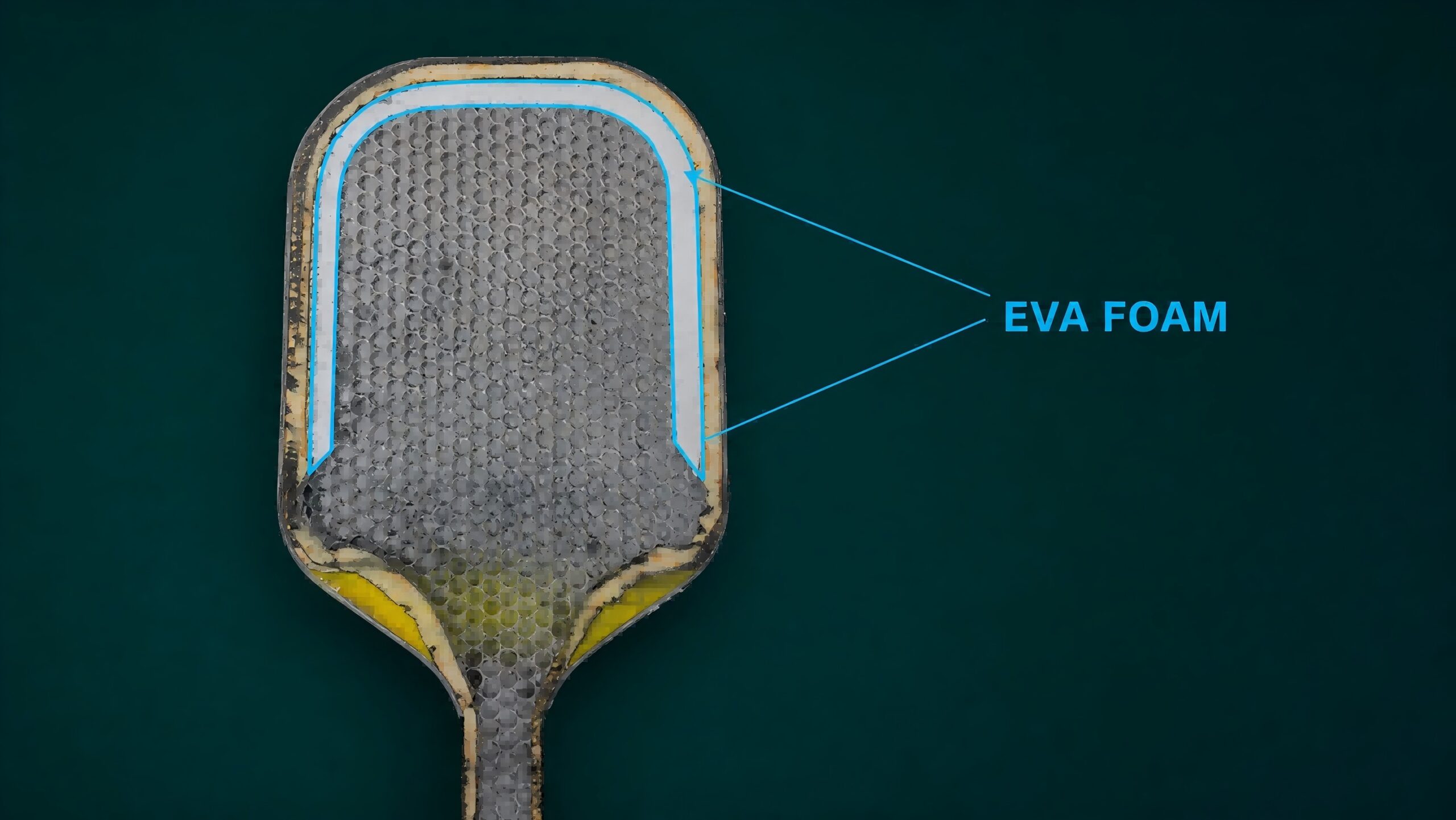
This architecture delivers three concrete performance advantages. First, it eliminates the fragile neck joint entirely, allowing the paddle to withstand maximum-effort swings without structural compromise. Second, it enables injection of high-density perimeter foam around the core edges prior to sealing — foam that expands during thermoforming to increase perimeter density, expand the sweet spot, and create a solid, predictable feel on off-center contact. Third, the continuous carbon wrap from face through handle means energy transfer is uninterrupted and consistent across every hit. Brands building a high-performance product line must prioritize thermoformte Pickleball-Schläger to meet the durability and performance standards this buyer segment demands. For brands evaluating the full range of construction options, T700-Carbonfaser-Schläger built on this thermoformed architecture represent the current performance benchmark.
The B2B Business Case: Capturing the Crossover Market
The tennis crossover demographic is the highest-margin consumer segment in pickleball today. These are athletes already conditioned to paying premium prices for technical gear — a buyer who spends $250 on a tennis racket will not hesitate to invest $200 in a structurally superior paddle. They are also technically sophisticated: they research core thickness, fiber grade, and handle specs before committing to a purchase. Entry-level product assortments do not capture this revenue. They actively repel it.
Adding an elongated SKU engineered for this segment is a low-risk, high-return portfolio expansion. It extends your addressable market without cannibalizing standard-shape sales, since the two geometries serve distinct biomechanical use cases. Positioning a 145 mm handle model as your premium “Pro” or “Tour” tier elevates the perceived technical authority of your entire brand portfolio — a halo effect that builds credibility across your full customer base.
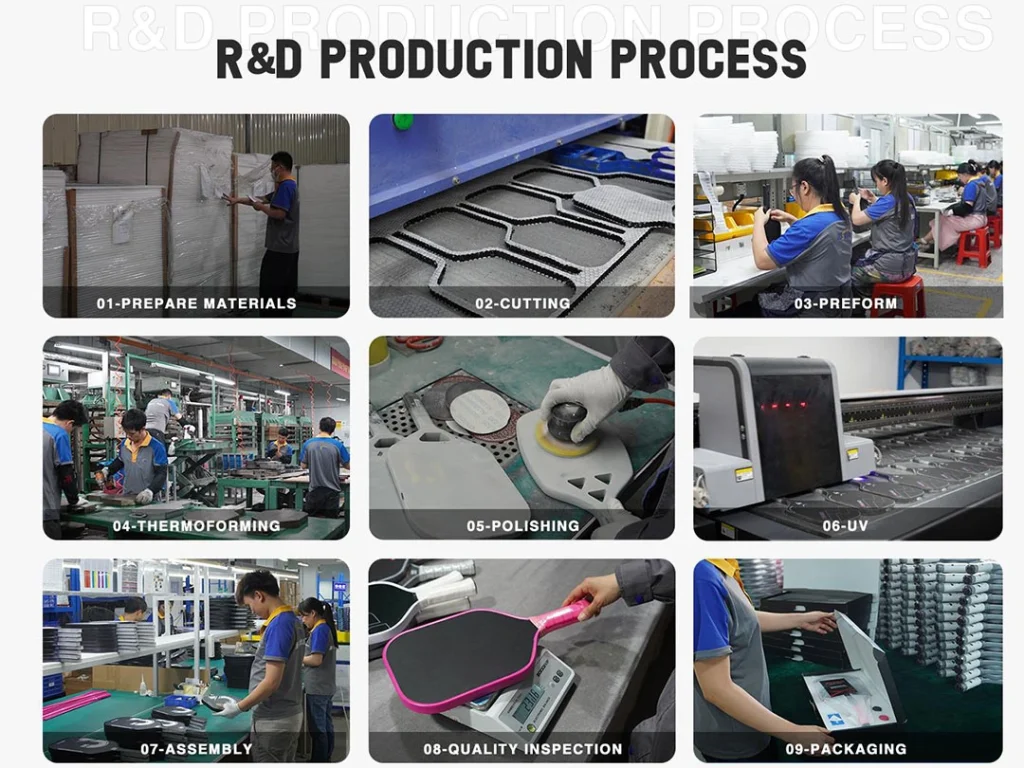
For brands seeking the fastest path to market, partnering with an established elongated pickleball paddles B2B supplier eliminates the costly R&D phase entirely. Proven mold geometries like Mold #5 are ready to deploy. Brands can source benutzerdefinierte OEM-Pickleball-Paddles with proprietary branding, custom graphics, and specified edge guard colors — launched on an architecture with documented performance credentials. Whether you need a test batch of maßgeschneiderten Paddles for regional retail validation or a container-scale wholesale order, leveraging existing premium molds delivers tour-level performance to market immediately, without engineering risk.
Häufig gestellte Fragen
Welche Griffgröße ist am besten für eine beidhändige Rückhand im Pickleball?
Eine 145 mm (5,7 Zoll) Griff ist die optimale Länge für erwachsene Spieler, die eine echte beidhändige Rückhand ausführen. Diese Dimension bietet ausreichend Fläche, damit beide Hände unabhängig am Griff ruhen können, ohne sich zu überlappen, und ermöglicht eine ordnungsgemäße biomechanische Hebelwirkung sowie Stabilität des Paddels über den gesamten Schwungbogen. Spieler, die maximale Hebelwirkung für aggressive Grundlinienangriffe bevorzugen, könnten den 149 mm Griff in der GEN3 Core 2.0 Serie in Betracht ziehen.
Sind verlängerte Pickleball-Paddel USAPA-zugelassen?
Ja. Verlängerte Paddel sind vollständig konform, sofern sie die Größenbeschränkungen der zuständigen Stelle einhalten. Die USAPA begrenzt die kombinierte Länge und Breite des Paddels auf 24 Zoll / 609,6 mm. Standardmäßige verlängerte Dimensionen von 415 mm Länge und 185 mm Breite ergeben insgesamt 600 mm, was im rahmen der zulässigen Turnierparameter liegt.
Generiert ein schwereres Paddel mehr Kraft?
Kraft ist sowohl eine Funktion des statischen Gewichts als auch der Hebelgeometrie – nicht nur des Gewichts. Ein Paddel im 215–230 g Bereich bietet ausreichende Masse, um durch den Ball zu treiben, aber die verlängerte Form ist der primäre Kraftvervielfacher. Der längere Griff und der erhöhte Sweet Spot erhöhen das Schwunggewicht und den rotatorischen Schwung, was eine höhere Schussgeschwindigkeit als ein paddel in standardform mit identischem statischen Gewicht erzeugt.
Was ist die MOQ für maßgefertigte gebrandete verlängerte Paddel?
Das termoformbare Mold #5 von NexaPaddle beginnt bei 100 Stück pro Variante. Diese MOQ soll eine kommerzielle Machbarkeit für Brand-Tests schaffen – damit aufstrebende Marken, Fachhändler und Pro Shops ein vollständig maßgefertigtes, verlängertes Paddel (proprietäre Grafiken, Randschutzfarben, Griffwicklungen) launchen können, ohne sich auf Massenproduktionsvolumen festzulegen. Die Produktionsleadzeit erstreckt sich 60–90 Tage vom bestätigten Entwurfsbrief bis zum fertigen Inventar.
Wie unterscheidet sich die Oberfläche von T700-Carbonfaser von beschichteten Paddeln?
Beschichtete Paddel verlassen sich auf aufgebrachte Grit-Sprays oder Reibungsfarben, die unter wettbewerblichen Bedingungen schnell abnutzen – typischerweise innerhalb von 60–90 Tage regulärer Spielzeit. T700-Carbonfaser erzeugt Reibung durch ihre rohe 7μm -Filamentstruktur – eine intrinsische, permanente Eigenschaft des gewebten Materials selbst. Diese Oberfläche verschlechtert sich nicht und blättert nicht ab, was eine konstante Spin-Leistung über die gesamte Lebensdauer des Paddels gewährleistet.
Sport- & Fitness-Industrie-Vereinigung (SFIA) / USA Pickleball. 2024 Pickleball-Faktenblatt. 36,5 Millionen Spieler in den Vereinigten Staaten.
Grand View Research / Cognitive Market Research. Pickleball Equipment Market Report 2025. Market size $702.9M; carbon fiber segment $137.9M at 12.8% CAGR through 2034.
Toray Industries. Torayca T700S Carbonfaser-Datenblatt. Zugfestigkeit 4.900 MPa; Modul 230 GPa; Filamentdurchmesser 7 μm; Bruchdehnung 2,1%.
NexaPaddle interne Leistungstestdaten für Paddel. Unbearbeitete T700-Carbonfasern wurden bei über 2.300 RPM unter standardisierten Testbedingungen gemessen.